

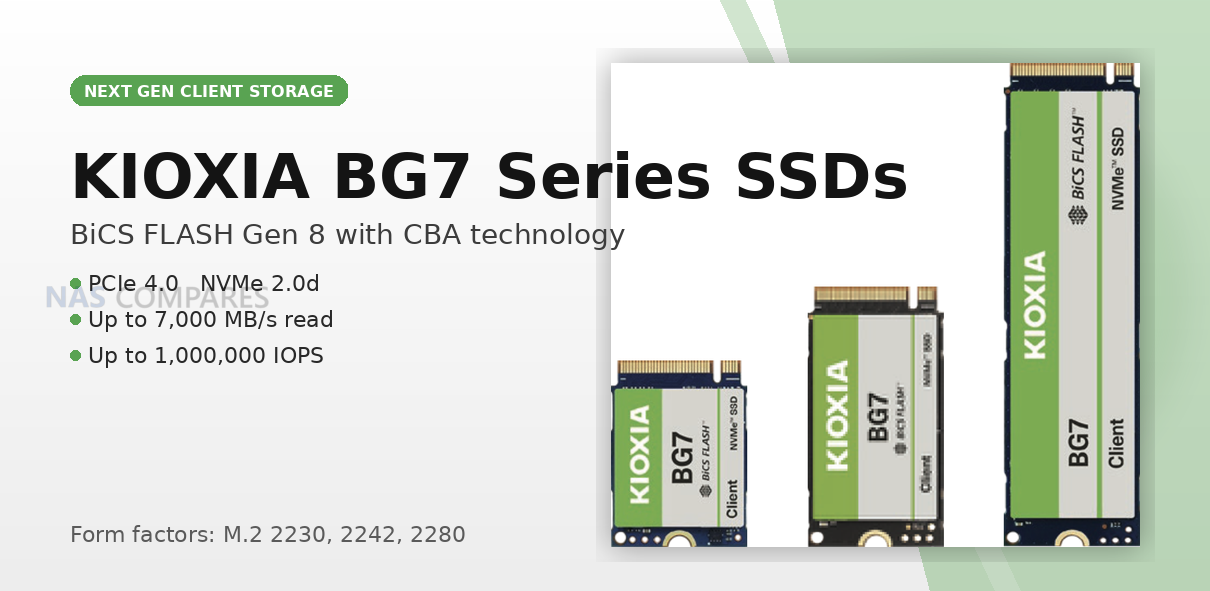
A new DRAM-less, PCIe 4.0 NVMe client SSD family aimed at PC OEM notebooks and desktops, with a focus on performance per watt.
What KIOXIA announced
KIOXIA introduced the BG7 Series as its next generation, value oriented client SSD line for PC OEMs. The headline upgrade is the move
to BiCS FLASH generation 8 3D flash memory, paired with CBA (CMOS directly Bonded to Array) technology. The company says this combo
improves both throughput and power efficiency for everyday client workloads in commercial and consumer systems.
Big picture: BG7 targets thin and light notebooks, compact desktops, and new AI PC designs that need strong Gen4 NVMe performance without a DRAM bill of materials.
At a glance
- Interface: PCIe 4.0 (Gen4 x4)
- Protocol: NVMe 2.0d
- Form factors: M.2 2230, 2242, 2280 (single sided options)
- Capacities: 256 GB, 512 GB, 1 TB, 2 TB
- Design: DRAM-less with Host Memory Buffer (HMB)
- Security option: Self encrypting variants supporting TCG Opal 2.01
Why BiCS FLASH Gen 8 plus CBA matters
NAND generation upgrades are not just about peak speed. For client PCs, power efficiency and thermals can be just as important, especially
in small M.2 2230 or 2242 slots with limited airflow. KIOXIA’s CBA approach bonds CMOS control circuitry directly to the memory array,
shortening signal paths and reducing overhead. In practical terms, the goal is better performance per watt and better sustained behavior
under tight power envelopes.
KIOXIA also positions BG7 as an “everyday” client SSD that inherits improvements from its latest flash technology without moving the product
into a premium, high cost category.
BG7 performance and specs (from KIOXIA client SSD datasheet)
Peak performance varies by capacity. Higher capacity models typically have more NAND parallelism, which is why 1 TB and 2 TB SKUs lead on
sequential throughput.
| Capacity | Sequential read (up to) | Sequential write (up to) | Interface | Typical power | Operating temperature |
|---|---|---|---|---|---|
| 2 TB | 7,000 MB/s | 6,000 MB/s | PCIe Gen4 x4 | 4.5 W | 0 to 85 C |
| 1 TB | 7,000 MB/s | 6,000 MB/s | PCIe Gen4 x4 | 4.5 W | 0 to 85 C |
| 512 GB | 6,400 MB/s | 5,000 MB/s | PCIe Gen4 x4 | 4.5 W | 0 to 85 C |
| 256 GB | 4,000 MB/s | 4,000 MB/s | PCIe Gen4 x4 | 4.5 W | 0 to 85 C |
Note: figures shown are “up to” values from KIOXIA’s client SSD datasheet. Real world results depend on platform, firmware, thermals, and workload.
Form factors and why the new 2242 option is useful
BG7 expands beyond the usual 2230 and 2280 with an M.2 2242 variant. That extra length can help OEMs route components, fit mounting points,
or meet internal layout constraints without committing to a full 2280 slot.
| Form factor | Typical use cases | What to watch |
|---|---|---|
| M.2 2230 | Ultra portable notebooks, compact systems, space constrained designs | Thermals and sustained performance are often the limiting factors |
| M.2 2242 | Thin notebooks, OEM layouts needing a middle size between 2230 and 2280 | Good balance of space and flexibility for board layout |
| M.2 2280 | Mainstream notebooks and desktops | Best compatibility and easiest thermal management |
BG7 vs BG6: what changes for OEMs
BG6 was already a widely used Gen4, DRAM-less client SSD line. BG7 keeps the same broad philosophy but upgrades the underlying flash generation
and extends the footprint options. KIOXIA also highlights major improvements in efficiency for sequential writes, tied to CBA technology.
| Category | BG7 Series | BG6 Series | Why it matters |
|---|---|---|---|
| Flash technology | BiCS FLASH Gen 8 (3D TLC) with CBA | BiCS FLASH Gen 6 (3D TLC) | Higher performance per watt potential and a newer platform for OEM roadmaps |
| Peak sequential read | Up to 7,000 MB/s (1 TB, 2 TB) | Up to 6,000 MB/s (1 TB, 2 TB) | More headroom for modern client workloads and faster large transfers |
| Peak sequential write | Up to 6,000 MB/s (1 TB, 2 TB) | Up to 5,300 MB/s (2 TB) and 5,000 MB/s (1 TB) | Better burst and large file write performance on higher capacities |
| Smaller capacity throughput | 256 GB: up to 4,000 MB/s read, 4,000 MB/s write | 256 GB: up to 4,400 MB/s read, 3,000 MB/s write | Write speed lift at 256 GB; read depends on SKU behavior and platform |
| Form factors | 2230, 2242, 2280 | 2230, 2280 | 2242 gives OEMs another layout option |
| OEM control features | NVMe 2.0d support noted | Earlier NVMe generation | Newer NVMe feature set can help platform tuning and management |
| Power efficiency claim | Company claims up to ~67% improvement in sequential write power efficiency vs BG6 | Baseline | Potential battery life gains during sustained writes and heavy usage periods |
Note: BG7 and BG6 tables mix published “up to” throughput and company stated comparative claims. Always validate with your own platform testing.
What DRAM-less plus HMB means in real systems
BG7 is designed as a DRAM-less SSD that can use Host Memory Buffer (HMB), borrowing a small portion of system DRAM for mapping and metadata.
For OEMs, the appeal is lower SSD cost and simpler BOM without sacrificing typical client responsiveness.
The tradeoff is that performance can be more sensitive to platform memory behavior and workload mix. In most mainstream notebook scenarios,
HMB based drives perform well, but heavy sustained writes and edge cases under tight thermal limits are where SKU and firmware tuning matter most.
Availability and what to watch next
KIOXIA says BG7 will be shown publicly at CES 2026, with select PC OEM customers already evaluating samples. For most readers, the first place you
will likely encounter BG7 is inside new OEM notebook or desktop configurations rather than as a retail boxed drive.
- Short term: early OEM design wins and initial platform validation
- Mid term: systems shipping with 2230 and 2242 configurations in thin devices
- Long term: wider rollout as Gen 8 flash ramps across client portfolios
Sources
- Business Wire: KIOXIA announcement of BG7 Series SSDs (Jan 5, 2026)
- KIOXIA Client SSD Datasheet (Rev 6.0), BG7 and BG6 specification tables
- TweakTown and other trade coverage for contextual recap (Jan 5, 2026)
| Where to Buy a Product | |||
 |
    
|
  
|
VISIT RETAILER ➤ |
 |
|
|
VISIT RETAILER ➤ |
| Where to Buy a Product | |||
|
|
|
|
VISIT RETAILER ➤ |
|
|
|
|
VISIT RETAILER ➤ |
We use affiliate links on the blog allowing NAScompares information and advice service to be free of charge to you. Anything you purchase on the day you click on our links will generate a small commission which is used to run the website. Here is a link for Amazon and B&H. You can also get me a ☕ Ko-fi or old school Paypal. Thanks! To find out more about how to support this advice service check HERE





WHERE IS SYNOLOGY DSM 8? and DO YOU CARE? (RAID Room)
UniFi Routers vs OpenWRT DIY Routers - Which Should You Choose?
WHY IS PLEX A BIT S#!t NOW? IS 2026 JELLYFIN TIME? (RAID Room)
Synology FS200T NAS is STILL COMING... But... WHY?
Gl.iNet vs UniFi Travel Routers - Which Should You Buy?
UnifyDrive UP6 Mobile NAS Review
Access content via Patreon or KO-FI
Discover more from NAS Compares
Subscribe to get the latest posts sent to your email.

DISCUSS with others your opinion about this subject.
ASK questions to NAS community
SHARE more details what you have found on this subject
IMPROVE this niche ecosystem, let us know what to change/fix on this site