

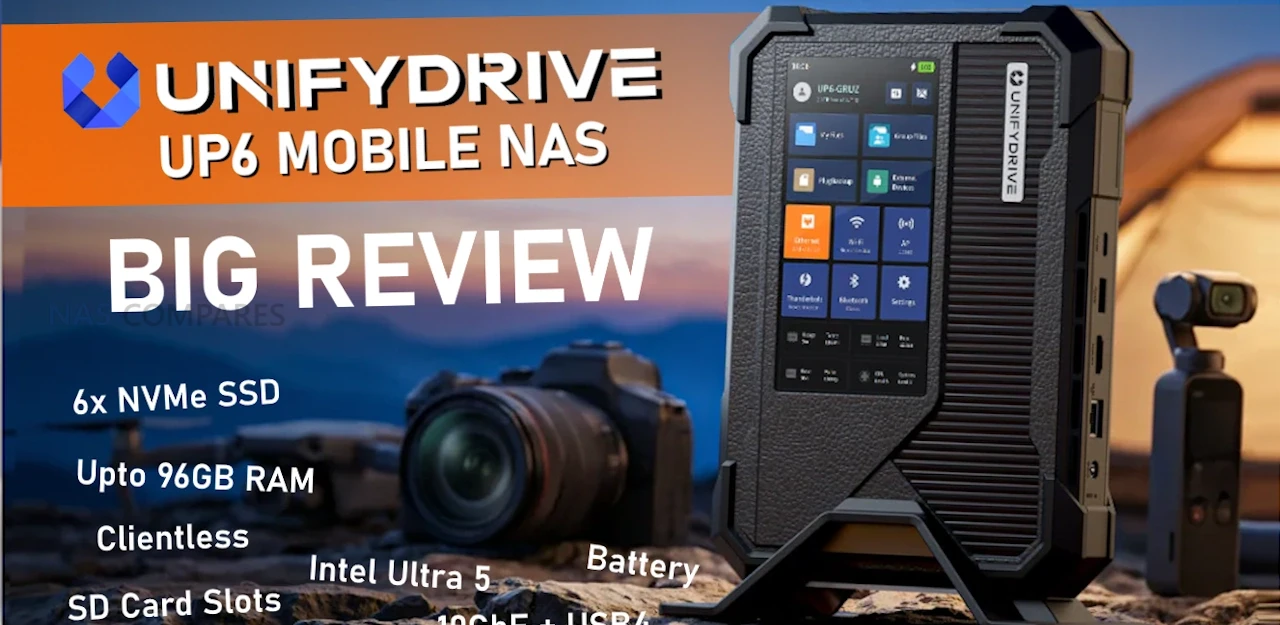
UnifyDrive UP6 Mobile NAS Review – And now for something completely different….
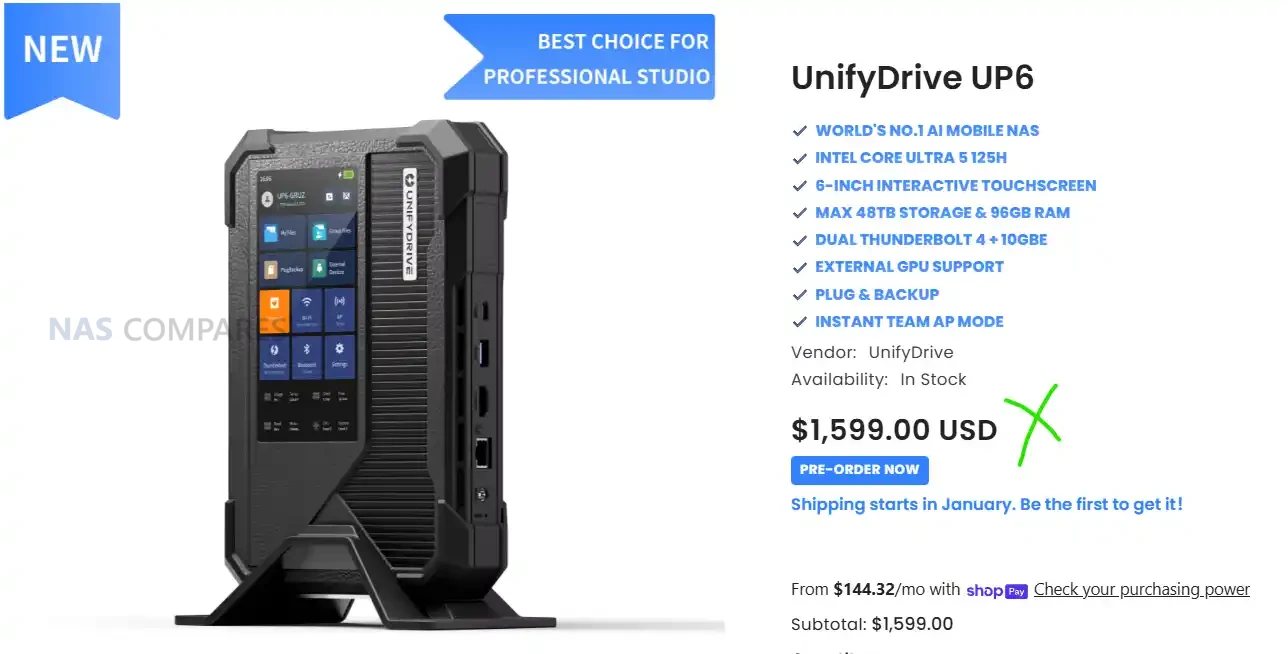
The UnifyDrive UP6 is a portable, battery-equipped mobile NAS intended for workflows that sit between direct attached storage and a traditional office NAS, particularly when backing up and moving large photo or video projects offsite. It sells for $1,599 USD and combines a compact chassis with a built-in 6-inch 2160×1080 touchscreen designed to provide basic device control and file access without needing a phone or laptop for every task. In use, the touchscreen is capable of navigation, monitoring backups, and previewing common media files, but it does not replace a full client experience for deeper system management. The UP6 is built around 6x PCIe 4.0 M.2 slots with a stated maximum of 48TB all-flash storage, alongside memory expansion up to 96GB DDR5, though it ships with 16GB installed. Connectivity is positioned as a major part of the product, including 2x Thunderbolt 4, a 10GbE port, Wi-Fi 6, Bluetooth 5.2, and HDMI 2.1 output. UnifyDrive also markets features such as plug-in card backup, a local AP mode for field collaboration without external Wi-Fi, and external GPU support via its high-speed USB-C connections, which places the UP6 closer to a small, portable workstation-class NAS than a basic travel backup device.
UnifyDrive UP6 Review – Quick Conclusion
The UnifyDrive UP6 is a $1,599 portable mobile NAS that combines a compact 170mm x 147mm x 43mm chassis and 6-inch 2160×1080 touchscreen with workstation-leaning hardware, including an Intel Core Ultra 5 125H (14-core), Intel Arc graphics, an 11 TOPS NPU, and support for up to 96GB DDR5 (16GB installed) plus 6x PCIe 4.0 M.2 slots for up to 48TB, split across 3x PCIe 4.0 x4 and 3x PCIe 4.0 x2 lanes. Its strongest points are connectivity and flexibility: 2x Thunderbolt 4, 10GbE, Wi-Fi 6 AP mode, Bluetooth, HDMI 2.1, SD UHS-II and CFexpress support, plus a plug-in, on-device backup workflow that can run without a laptop and can be verified through local file browsing and preview. The software stack is broad for a mobile NAS, with snapshots, sync and backup tooling, cloud options, encrypted secure space, media apps, AI-assisted photo organization, Docker, iSCSI, and generally strong usability, including some practical touches like built-in LAN testing. The main drawbacks are cost once SSDs and memory are added, missing SSD heat sinks despite Gen4 storage expectations, and a touchscreen interface that is useful for basic control but still falls short of a full client for deeper settings. Security is also an ongoing concern for a device designed to travel, with no standard authenticator-style 2FA and limited session control tools compared with what the platform otherwise suggests. In real testing, battery runtime varies sharply by workload: a 30-minute continuous 10GbE upload dropped the battery 42%, a 10-minute repeated read-write loop used 12%, and lighter interaction implied much longer runtime, while the battery also functions as a configurable UPS buffer. Noise and thermals were generally controlled, with roughly 37 to 38 dBA in auto fan mode under SSD access and 46 to 47 dBA at max, SSD temps briefly around 55 to 60C, and vent and surface readings mostly in the mid-30s to mid-40s C range with third-party heat sinks installed, though the CPU tends to sit around 60C in regular use. Overall, it is best viewed as a specialist tool for creators and teams who will use the mix of portable operation, fast ingest, high bandwidth connections, and feature-rich software, rather than as a value-focused alternative to a conventional desktop NAS.
UnifyDrive UP6 Review – Design & Storage
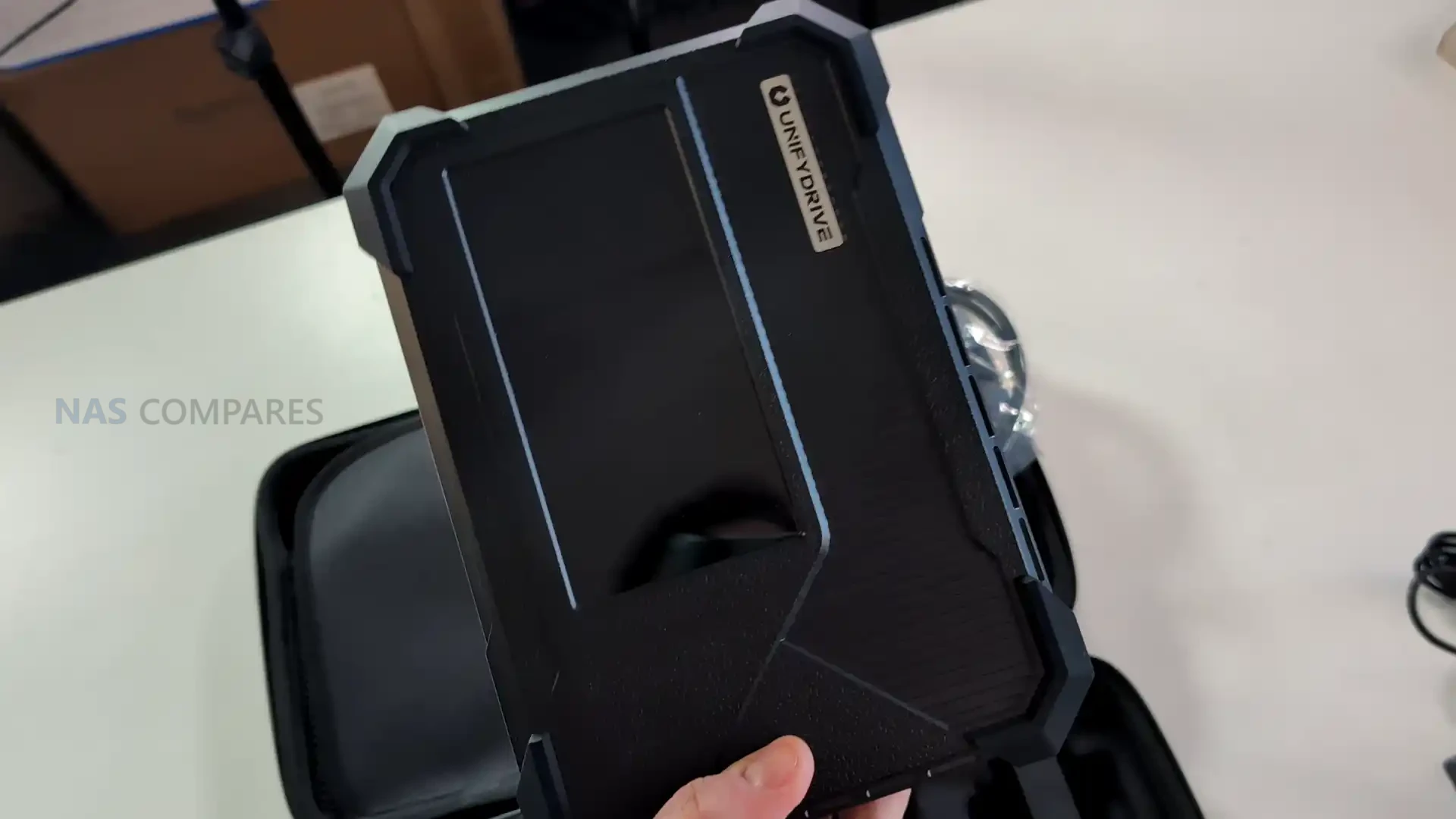
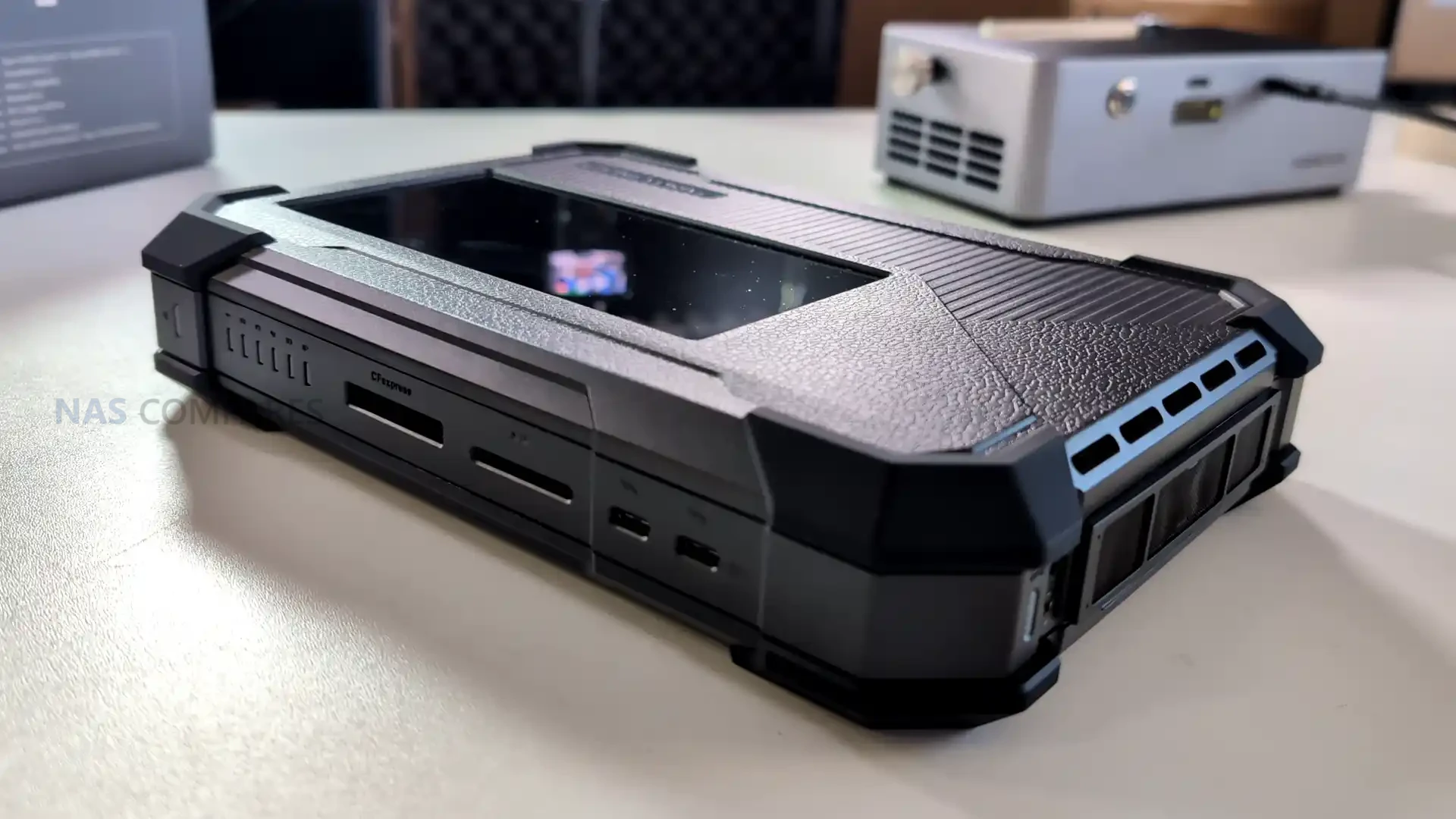
The UP6 uses a compact, travel-friendly footprint for the class, measuring 170mm x 147mm x 43mm, with a listed weight of 1300g without the silicone case. In practice it sits somewhere between a thick portable SSD enclosure and a small desktop NAS, and it is designed to be used both on a desk and in a bag. The outer shell is plastic, while the internal structure is metal, which is relevant because the device is built around densely packed NVMe storage and a laptop-class Intel platform. The front-facing 6-inch touchscreen is a key part of the industrial design and is bright enough to remain usable in typical indoor environments, with a phone-like layout for navigation.
 |
 |
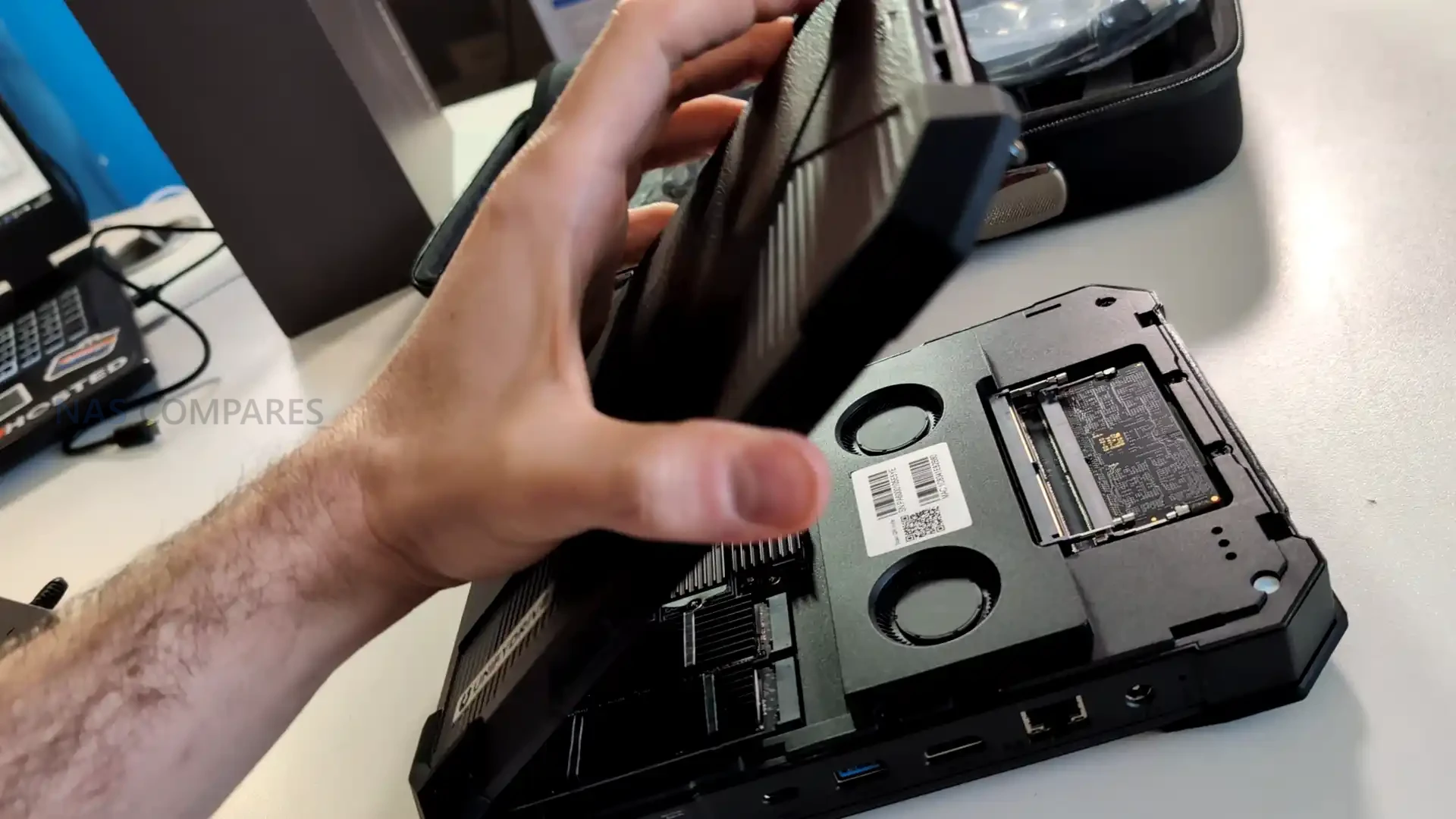
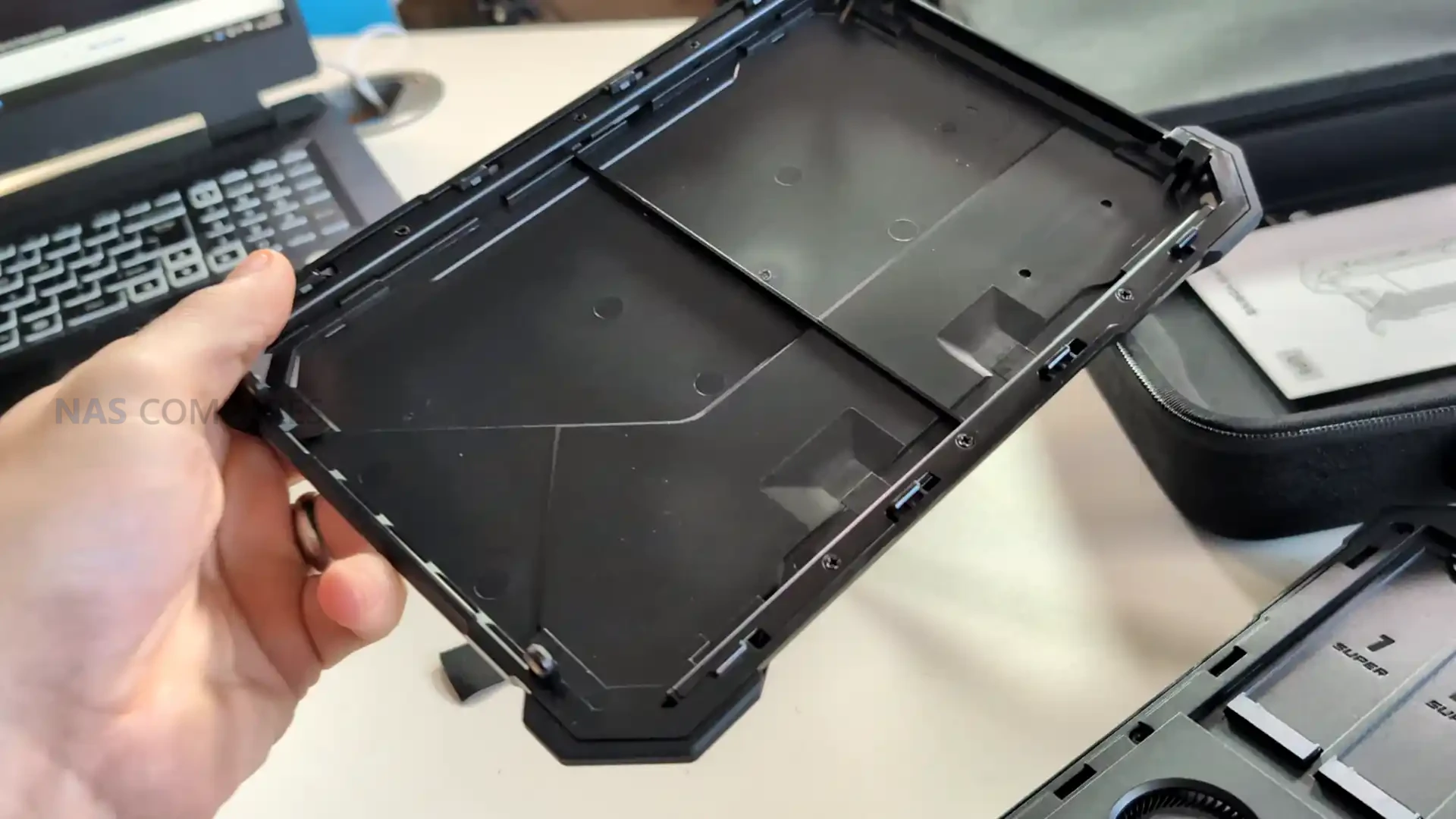
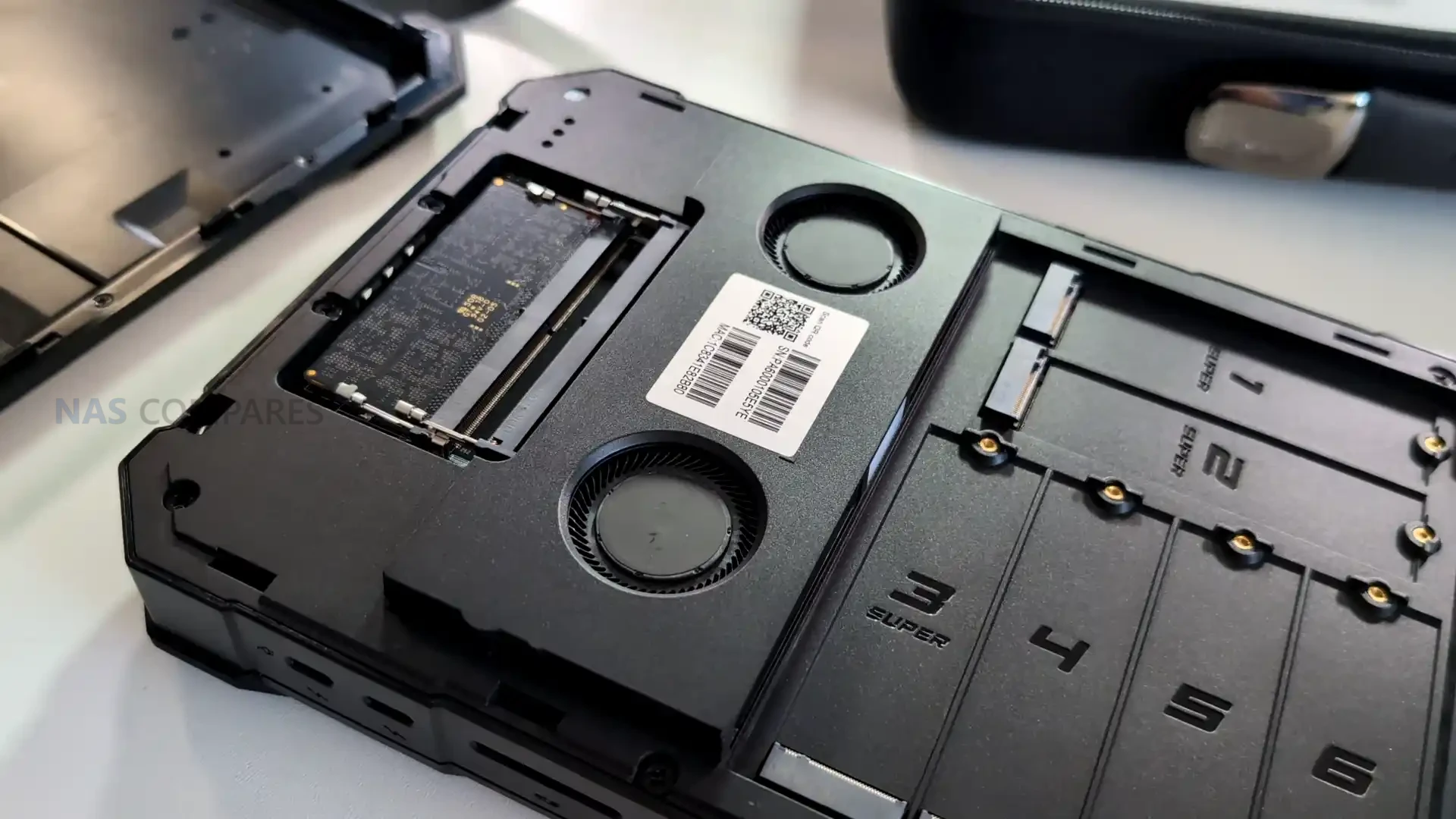
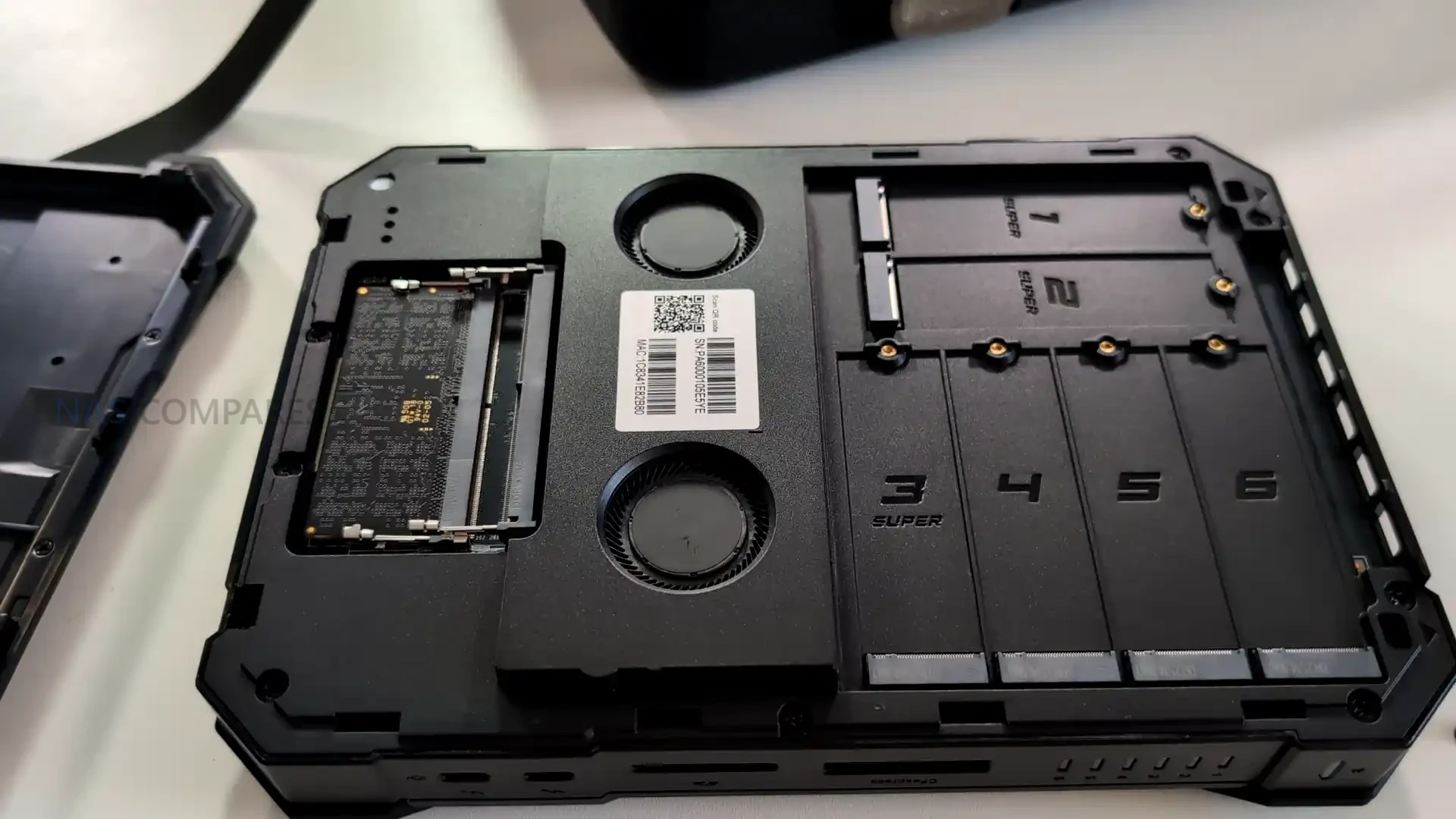
Access to storage is through a removable top panel that exposes the internal M.2 and memory area. The UP6 provides 6x PCIe 4.0 M.2 slots with a maximum stated capacity of 48TB, but the storage does not come pre-populated, so the final cost depends heavily on the SSDs chosen. UnifyDrive’s layout mixes bandwidth tiers: 3 slots are PCIe 4.0 x4 and 3 slots are PCIe 4.0 x2, which creates a performance hierarchy that matters if the array is built with mixed workloads or if certain volumes are reserved for cache, scratch, or active project storage. This 6-bay NVMe approach is consistent with the device’s mobile positioning since SSDs are less fragile in transit than hard drives and generally tolerate movement better.
 |
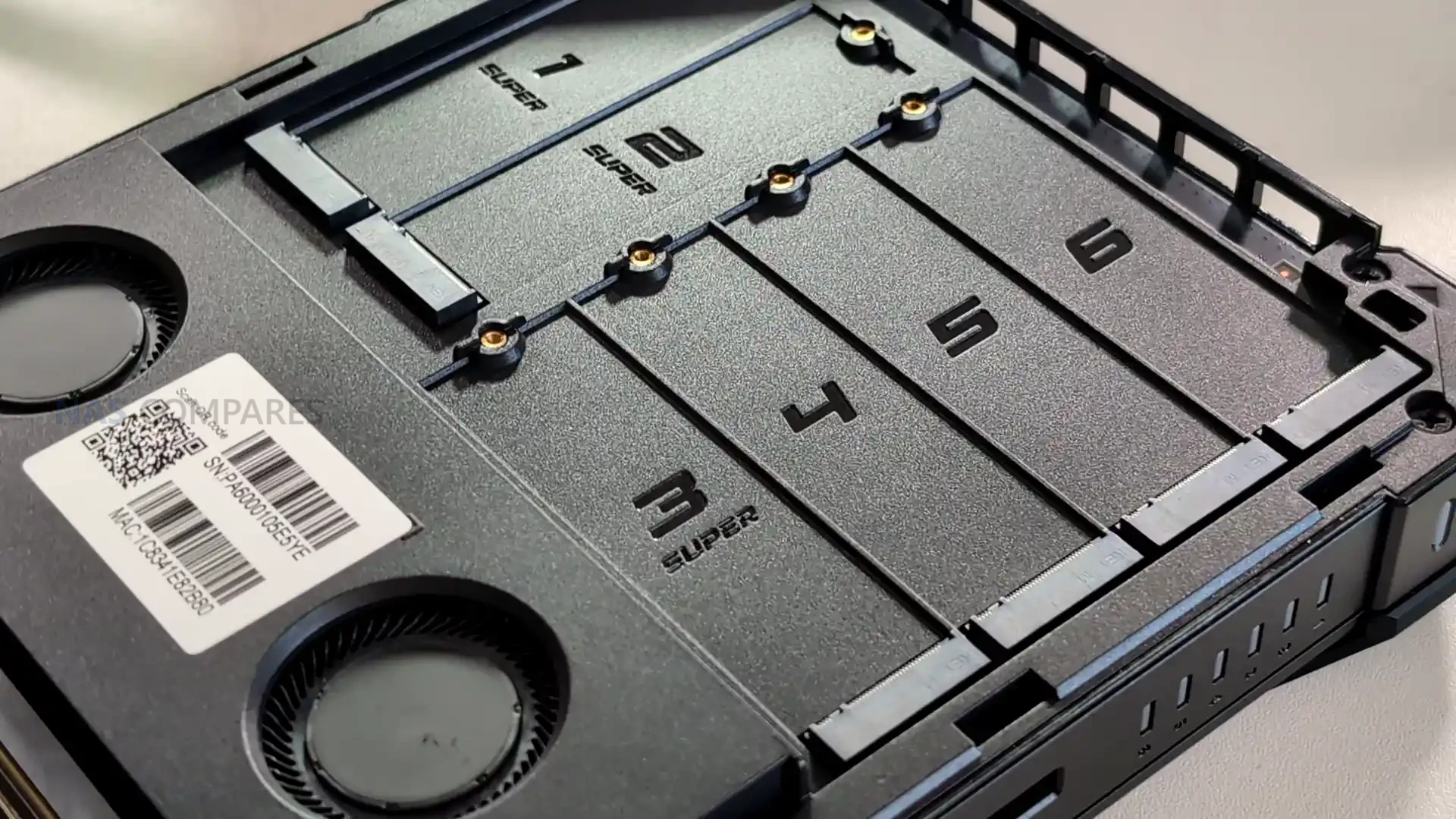 |
One of the main design concerns is thermals around the storage bay area. In early handling, the proximity of the M.2 drives to the plastic top cover stands out, particularly for PCIe 4.0 x4 SSDs that can run hot during sustained writes. The unit does not include M.2 heat sinks in the box, which is unusual at this price and places responsibility on the user to manage temperatures through third-party heat sinks if they plan to run higher power drives. The drive slots are also positioned at differing angles relative to airflow, raising questions about how evenly heat is removed across all installed SSDs during long transfers.
 |
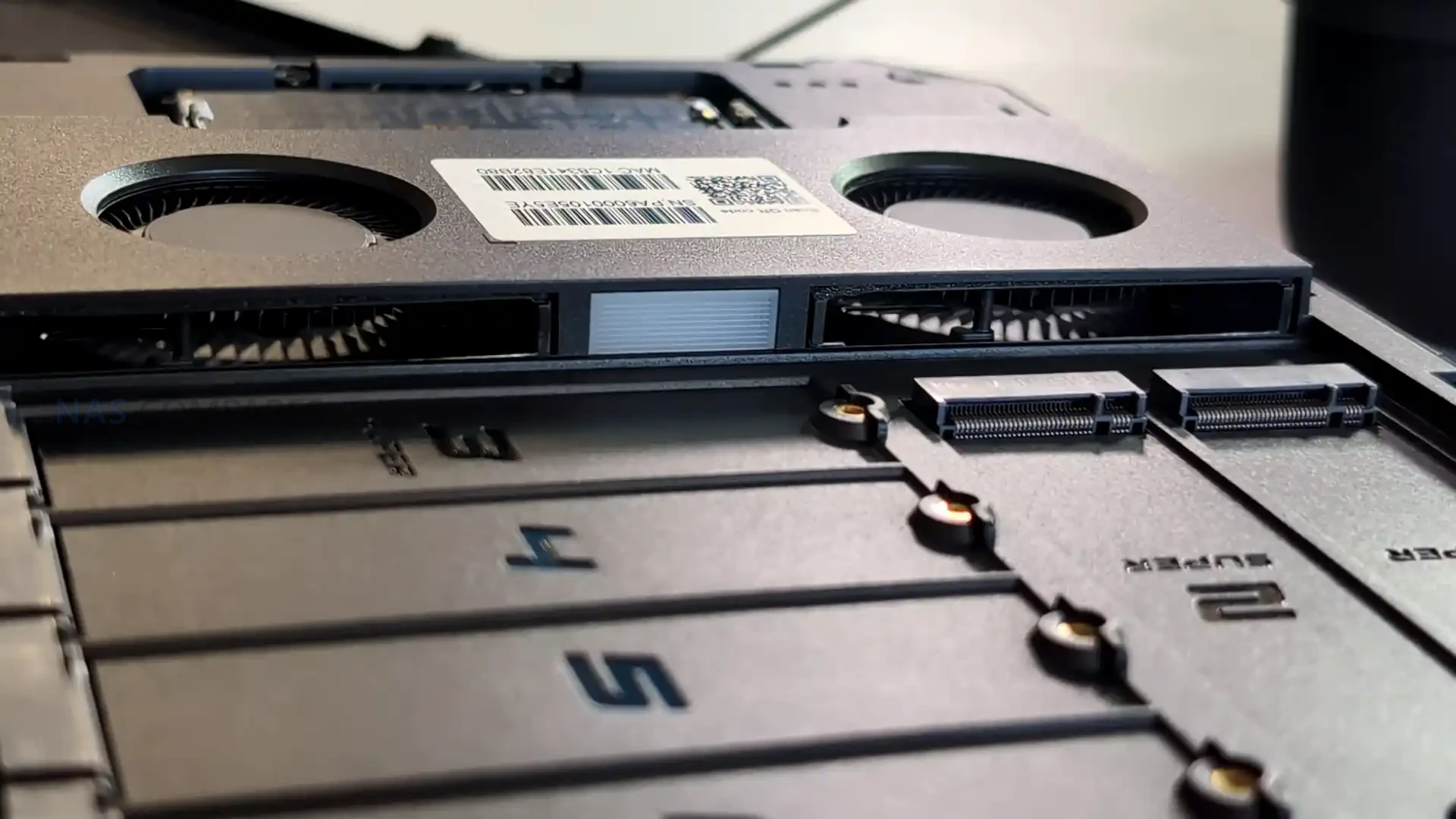 |
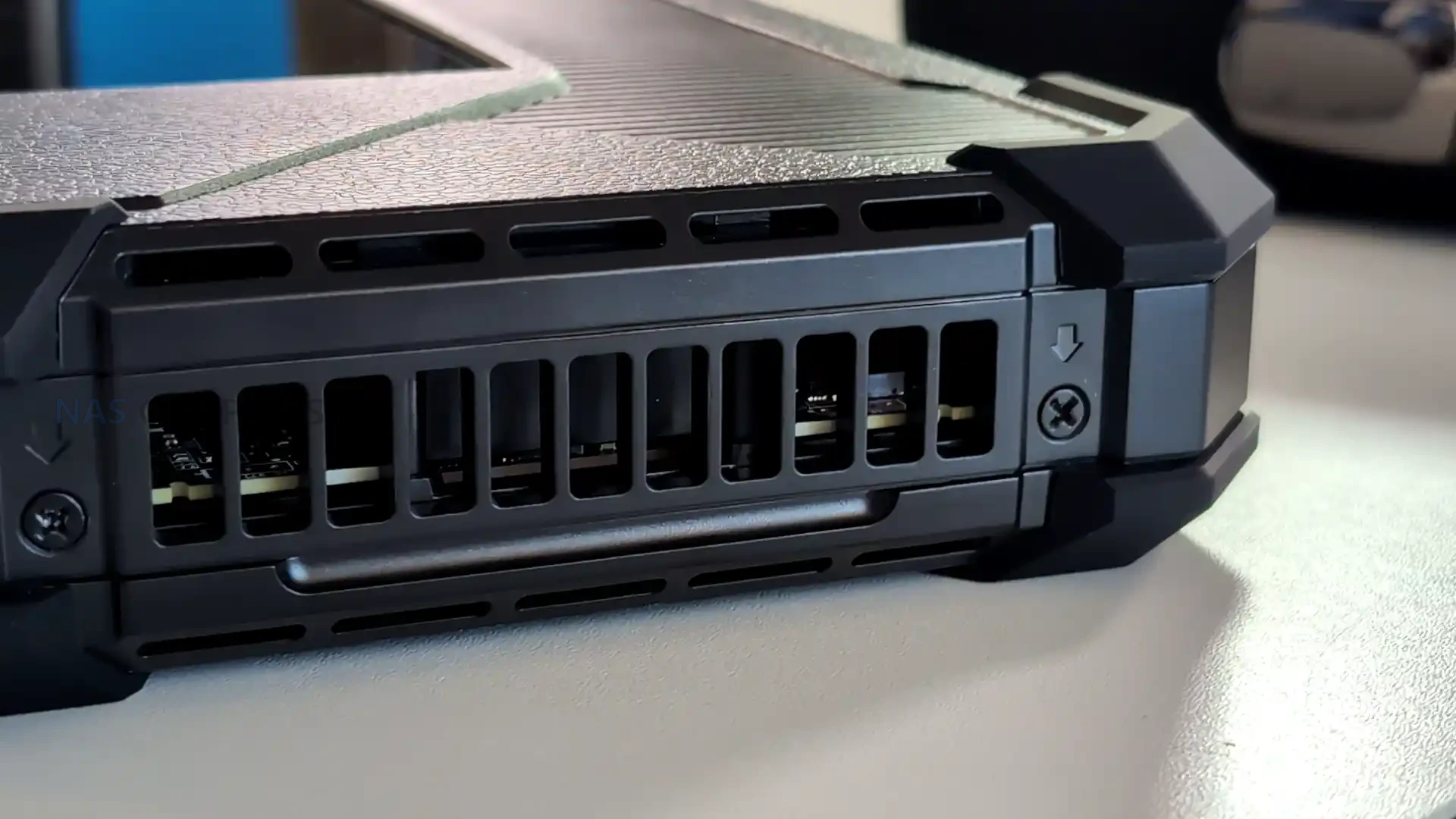
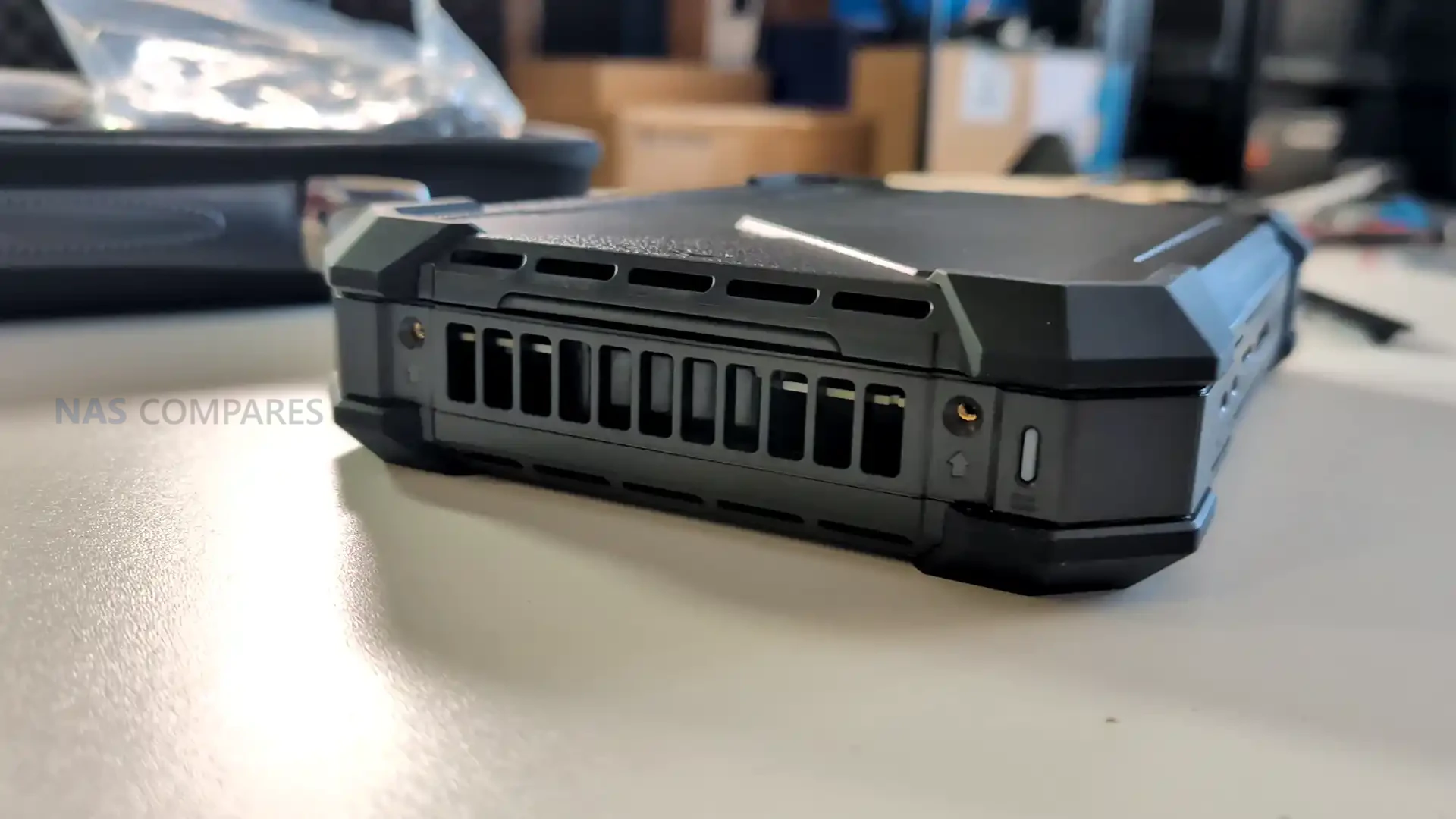
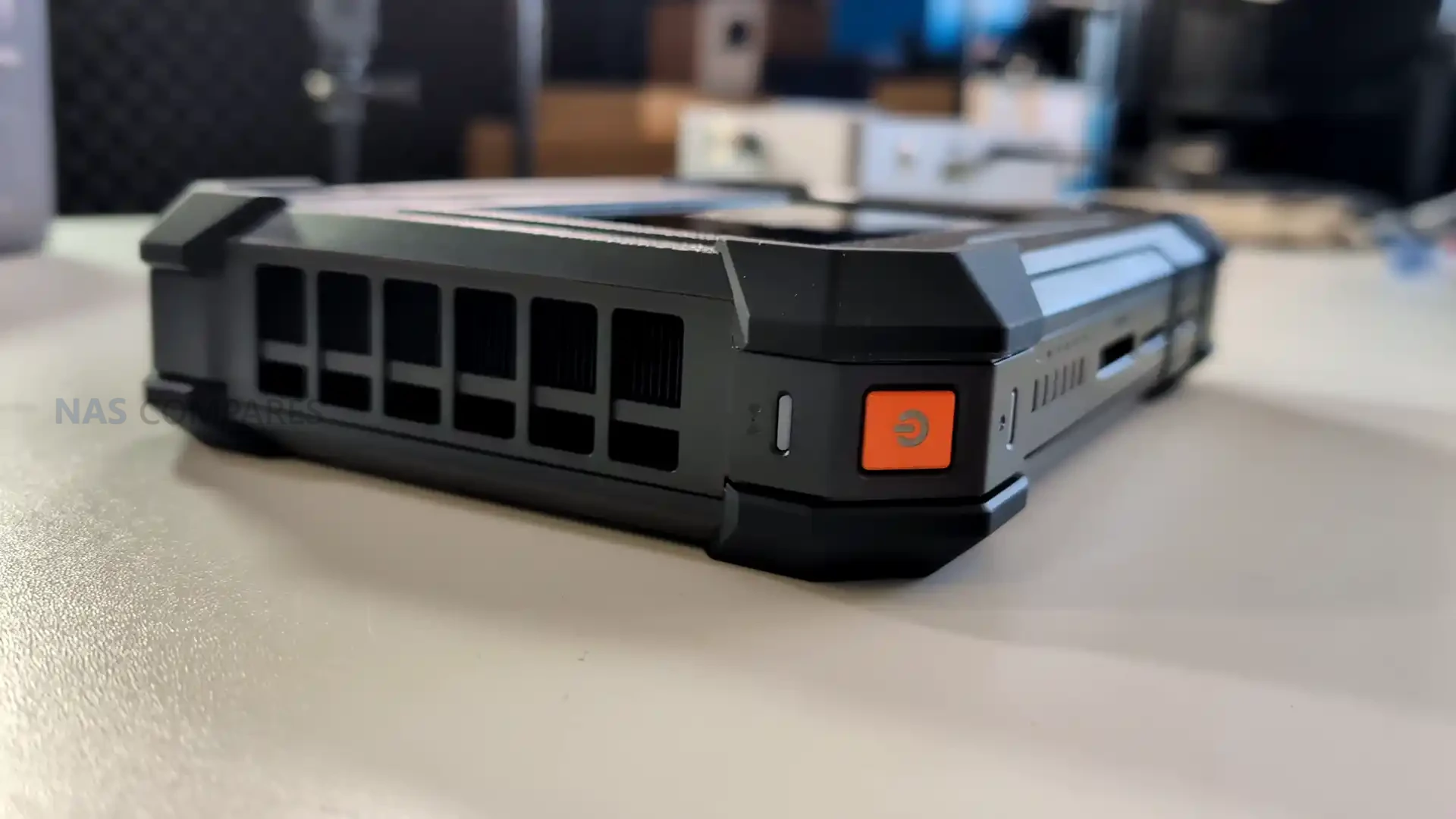
Ventilation is built into multiple sides of the chassis, including a vent path that runs through the main body, and the unit incorporates dust filtration on the intake areas. Over extended use, that ventilation design appears to do meaningful work, but it also means the UP6 relies on active airflow rather than passive dissipation through a metal outer shell. For a device that may be used in the field, this approach makes cleanliness and environment more relevant than with sealed enclosures, especially when operating in dusty locations or in bags where vents can be partially obstructed.
 |
 |
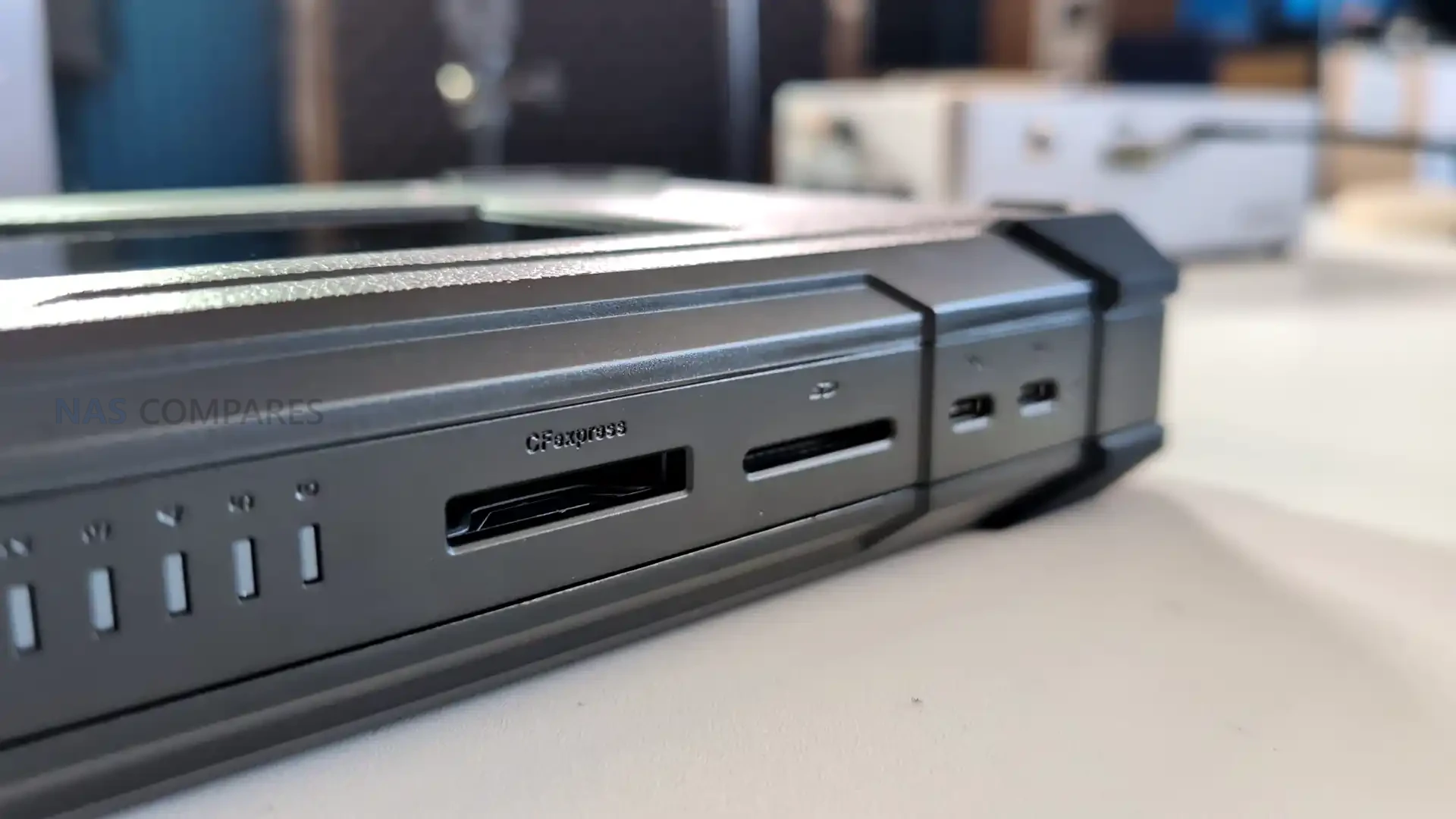
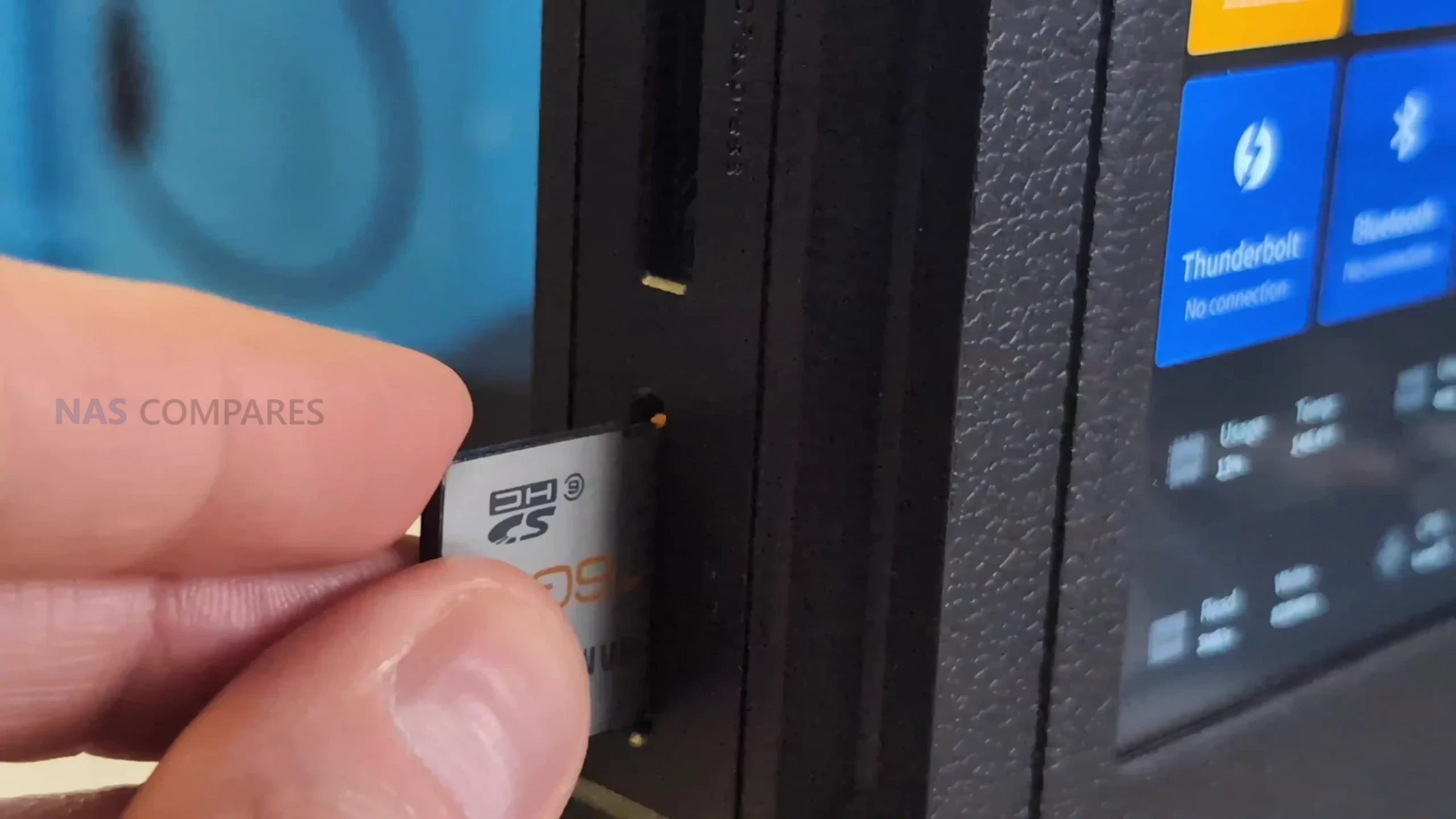
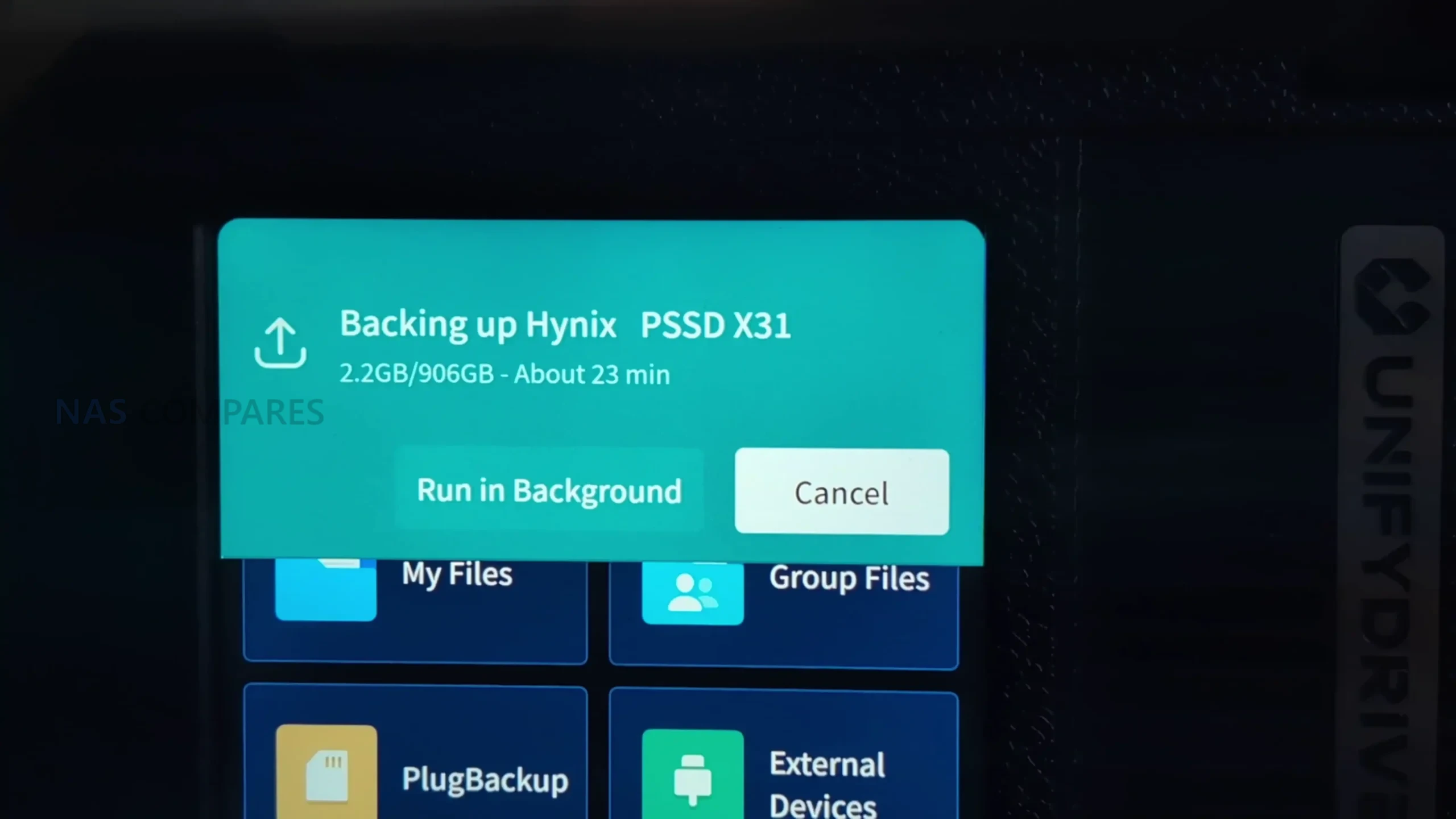
From a storage workflow perspective, UnifyDrive emphasizes quick ingestion and verification, and the physical layout supports that by pairing internal NVMe with front-of-device status visibility. The UP6 includes SD card support and CFexpress support for direct backup operations, and the system is designed to detect media on insertion and trigger a guided backup process on the touchscreen. That structure aligns with the intended use case of returning from a shoot, inserting cards, starting a backup without a laptop, and then confirming the results using on-device file browsing and preview tools before moving on.
 |
 |
UnifyDrive UP6 Review – Touchscreen Controls
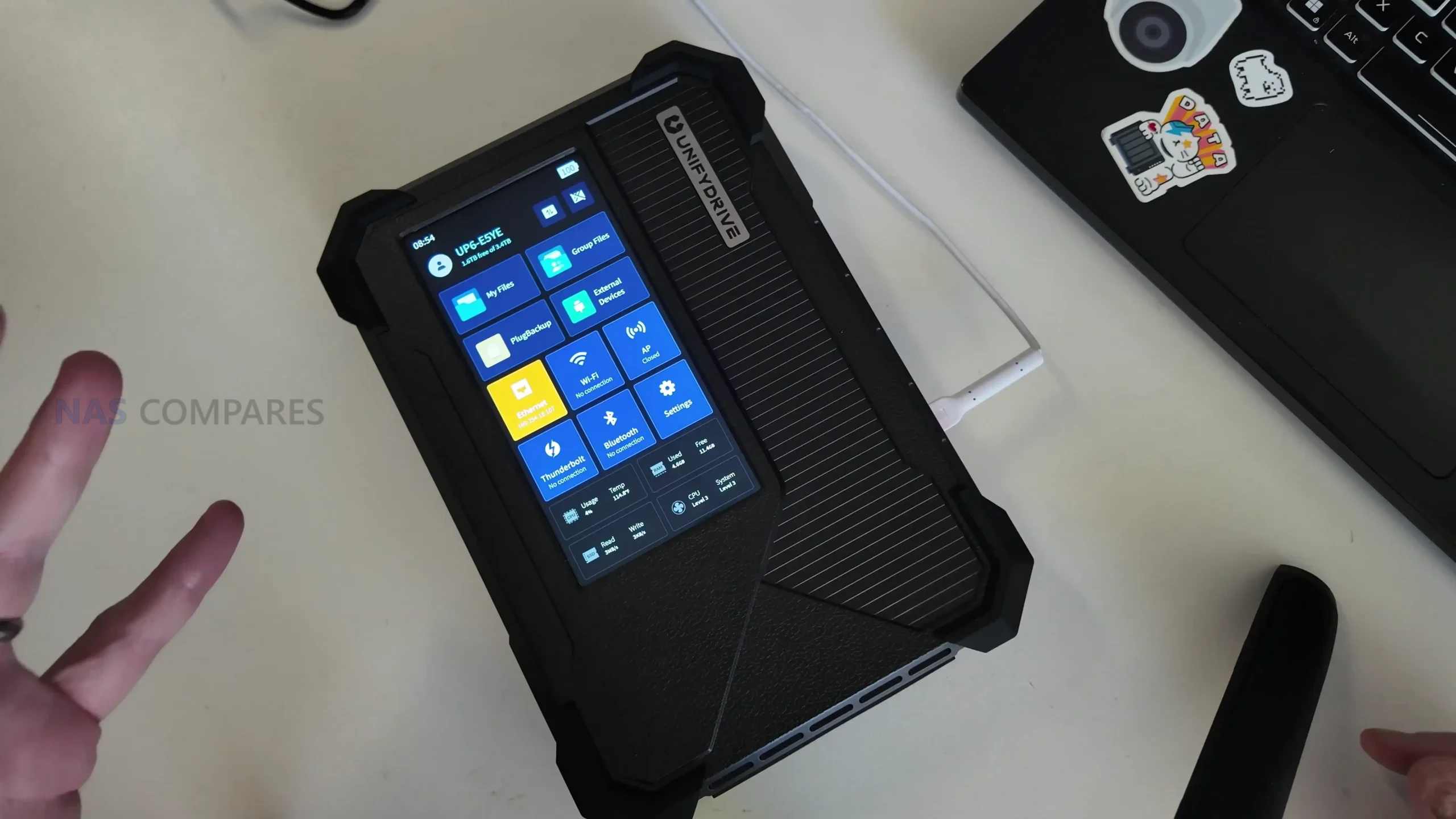
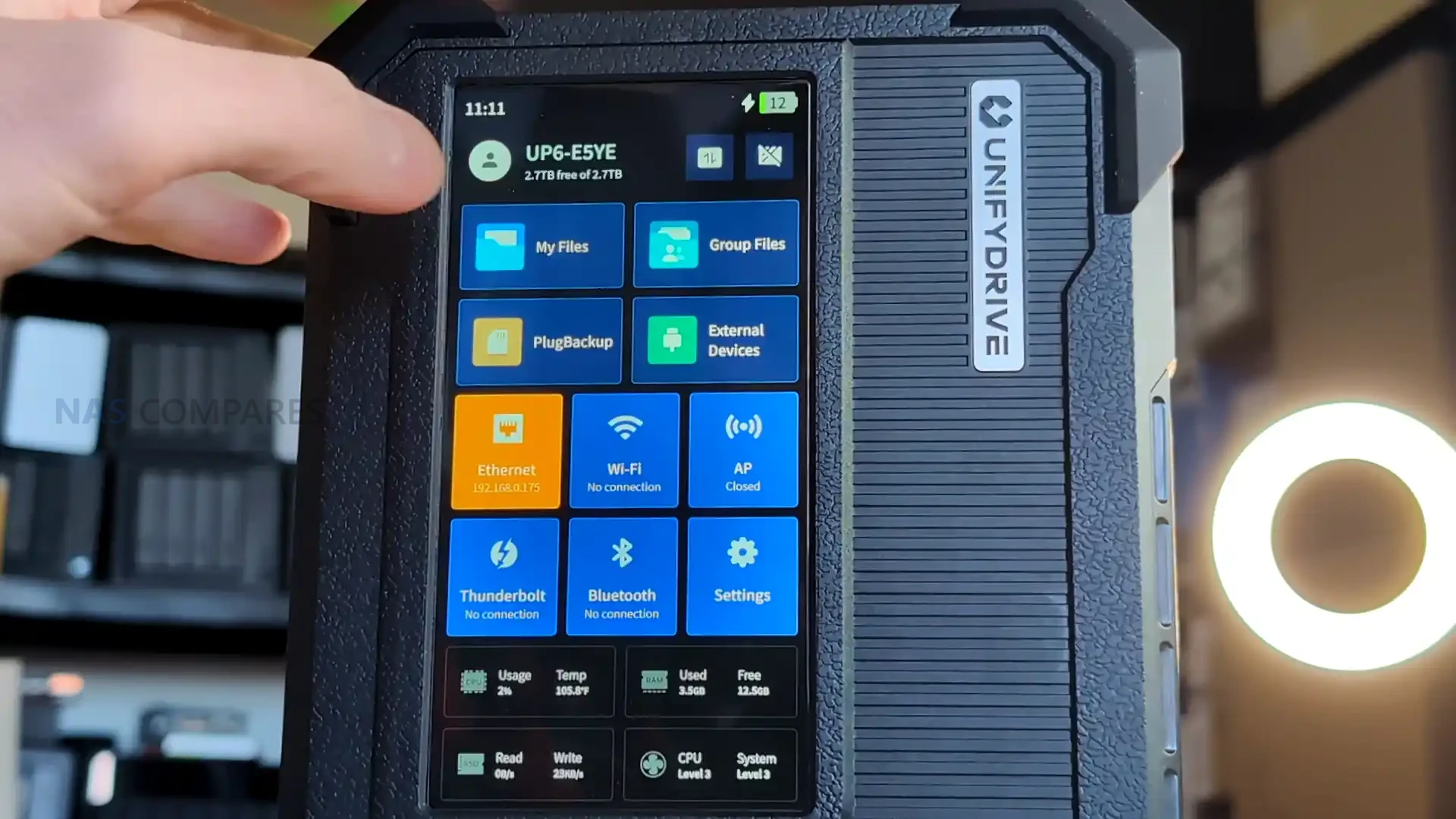
The UP6 includes a 6-inch 2160×1080 touchscreen that functions as a built-in local interface for the system. It is positioned on the front of the chassis and is intended to reduce dependence on a phone or laptop for basic tasks, particularly when the device is used in the field. In use, the panel is notably bright, which helps with visibility during on-site checks and quick interaction, and it provides a phone-like UI layout with app-style navigation.
 |
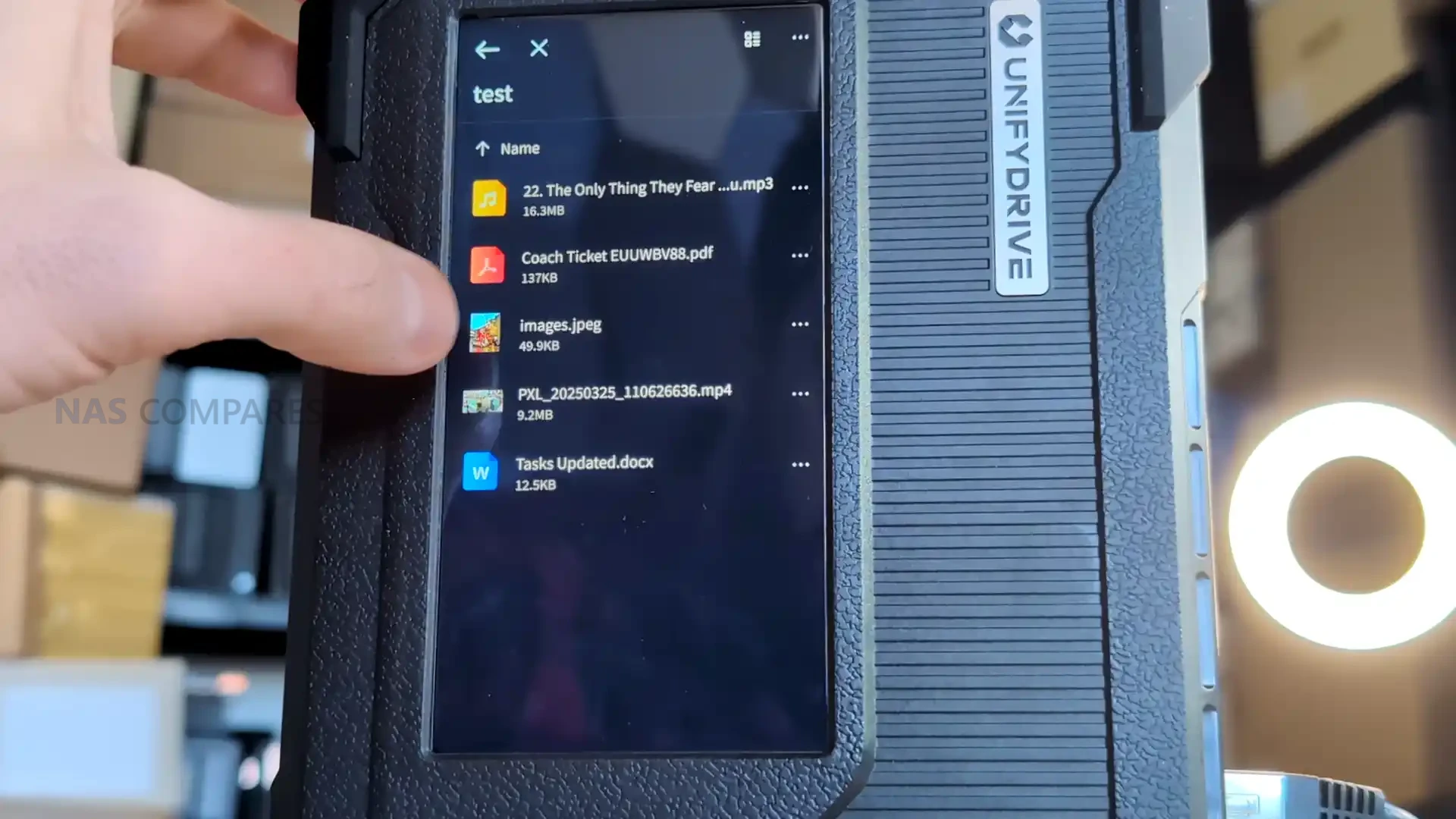 |
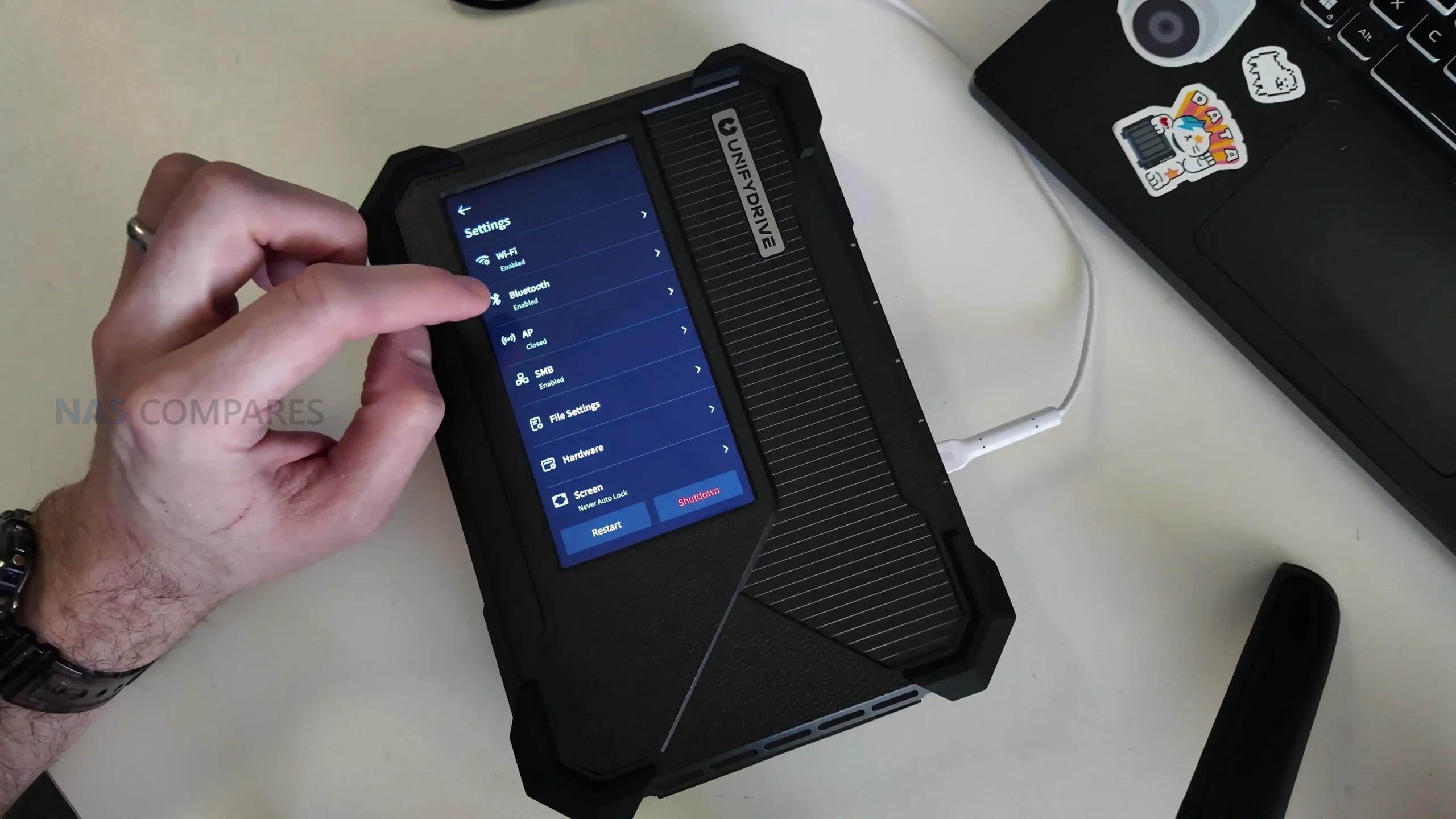
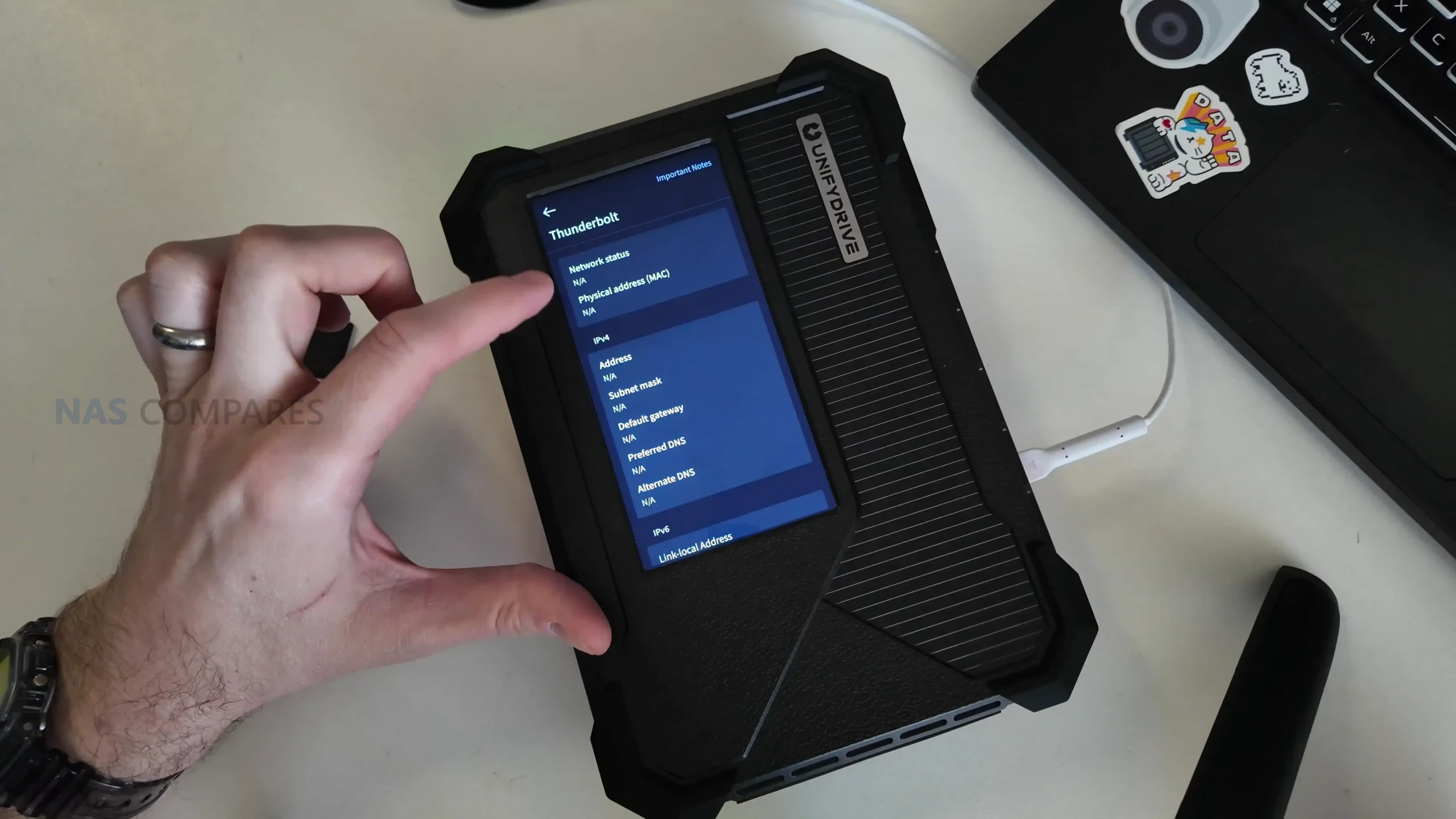
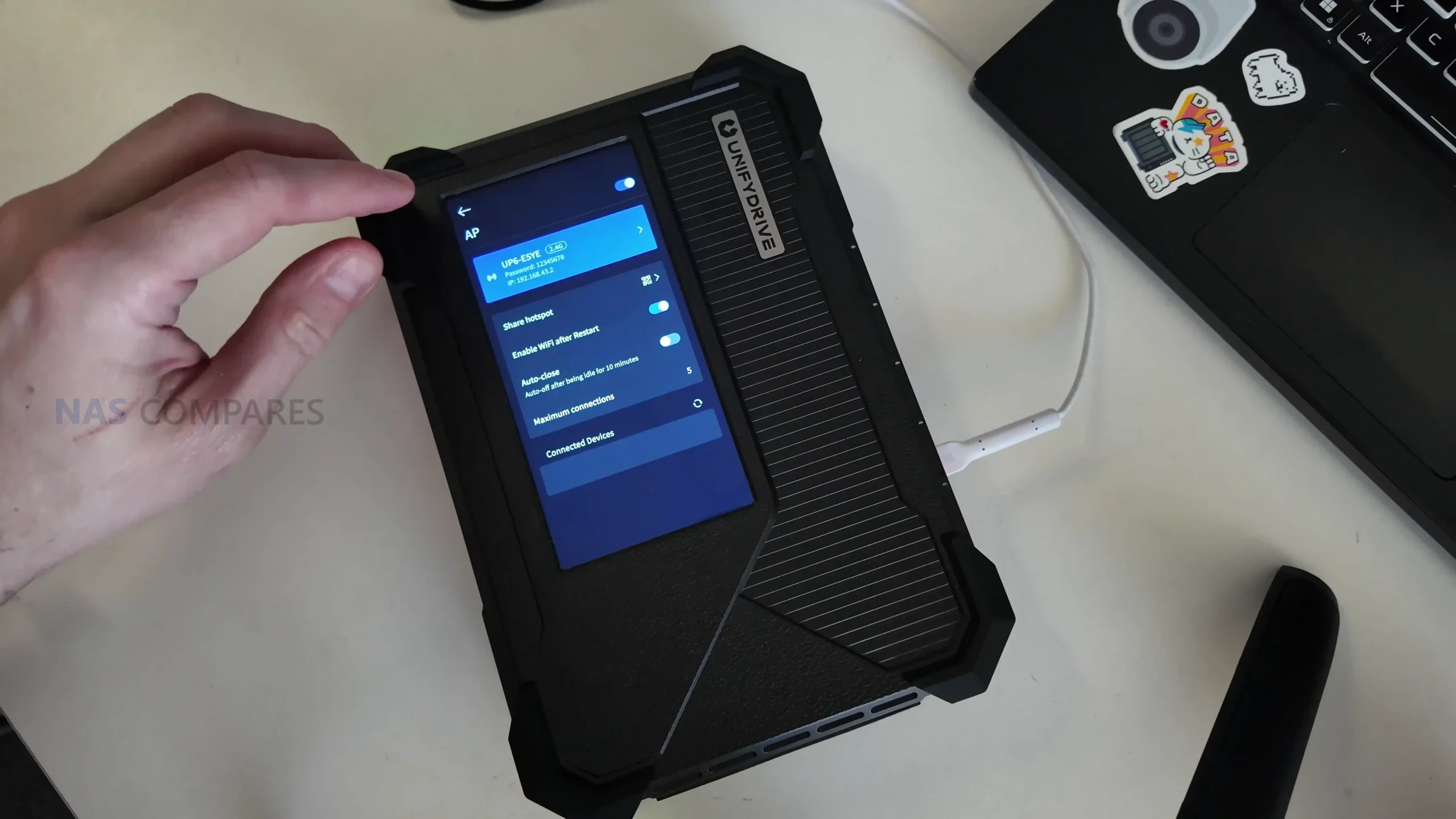
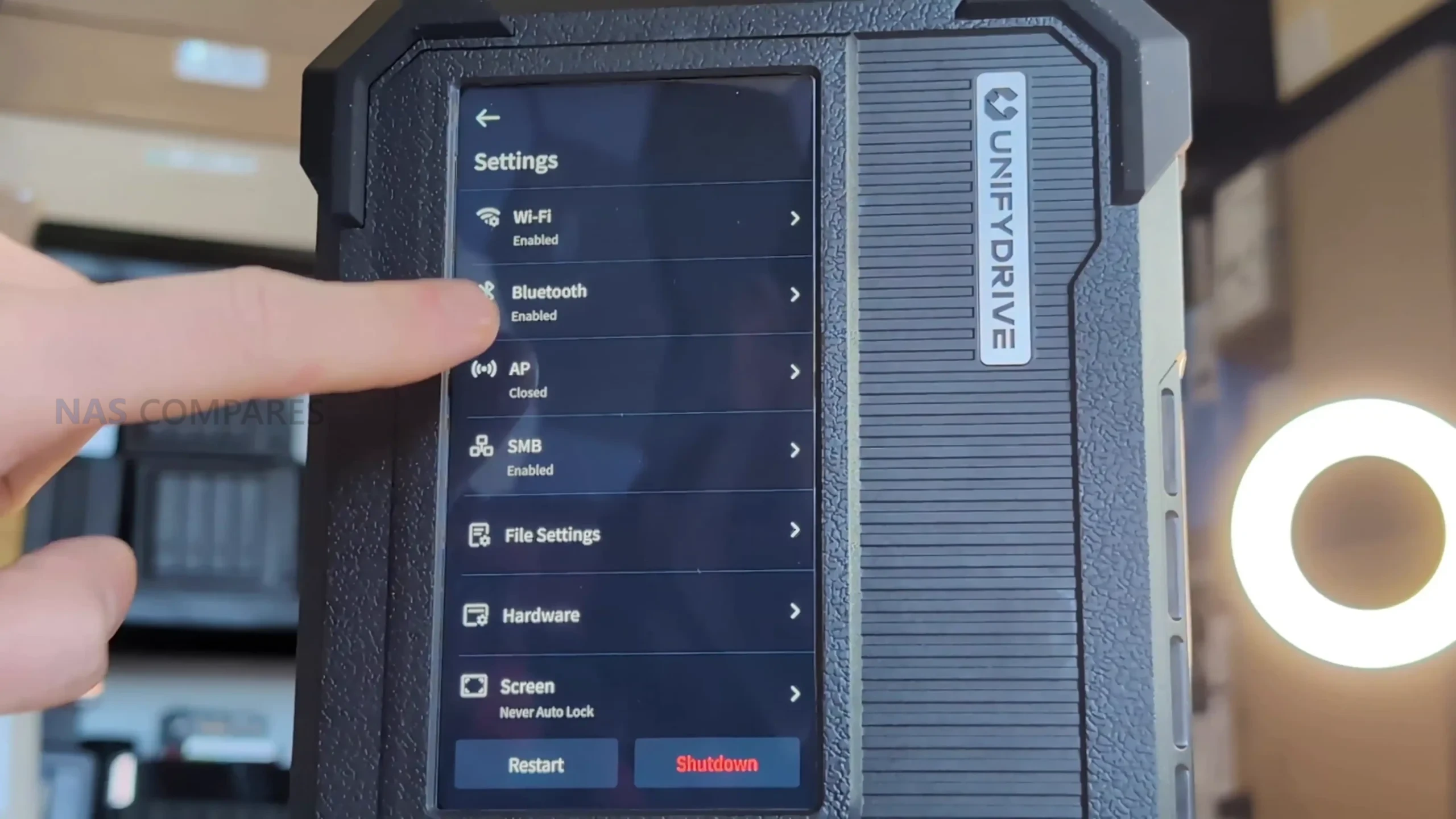
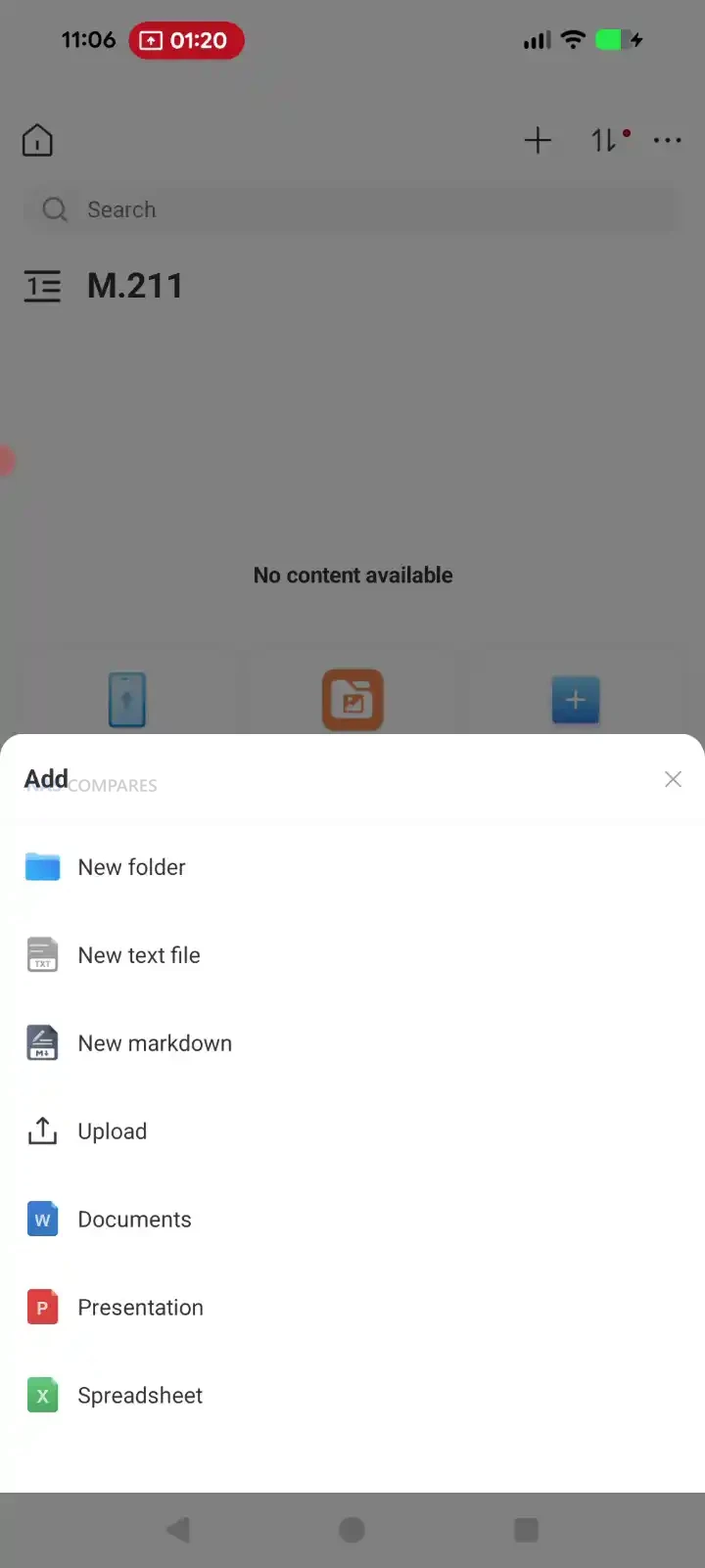
Functionally, the screen allows log-in access to core controls such as Wi-Fi setup, Ethernet configuration, Bluetooth, access point creation, basic security toggles, backup settings, and system status pages. It also provides a file manager that can browse shared storage, create folders within accessible areas, view file details, and preview certain media types, including playing video files directly on the display and showing image metadata. It can also show active task status, let you monitor backup progress in real time, and offers quick controls like screen brightness and basic power actions.
 |
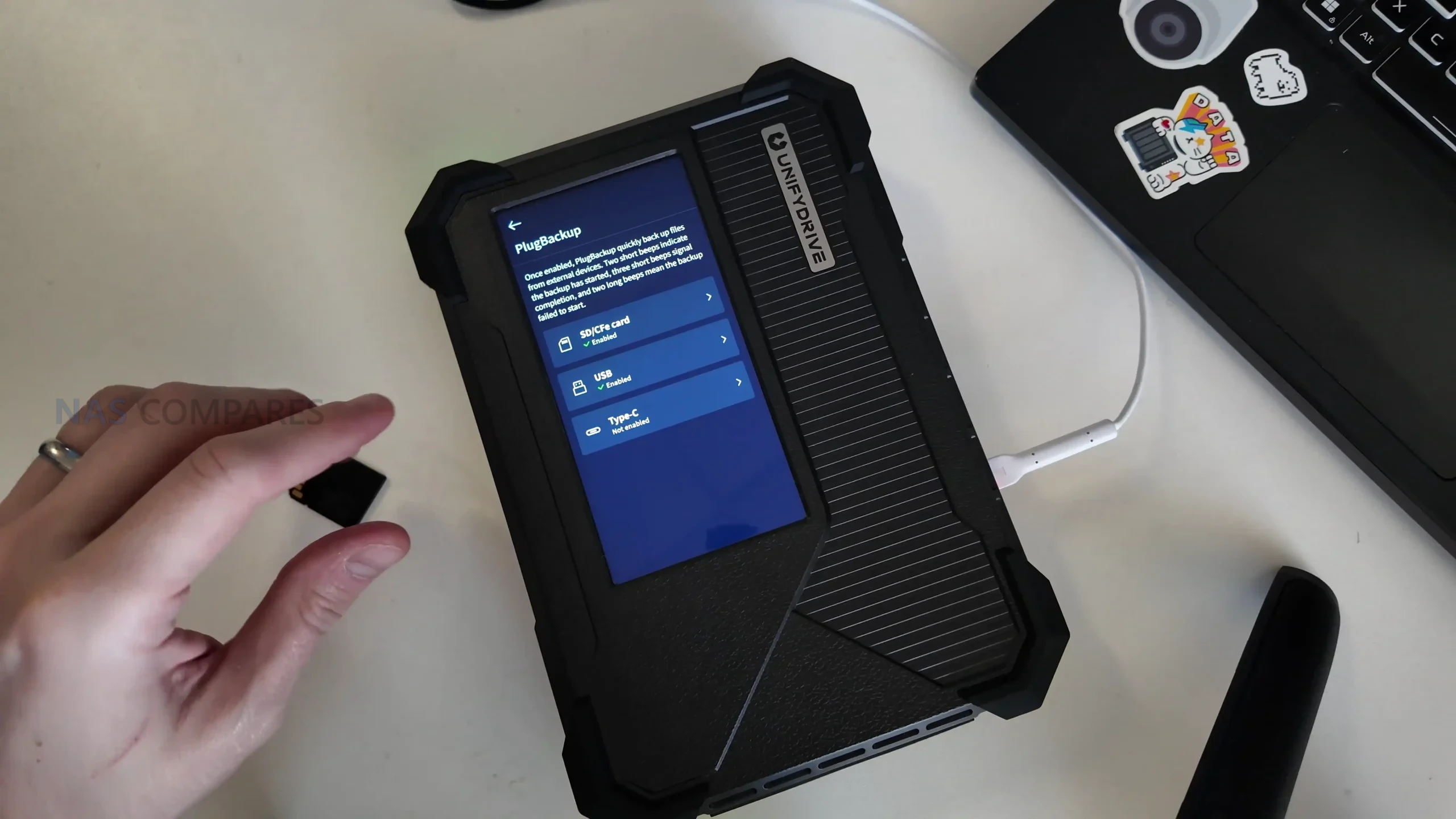 |
As a practical tool, the touchscreen is most useful for confirming that a card ingest or USB backup has started correctly, checking that files exist after a transfer, and doing light review without pulling out another device. Its limits show up when deeper administration is needed: the settings exposed on-screen are comparatively shallow, with missing or reduced control for items like detailed fan behavior, richer hardware telemetry, and some power-management preferences. Media preview is also constrained, including no built-in audio output during playback, and the overall interface does not fully replace what the mobile app or desktop browser can do for full management.
 |
 |
UnifyDrive UP6 Review – Internal Hardware
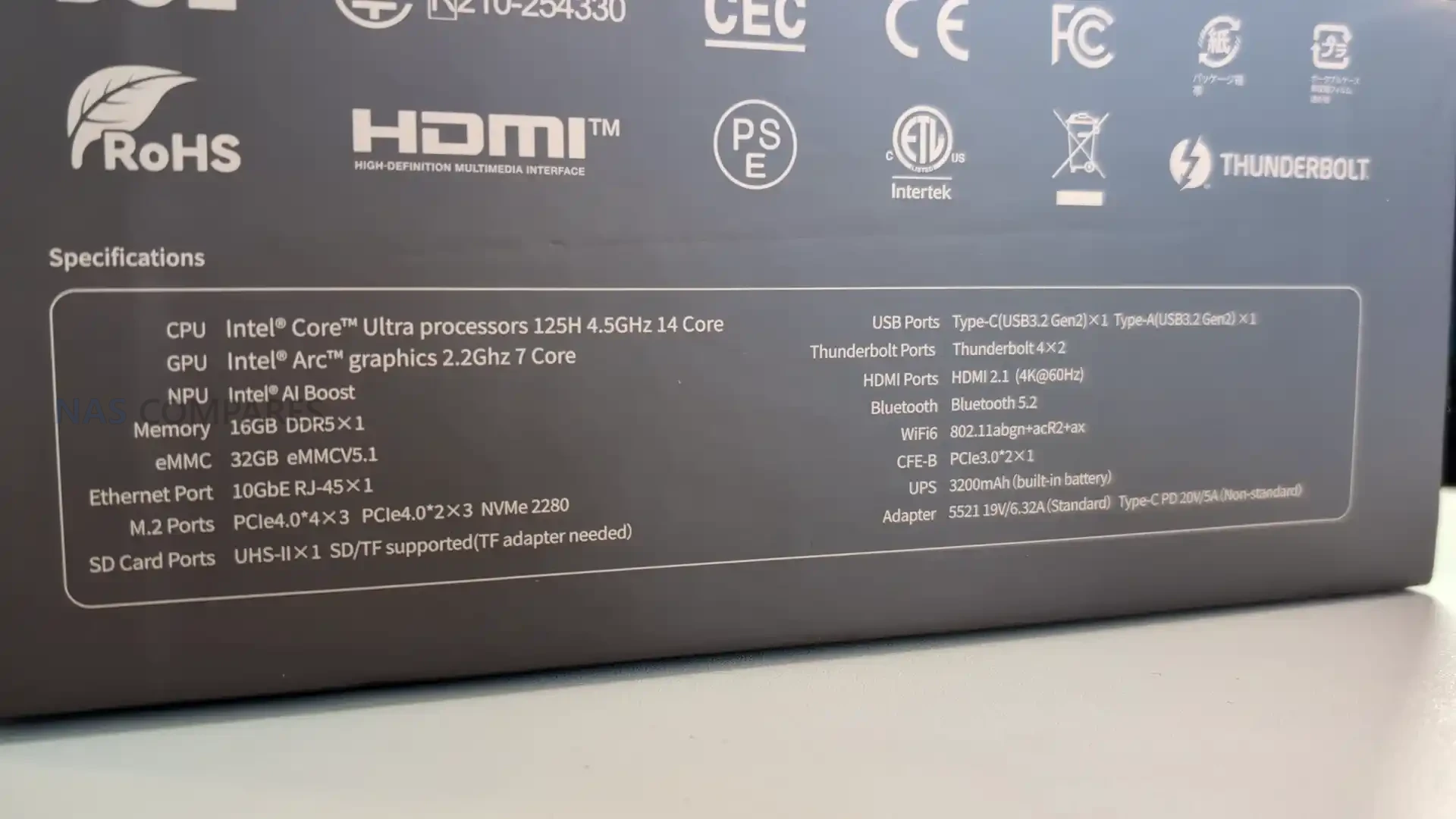
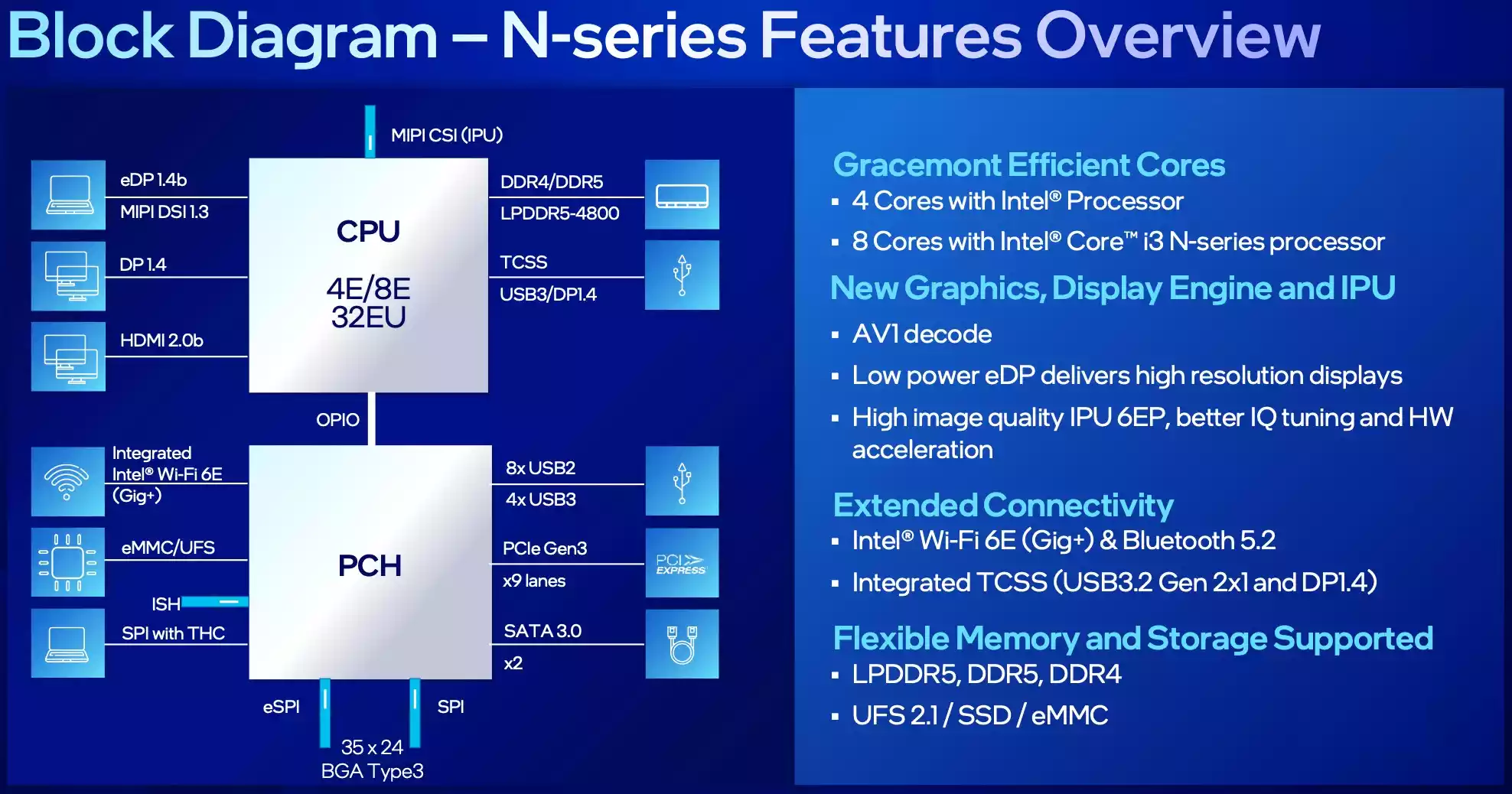
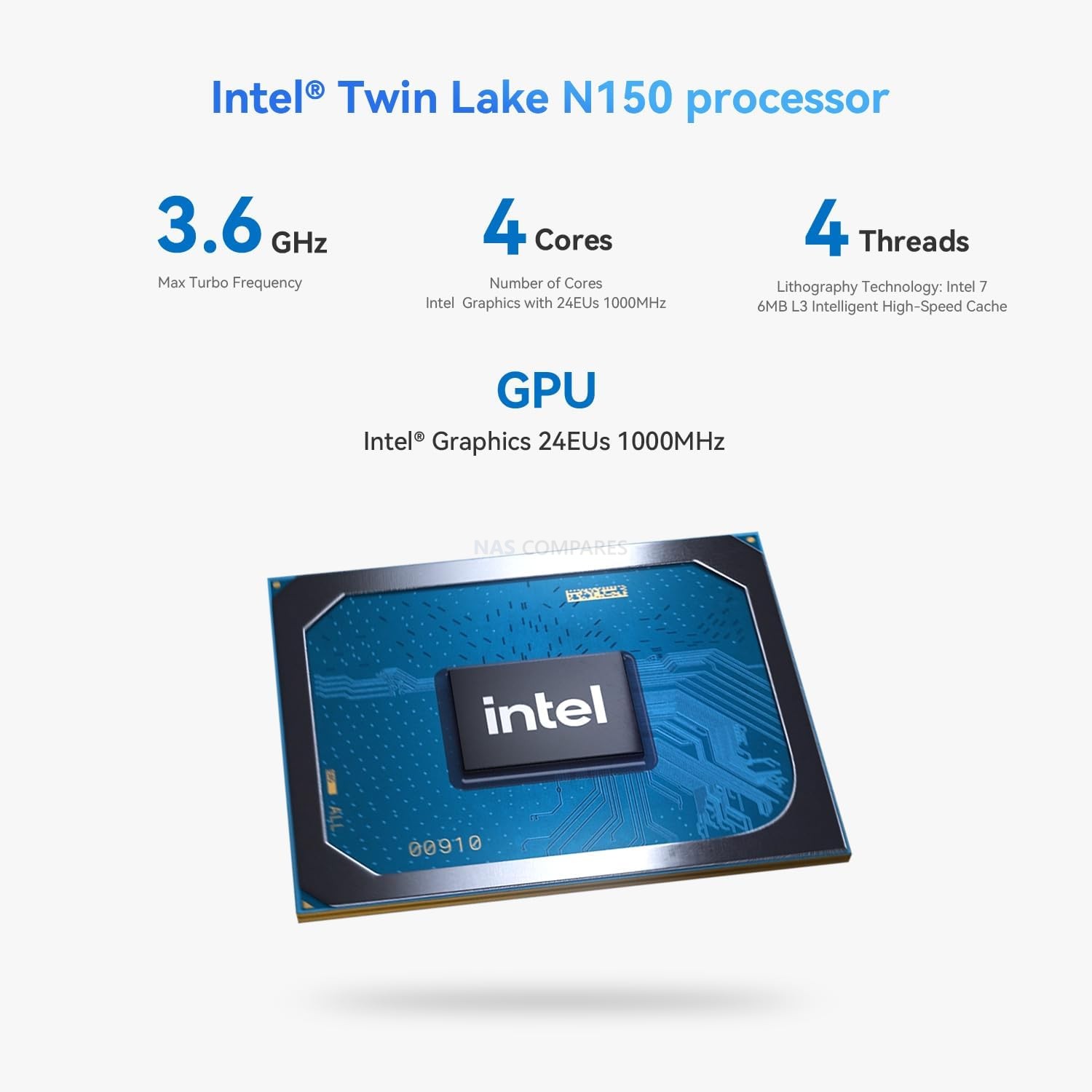
At the center of the UP6 is an Intel Core Ultra 5 125H, a 14-core mobile processor paired with Intel Arc integrated graphics and an onboard NPU rated at 11 TOPS for local AI workloads. This choice places the unit closer to a compact PC platform than a typical low power NAS appliance, which helps explain why UnifyDrive positions it for heavier tasks such as media handling, indexing, and local AI analysis rather than basic file serving alone. In day-to-day use, the platform has enough headroom to keep the interface responsive while running background services, and it also supports more advanced features like virtualization and container workloads through the software stack.
 |
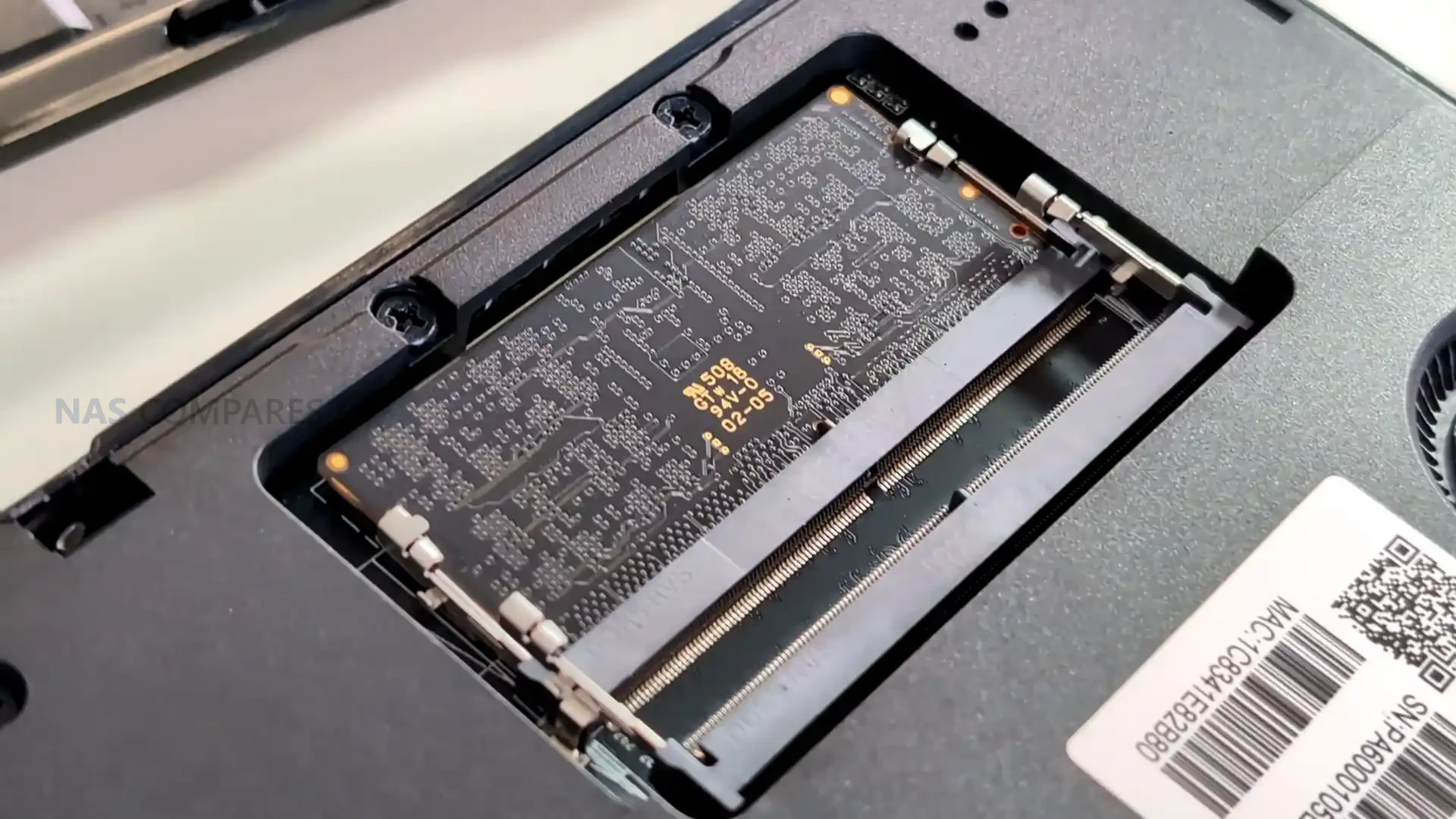 |
Memory is DDR5 with a maximum supported capacity listed at 96GB, while the base configuration ships with 16GB installed. This matters because several of the UP6’s promoted workloads, including multi-user access, Docker, indexing, and AI-assisted photo organization, benefit directly from additional RAM. In practical terms, the shipped configuration is usable for basic storage, backup, and light services, but it is likely to be a limiting factor if the device is used as a more general-purpose NAS with multiple apps running concurrently or if it is configured to handle larger media libraries with extensive metadata work.
 |
 |
The UP6 also includes 32GB of onboard eMMC used for the operating system and core services, separating the boot volume from the user-installed NVMe pool. That arrangement simplifies initial setup and keeps the system functional even before storage is populated, but it also means the OS layer is tied to the internal eMMC device rather than being mirrored across the NVMe array. For a portable device, that separation can be a practical choice, but it is still a component that cannot be swapped as easily as standard SSD storage.
 |
 |
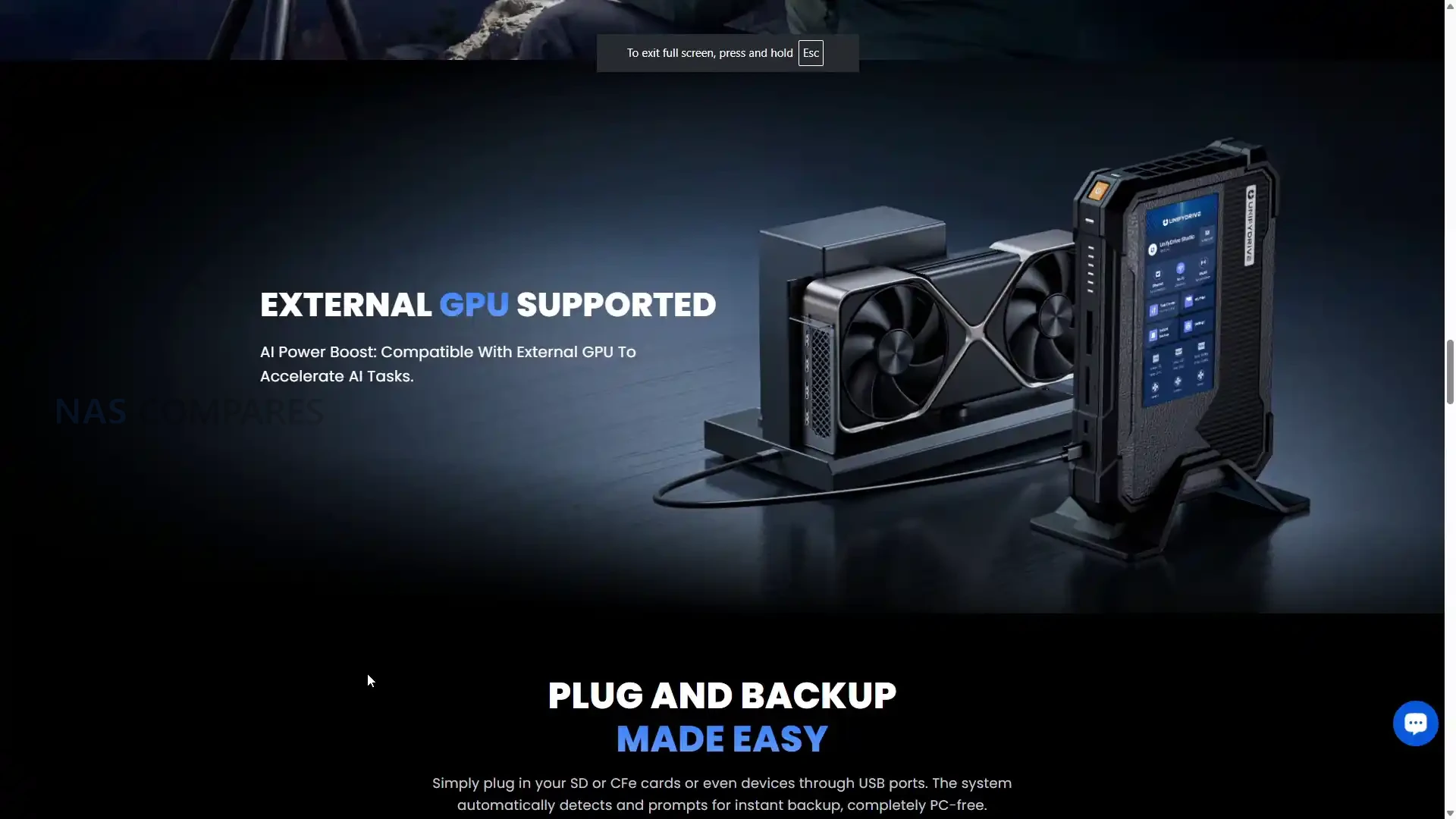
UnifyDrive also promotes external GPU support, enabled through the high bandwidth USB-C and Thunderbolt connections, with the expectation that a docked setup can accelerate AI tasks or other GPU-assisted workloads. In real use this feature is more relevant to stationary operation than travel, since adding an eGPU enclosure reduces portability, but it does extend the UP6 beyond the typical scope of a mobile backup unit. The result is a platform that can shift between a field device for ingest and a desk-bound system for heavier processing, depending on how it is connected and configured.
 |
 |
UnifyDrive UP6 Review – Ports & Connections
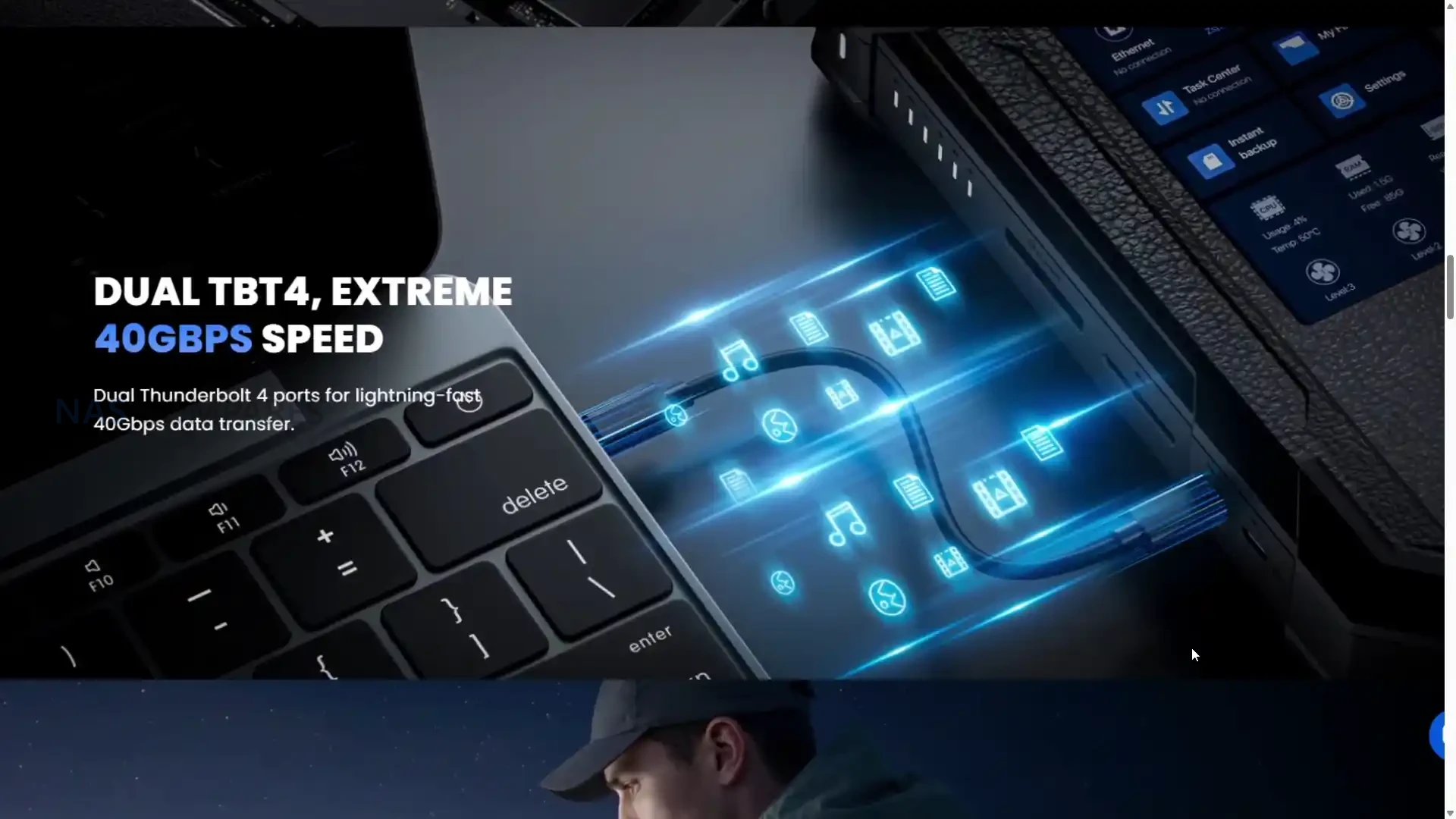
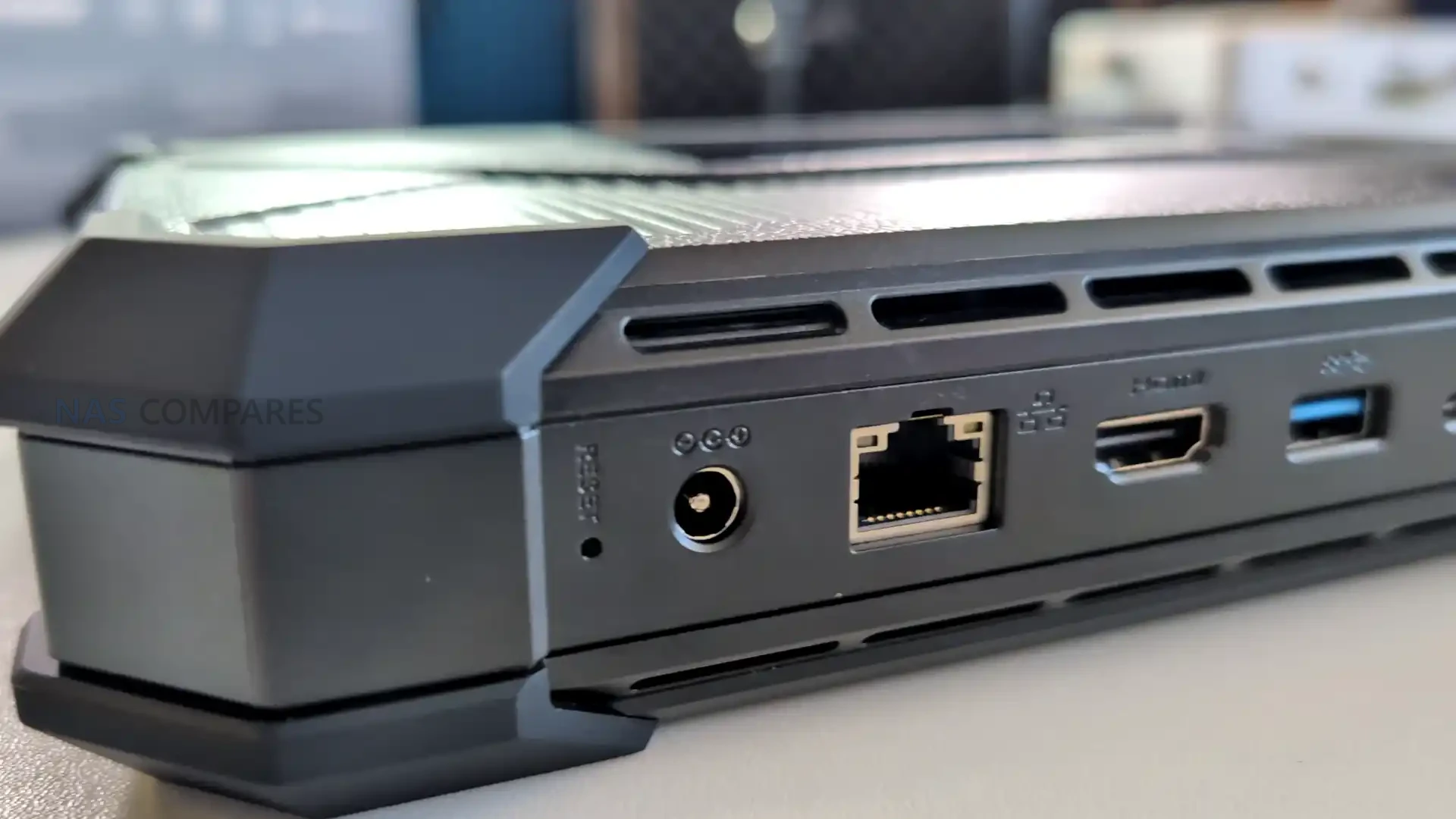
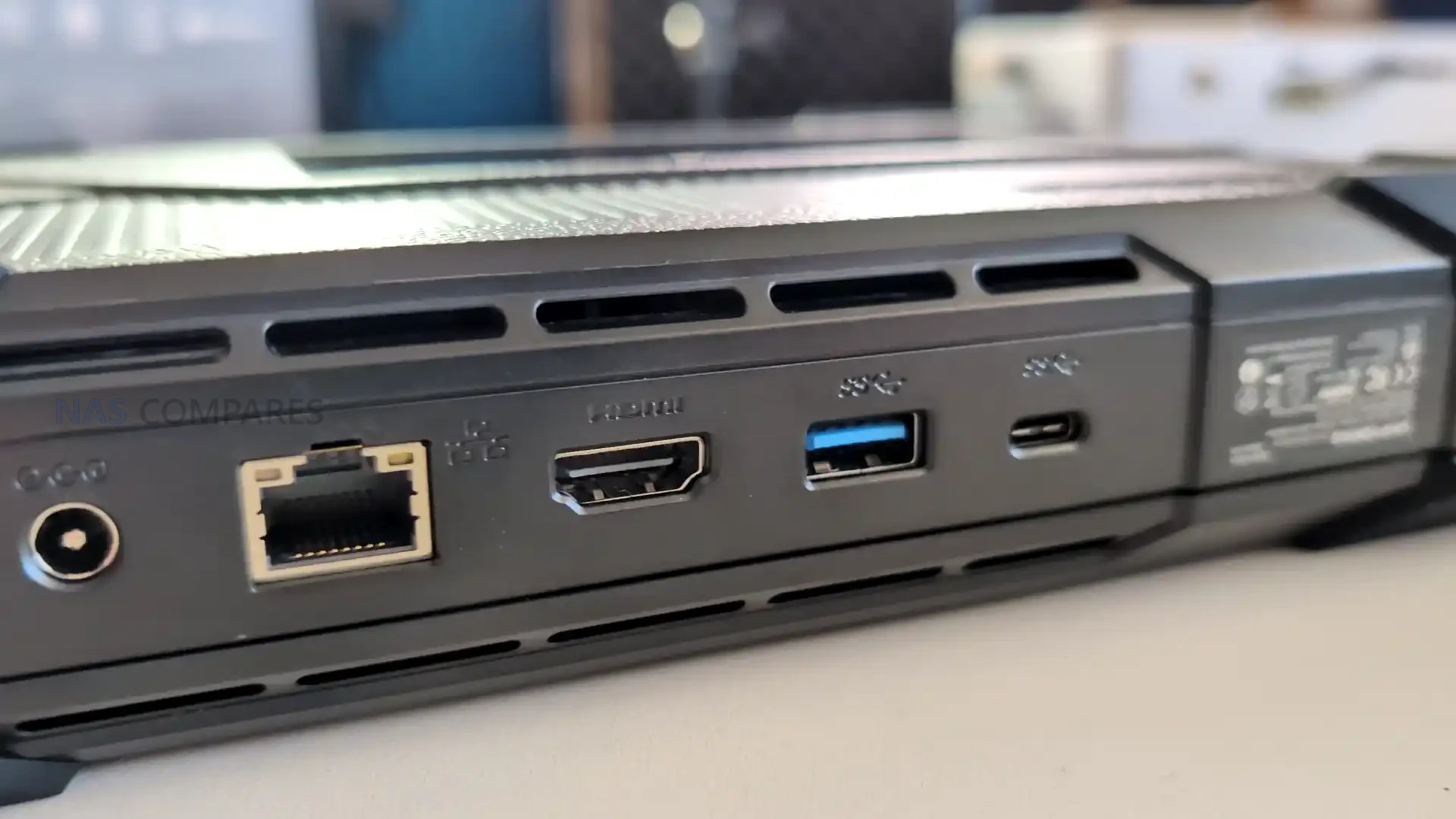
The UP6 is built around a mix of high-speed wired options and short-range wireless, with the headline being 2x Thunderbolt 4 ports rated at 40Gbps alongside a single 10GbE RJ-45 port. In practice, this gives it two distinct usage patterns: network-based access for multiple users over Ethernet or Wi-Fi, and direct host connectivity for a single workstation that wants high bandwidth without going through a switch. In testing and general use, the Thunderbolt link is positioned as a way to treat the unit like a fast direct attached volume when needed, while still keeping its NAS features available for other connected devices.
 |
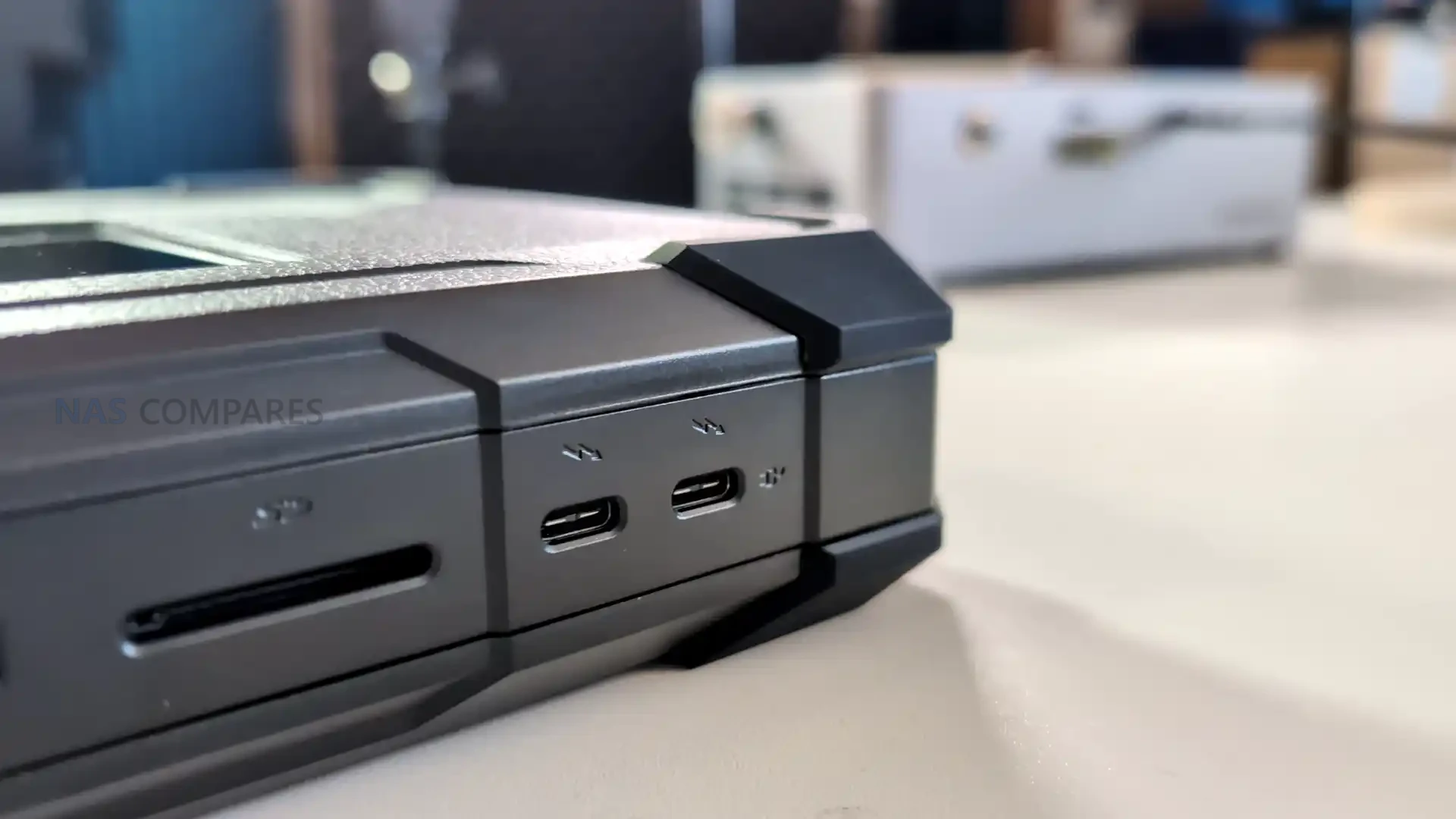 |
In addition to Thunderbolt, the UP6 includes standard USB connectivity for attaching peripherals and ingest sources, with the spec listing 1x USB 3.2 Gen2 plus USB-C alongside the Thunderbolt ports. UnifyDrive’s workflow emphasis here is card and device ingestion, where the system detects inserted media and can trigger a guided backup process. The unit also includes HDMI 2.1 output rated for 4K at 60Hz, which is mainly relevant if the UP6 is being used as a stationary box where an external display is preferred over the built-in screen for navigation or review.
 |
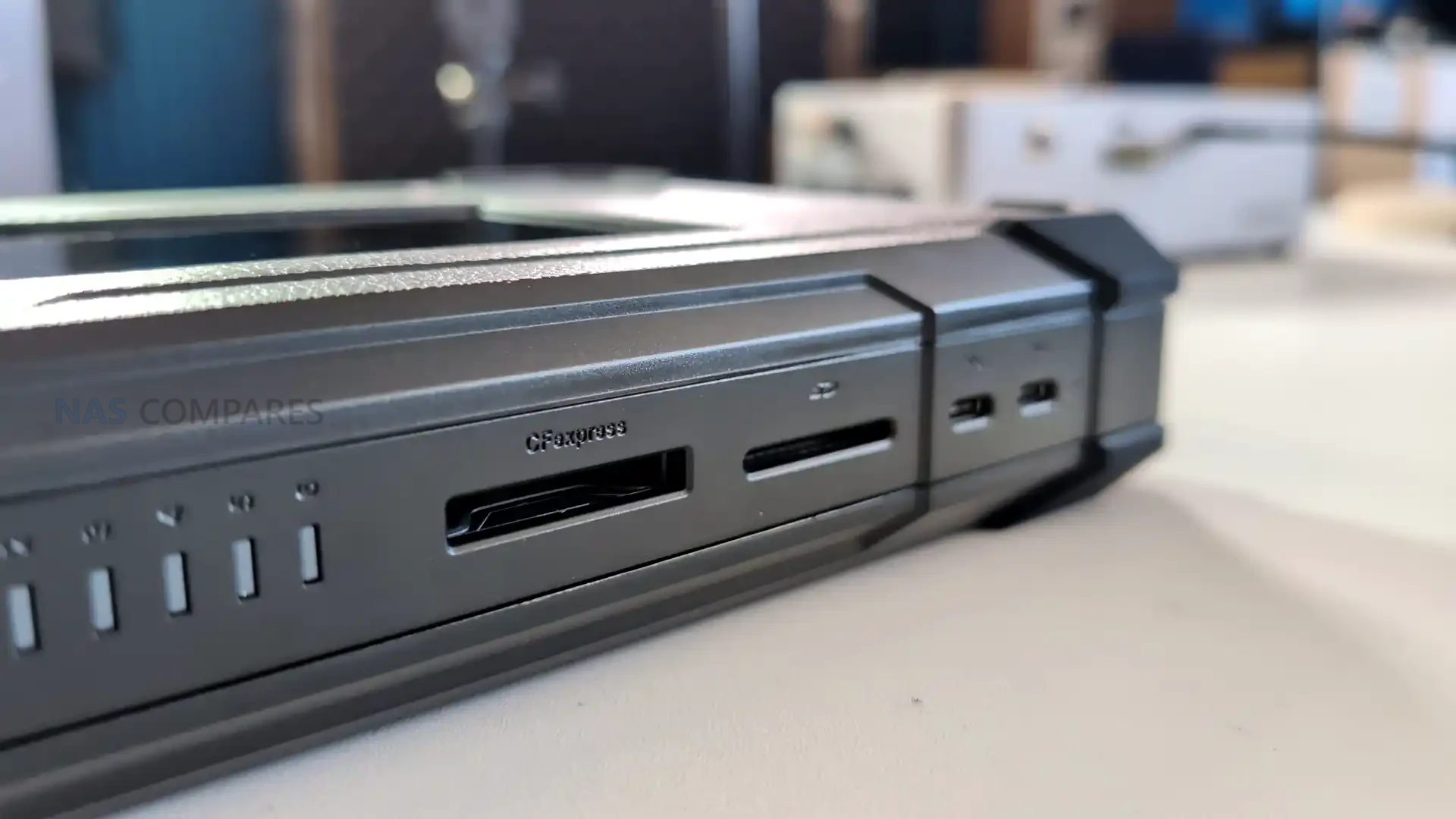 |
For removable media, the UP6 includes an SD slot with UHS-II support and a CFexpress slot that supports Type B, with Type A possible via an adapter. These slots are central to the device’s positioning for on-location photographers and video creators, since they enable direct backup without a laptop as an intermediate step. The spec sheet also lists maximum rates for the card interfaces, including 312 MB/s for SD or TF and up to 10Gb/s for CFexpress, though real-world results depend on the cards used and the backup settings configured.
 |
 |
Wireless support includes dual-antenna Wi-Fi 6 and Bluetooth 5.2, and the unit can either join an existing network or create its own local access point for nearby devices. That AP mode is intended for situations where there is no reliable external Wi-Fi, allowing multiple users to connect locally for transfer and collaboration. Power delivery is also flexible: the unit ships with an external PSU for charging and sustained operation, but it can also be powered and charged over USB-C, which makes it possible to run it directly alongside a Thunderbolt laptop setup while keeping the internal battery topped up.
 |
 |
UnifyDrive UP6 Review – Software and Services
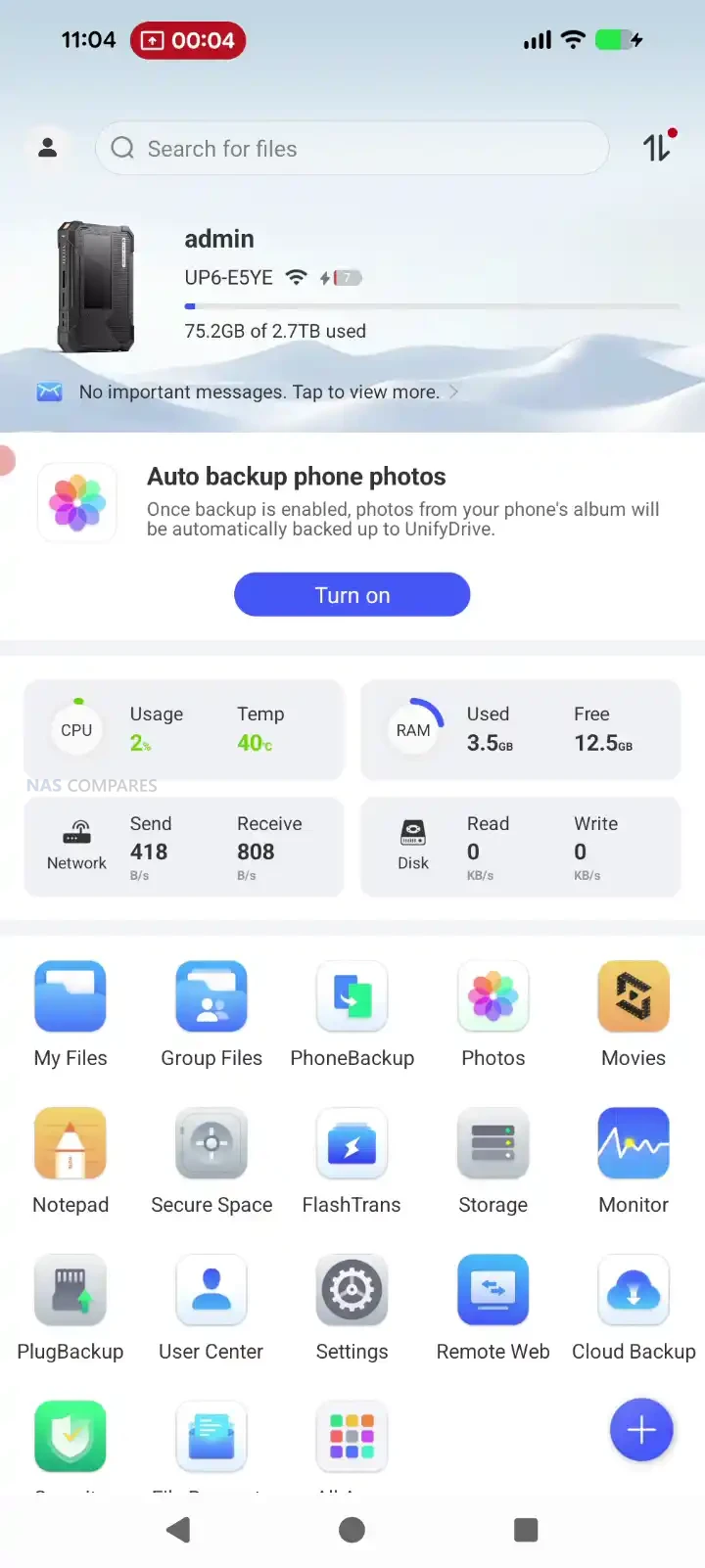
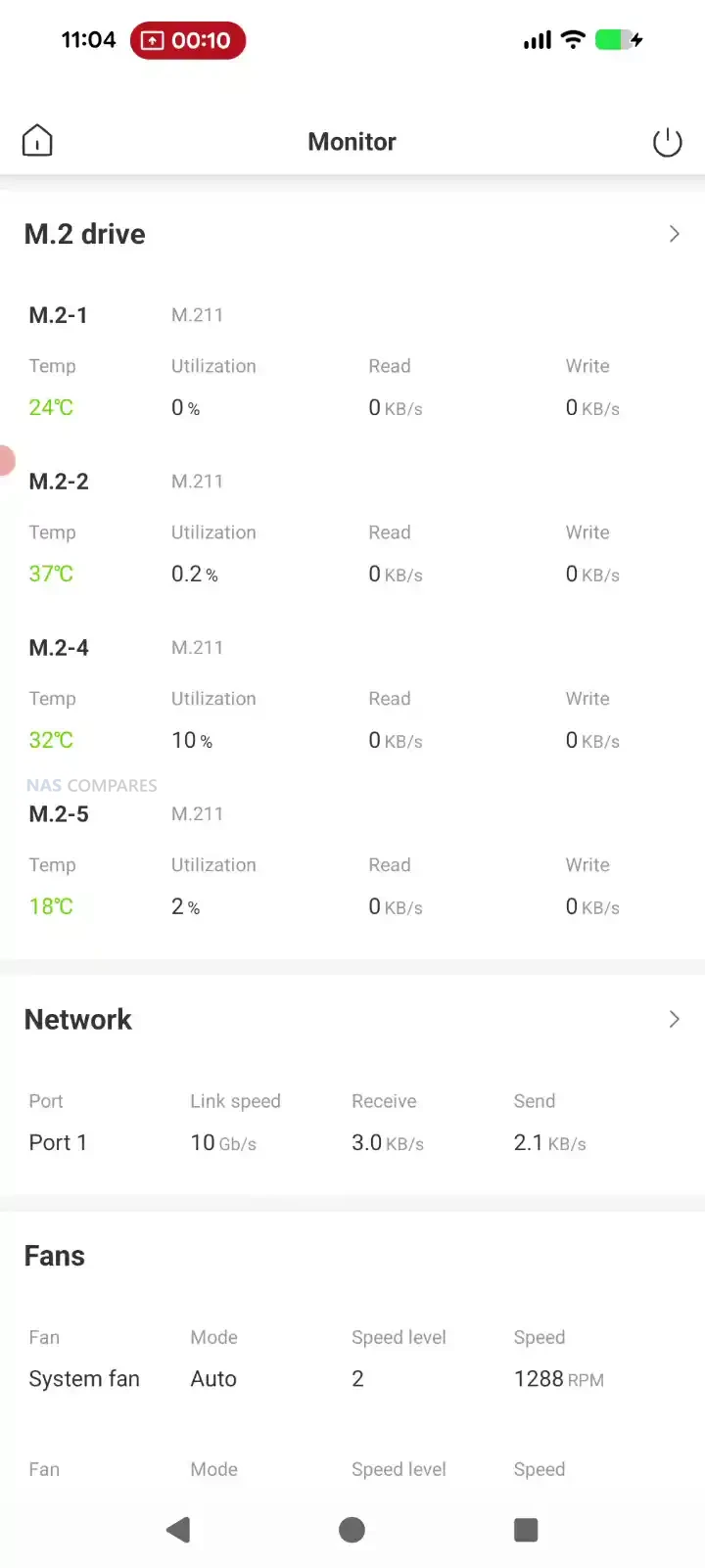
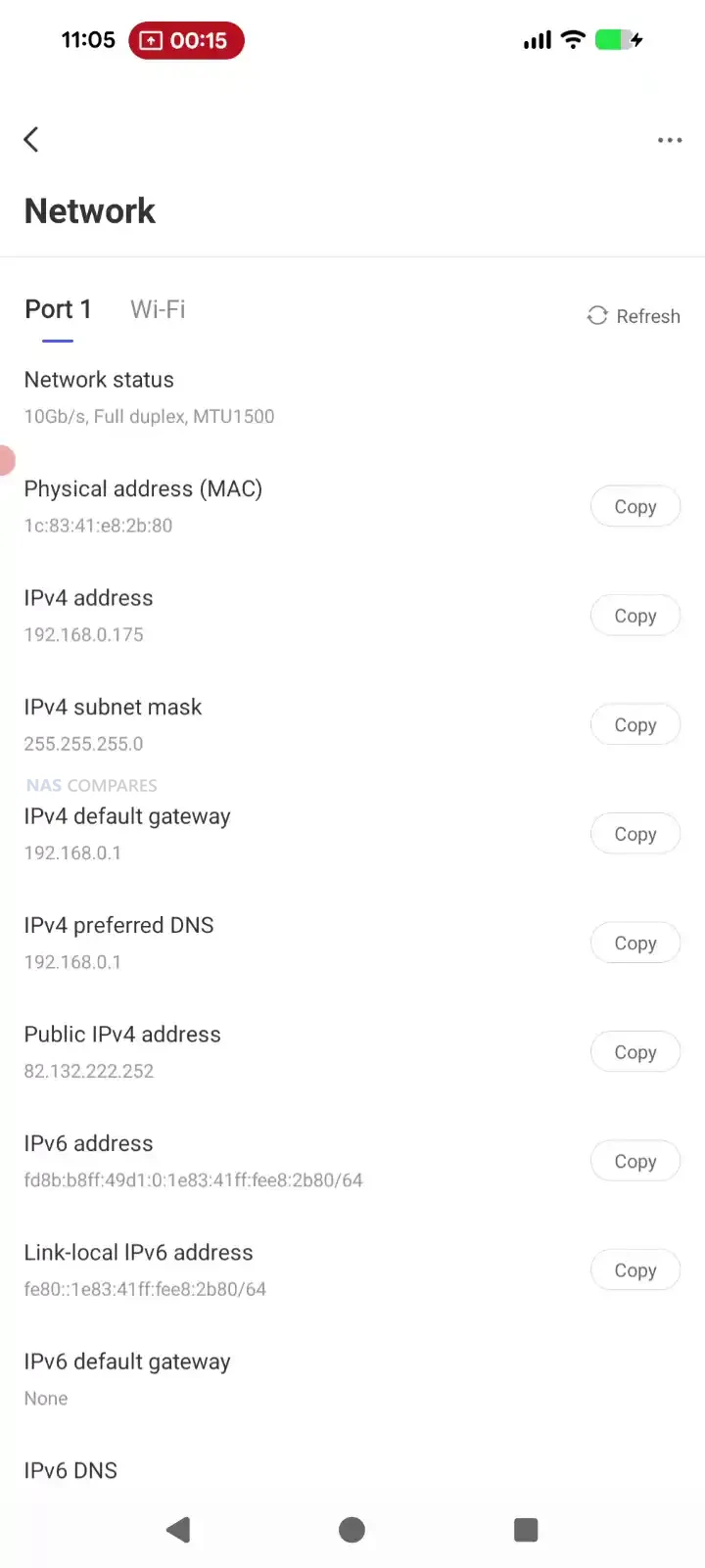
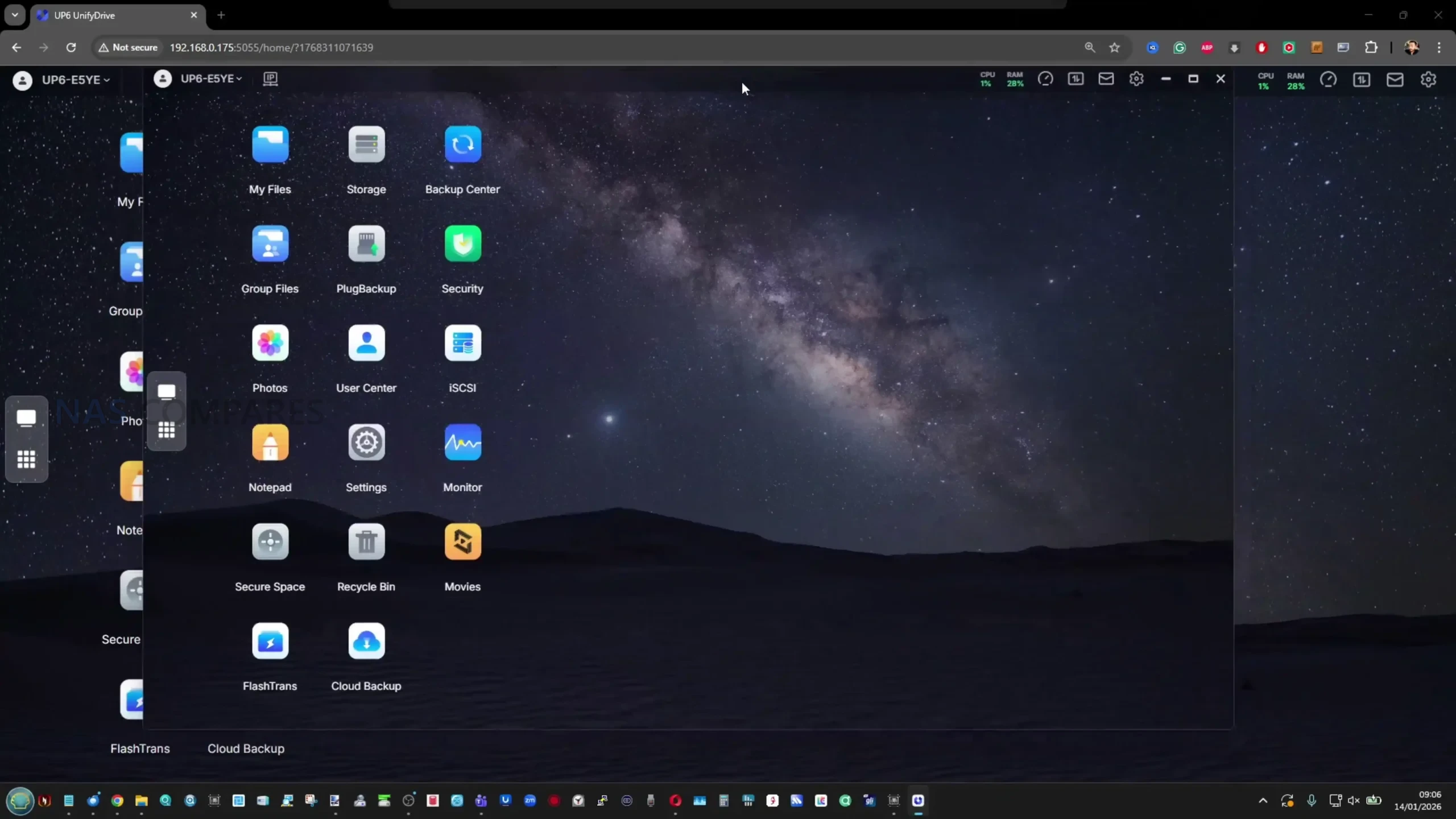
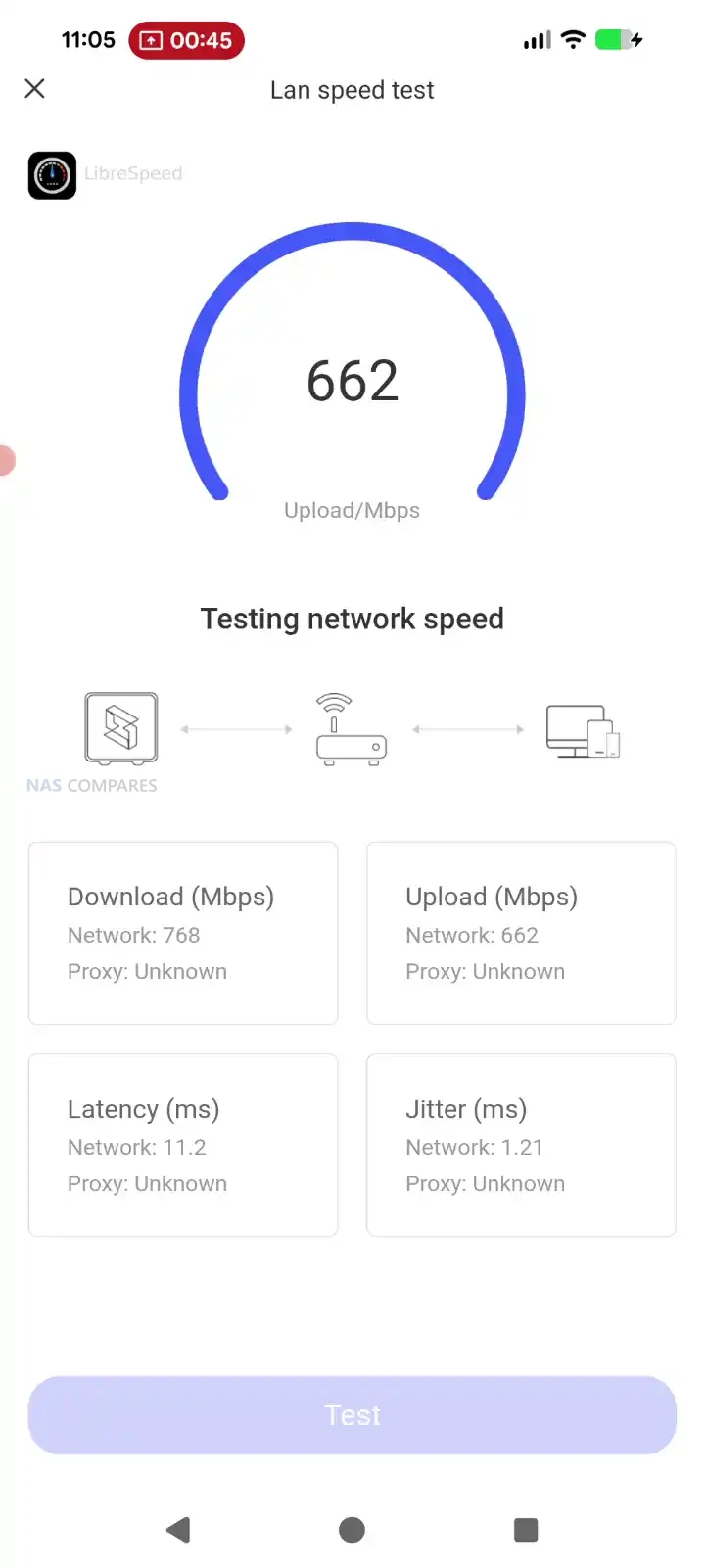
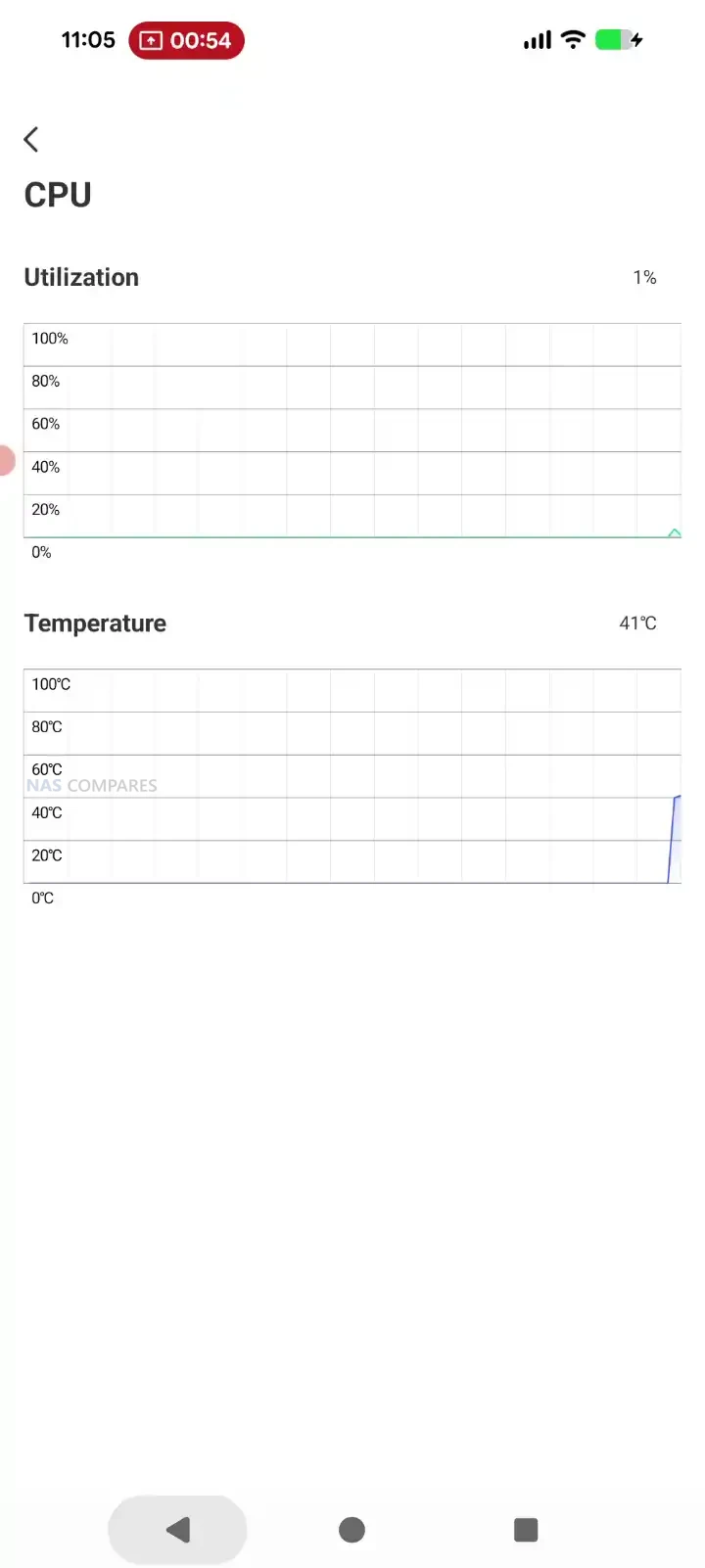
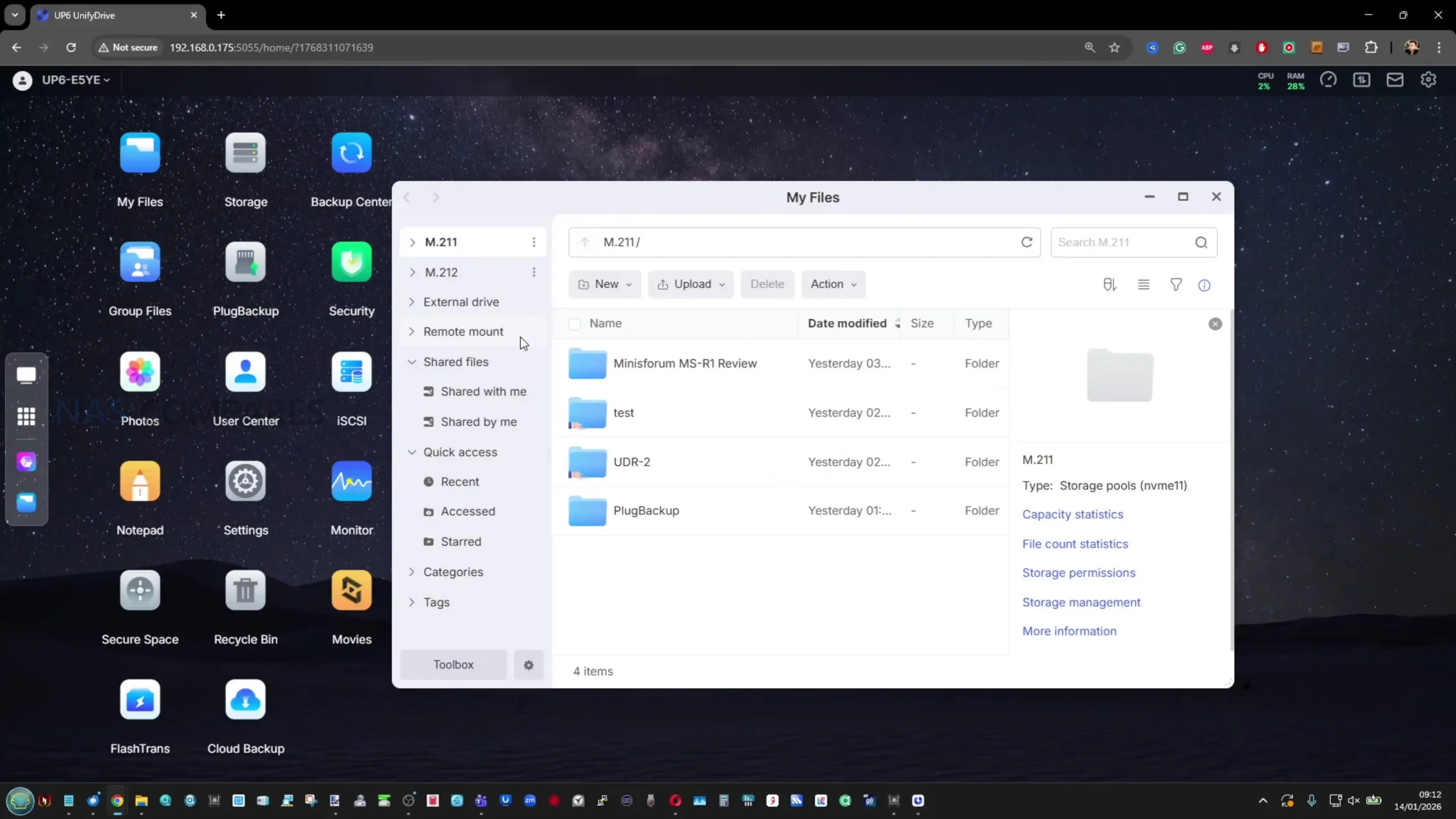
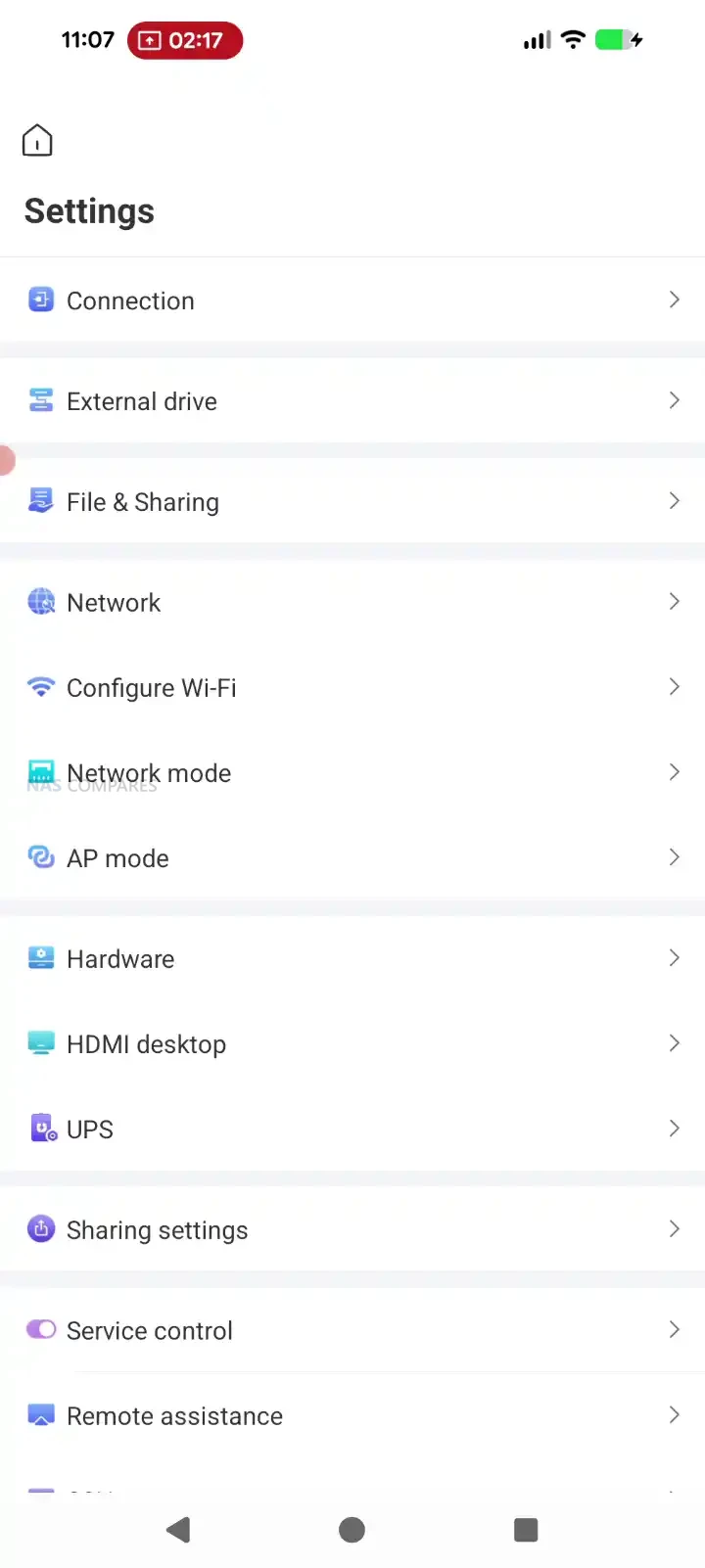
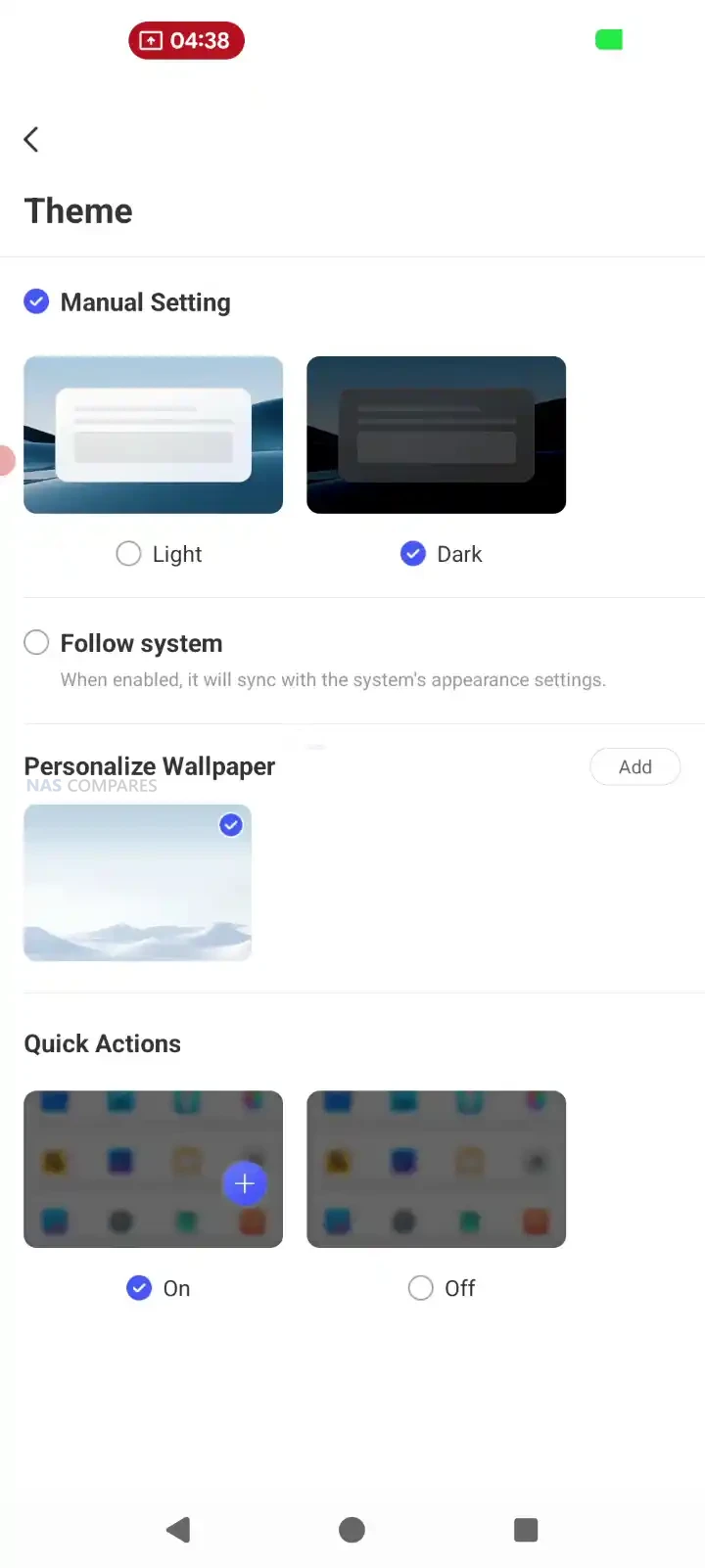
The UP6 runs UnifyDrive’s NAS operating system from internal storage and can be managed through a browser-based interface, a desktop client, and a mobile app. Day-to-day administration is generally handled through the web UI, with a familiar layout of system settings, storage tools, user permissions, and installed applications. The desktop client mirrors much of that structure and is used for some tasks that benefit from local responsiveness, while the mobile app provides a pared-back version of the same environment for monitoring, file access, and basic management when away from a computer.
 |
 |
 |
 |
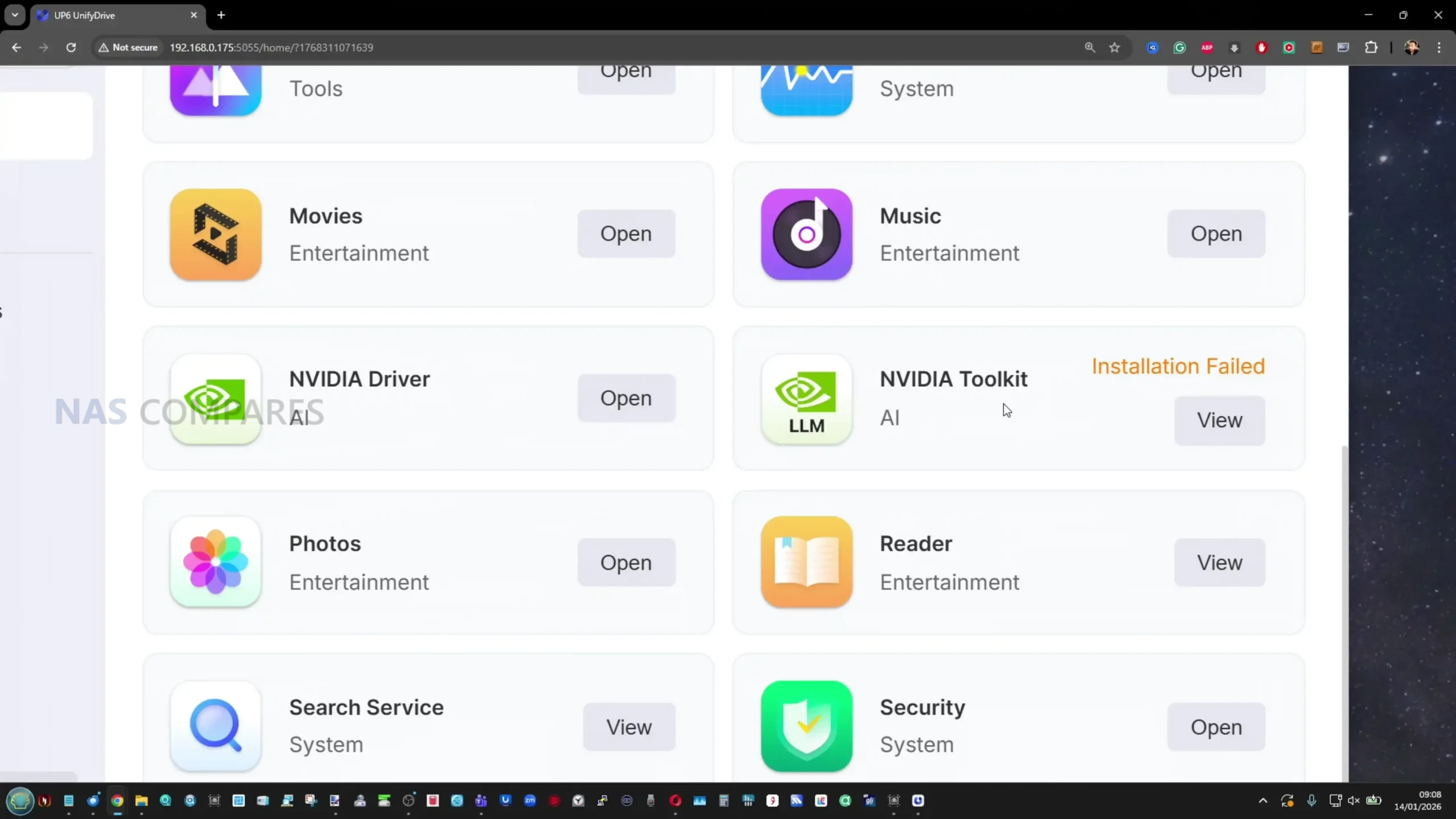 |
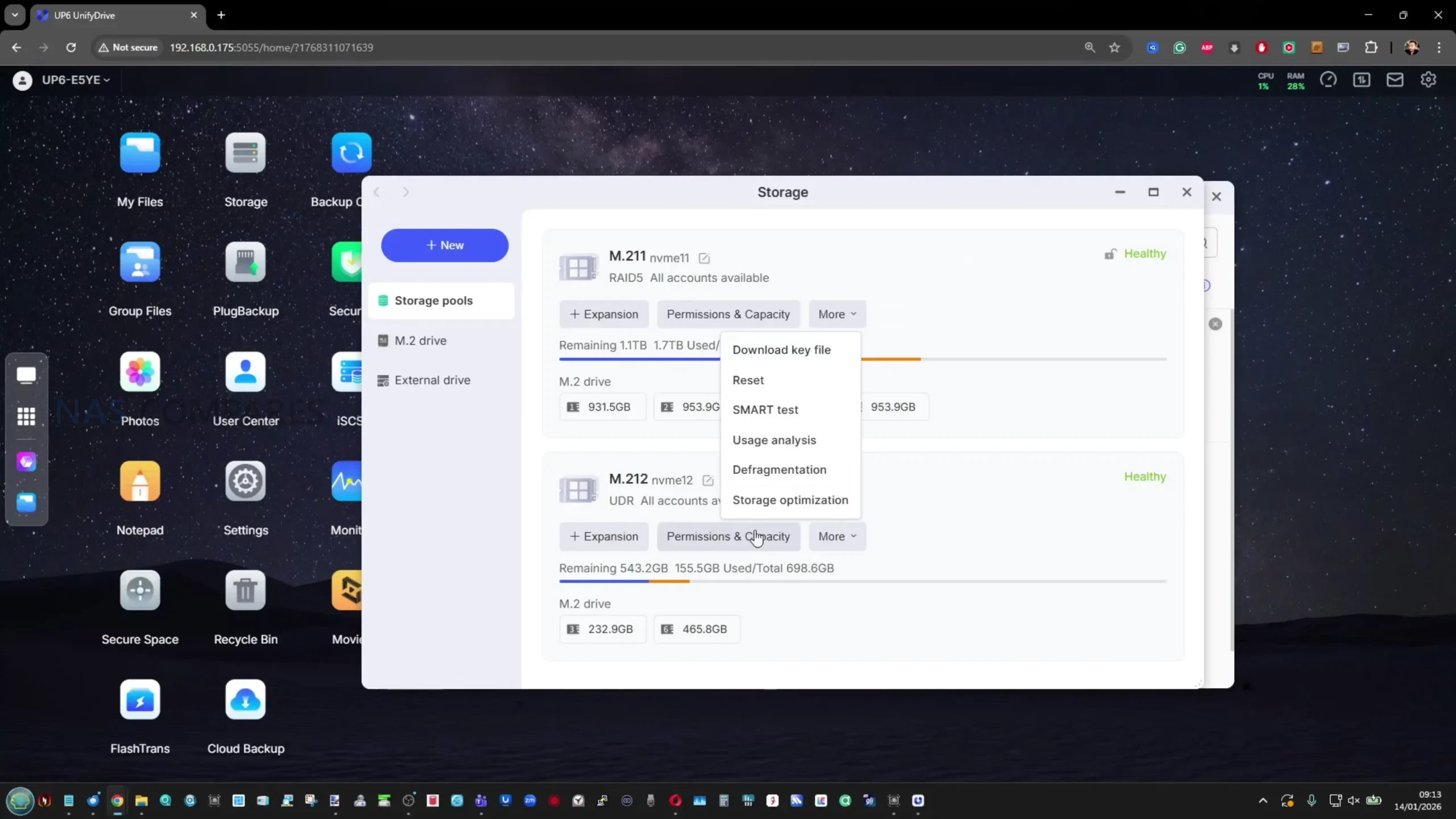
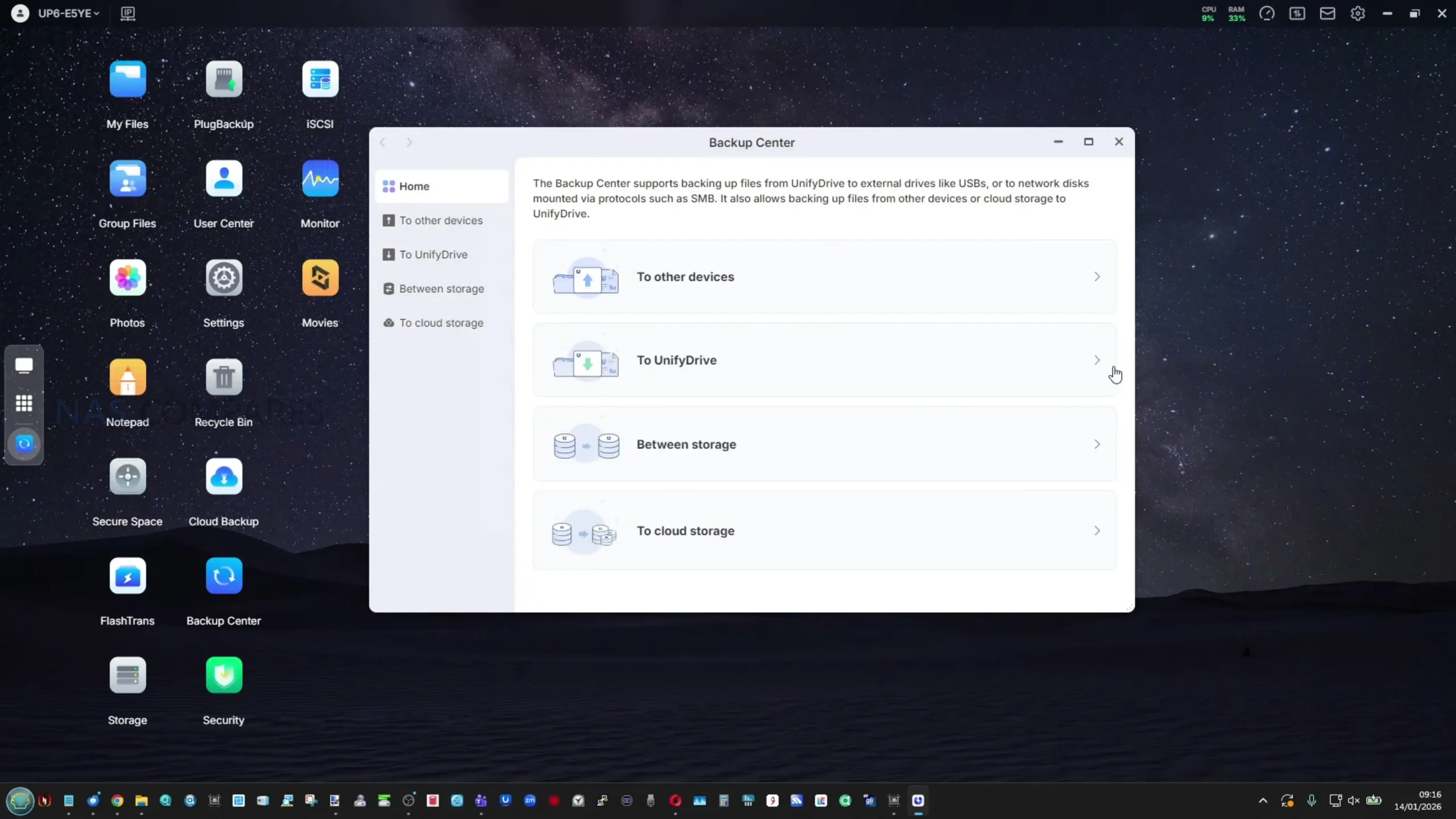
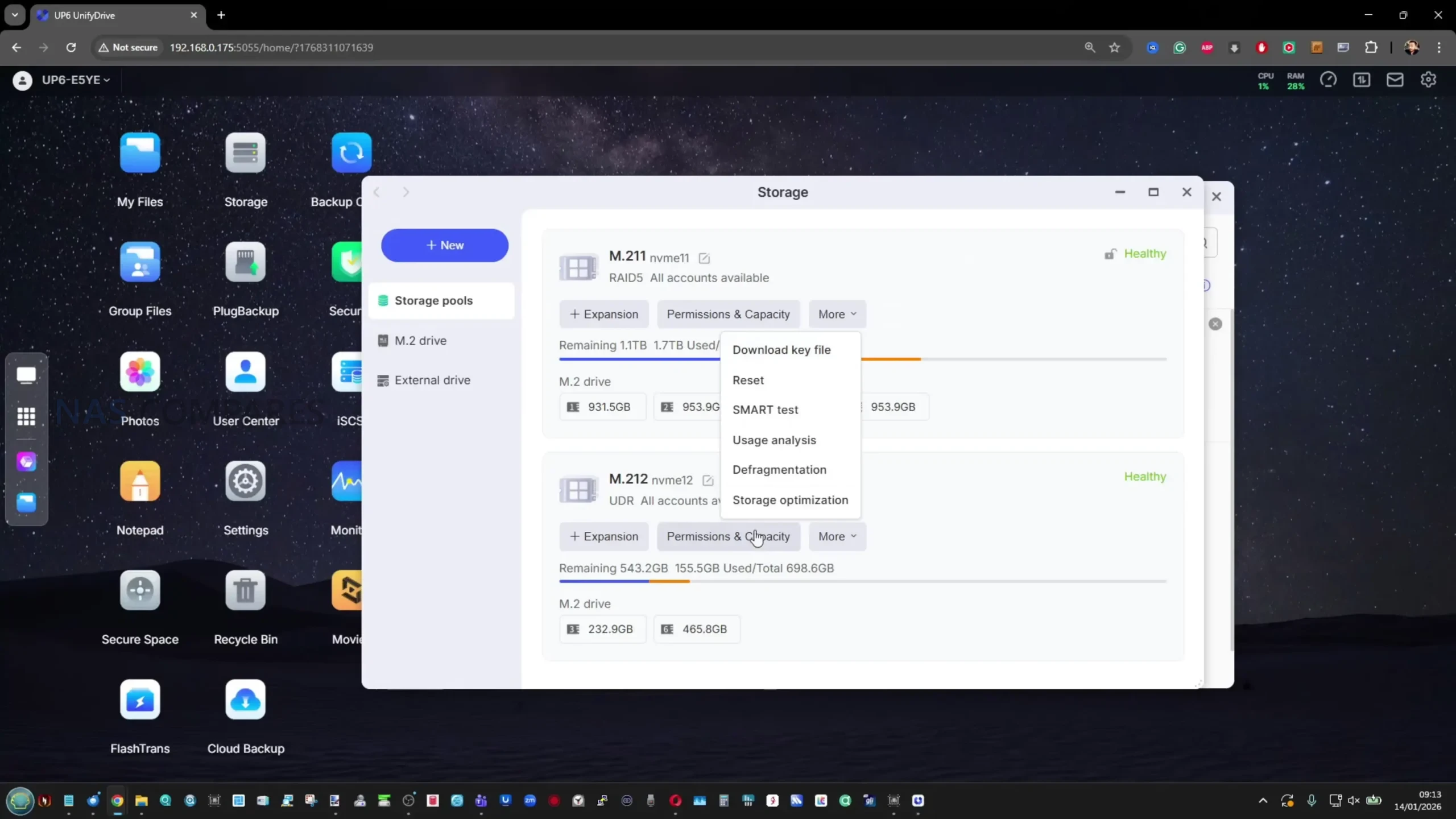
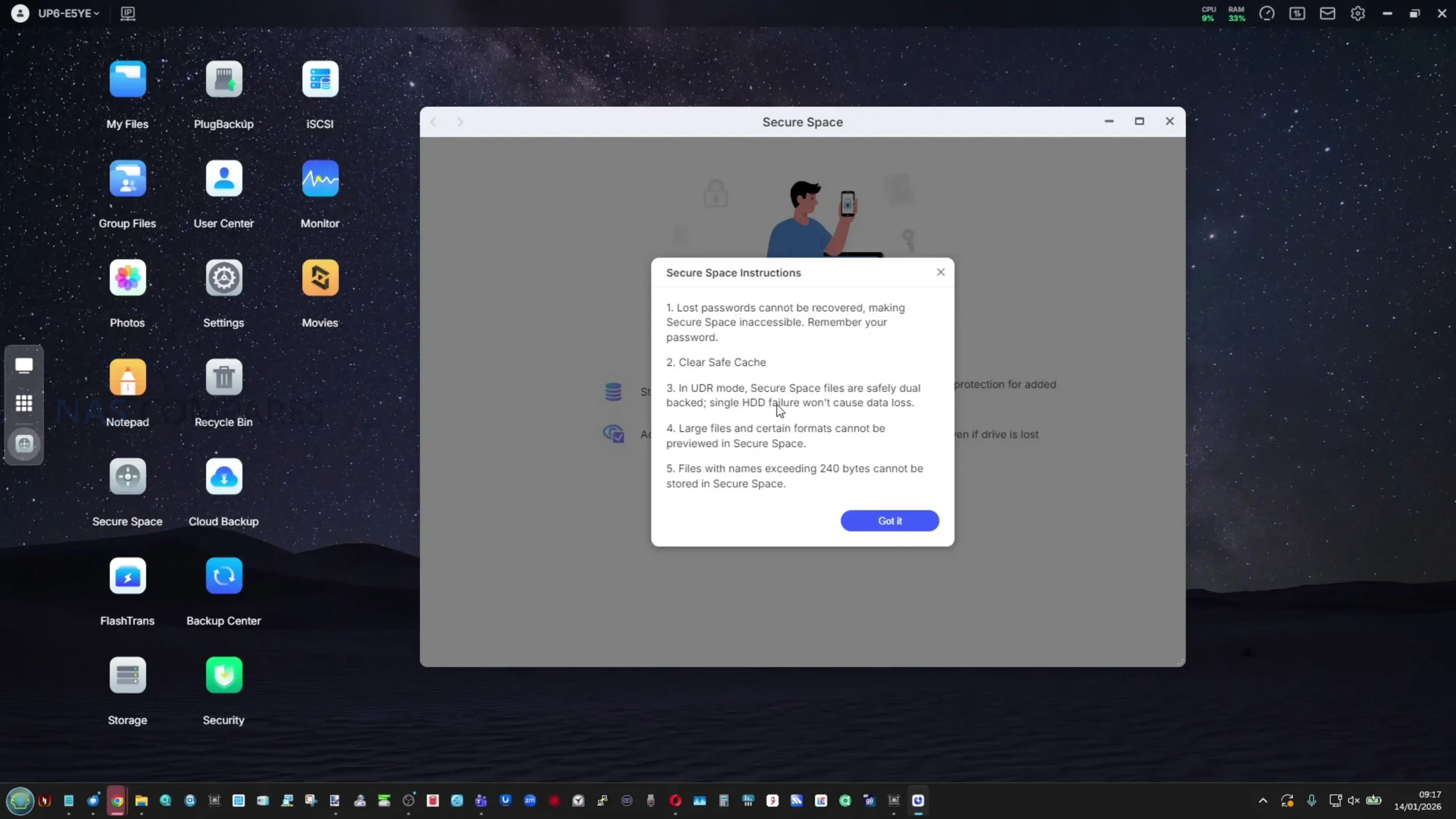
The application ecosystem is broad by current turnkey NAS standards, with an app center that includes common functions such as snapshots, multi-device backup jobs, synchronization tasks, and cloud integration. File and folder management is presented in a way that targets non-technical users, with share creation, permission adjustment, and storage expansion tools surfaced without requiring command line work. There is also support for encrypted storage through a dedicated secure space feature, which adds an extra password gate for a defined portion of capacity rather than encrypting the entire system volume by default.
 |
 |
 |
 |
 |
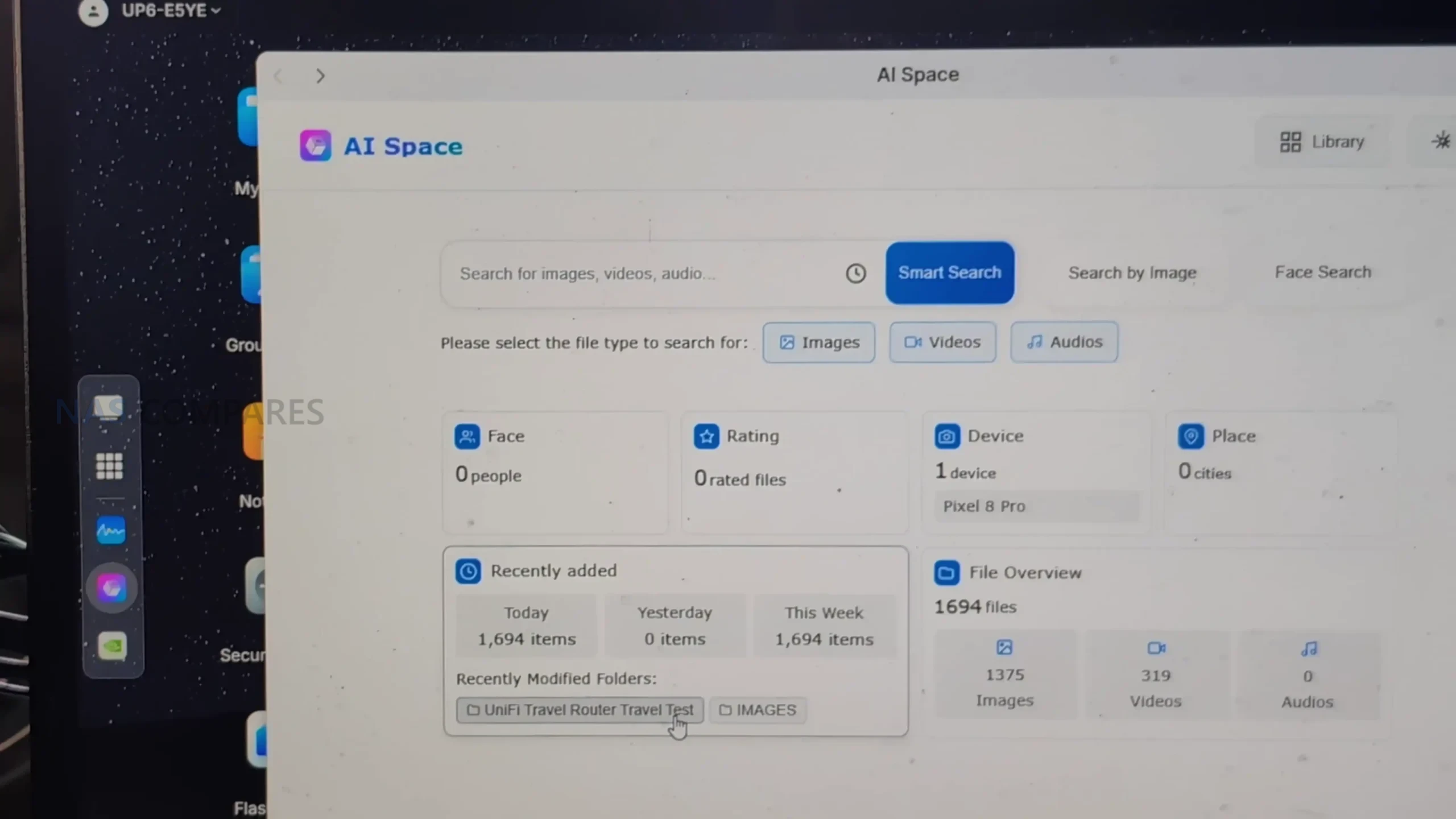
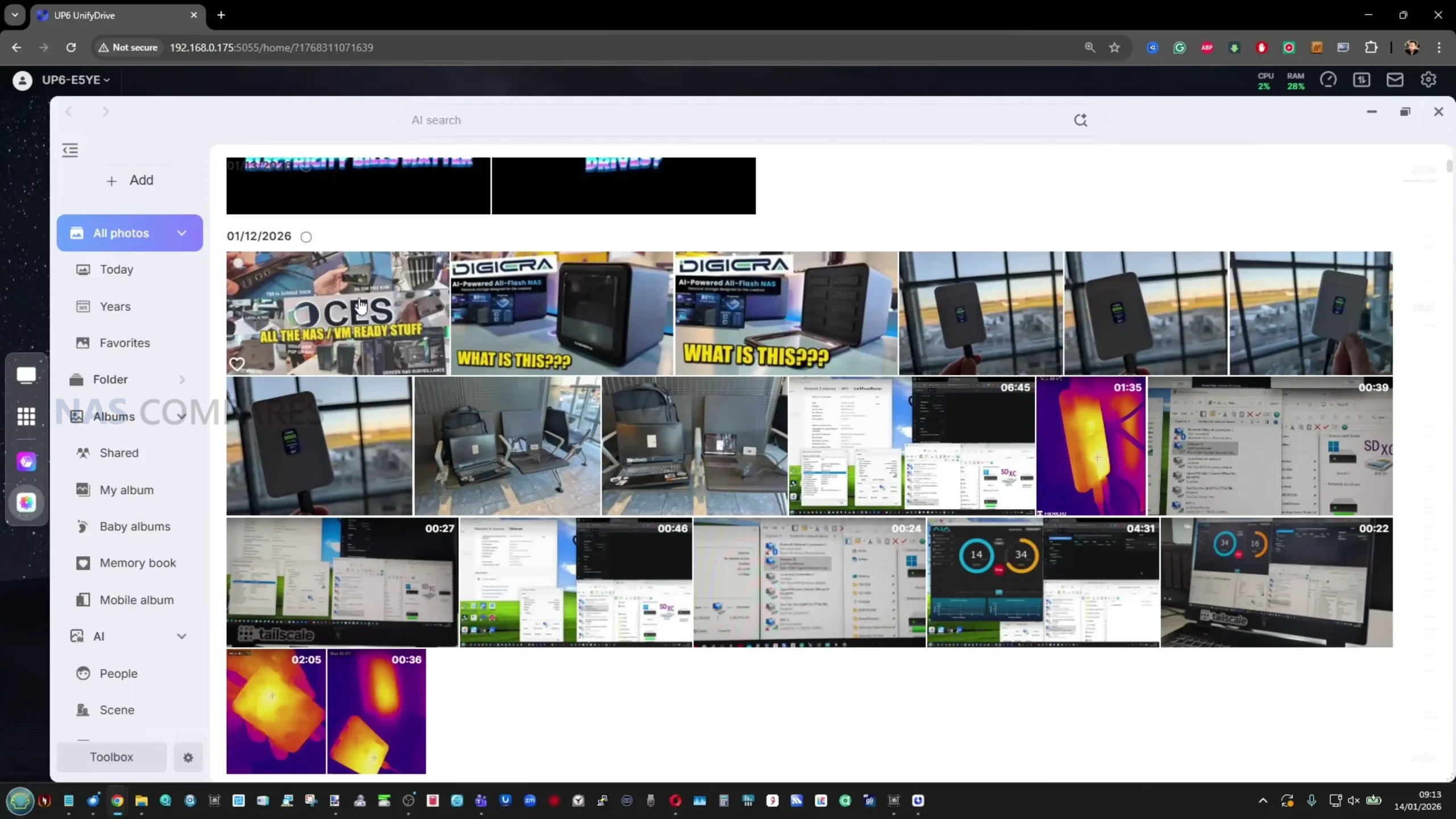
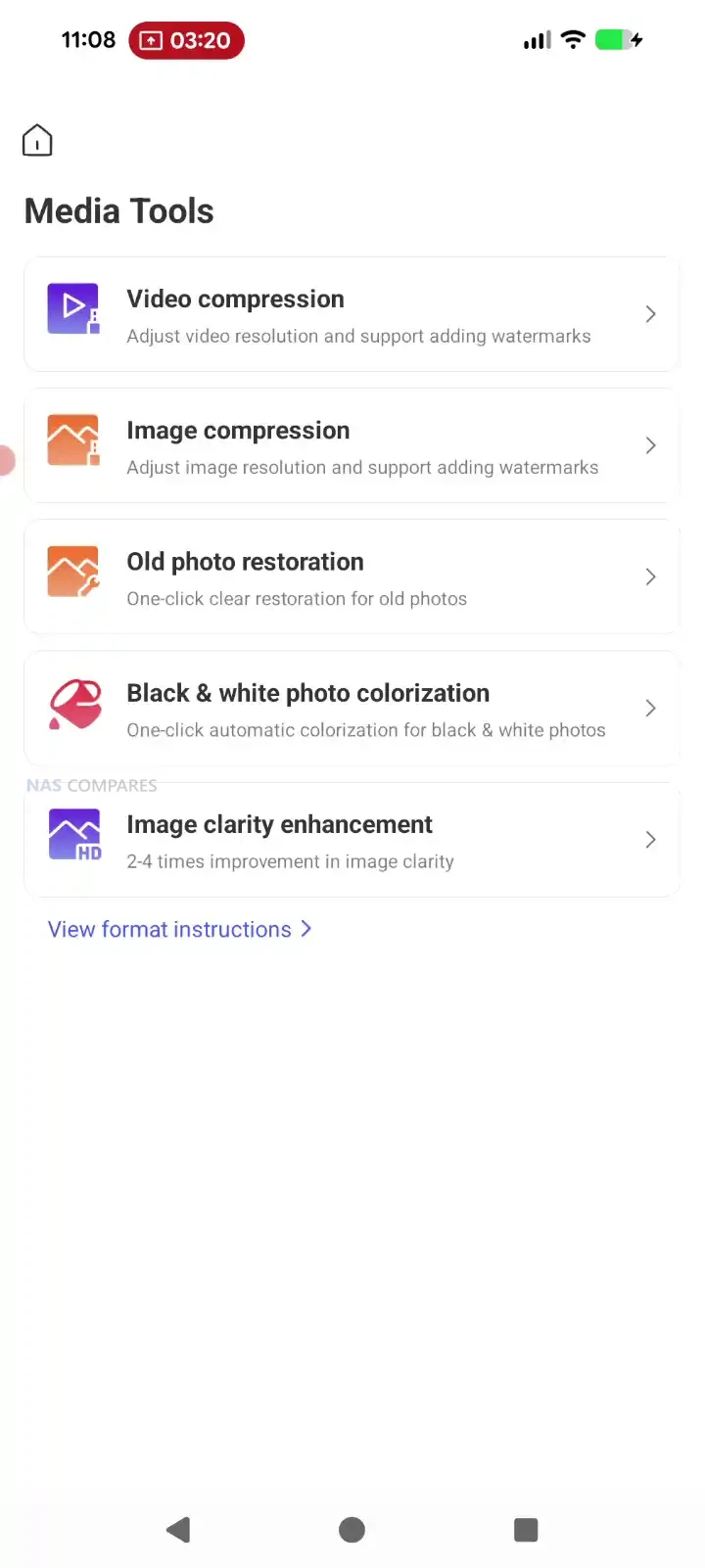
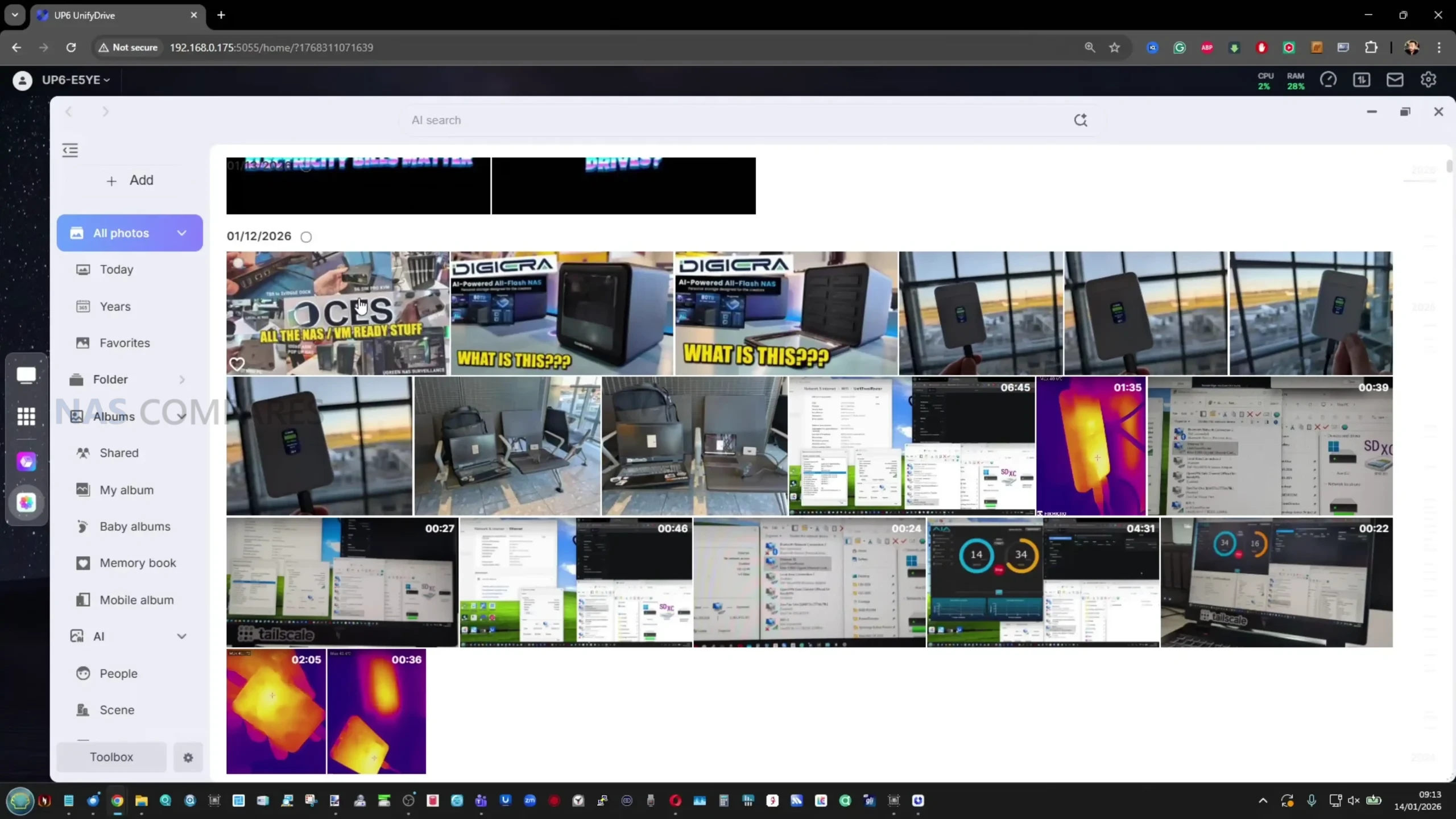
For creators, the media stack is a central part of the platform rather than an add-on. Photo management includes AI-driven categorization features that can analyze imported libraries and sort content by faces, scenes, and other detected elements, with the processing intended to run locally on the device rather than sending media to remote AI services. The media interface also supports playback and preview, along with metadata inspection, which fits the intended workflow of checking files after ingest and before moving on to the next job.
 |
 |
 |
 |
 |
Beyond media, the UP6 includes more advanced services than many mobile-focused units. Docker is available, and virtualization support exists through a dedicated VM application, though management depth varies by client. For example, the mobile app can monitor existing containers and VMs, but it does not provide the same creation and configuration controls available through the desktop or browser tools. iSCSI is also present for users who want block-level storage presentation to a workstation or server, which positions the UP6 as more than a simple file share target.
 |
 |
 |
 |
 |
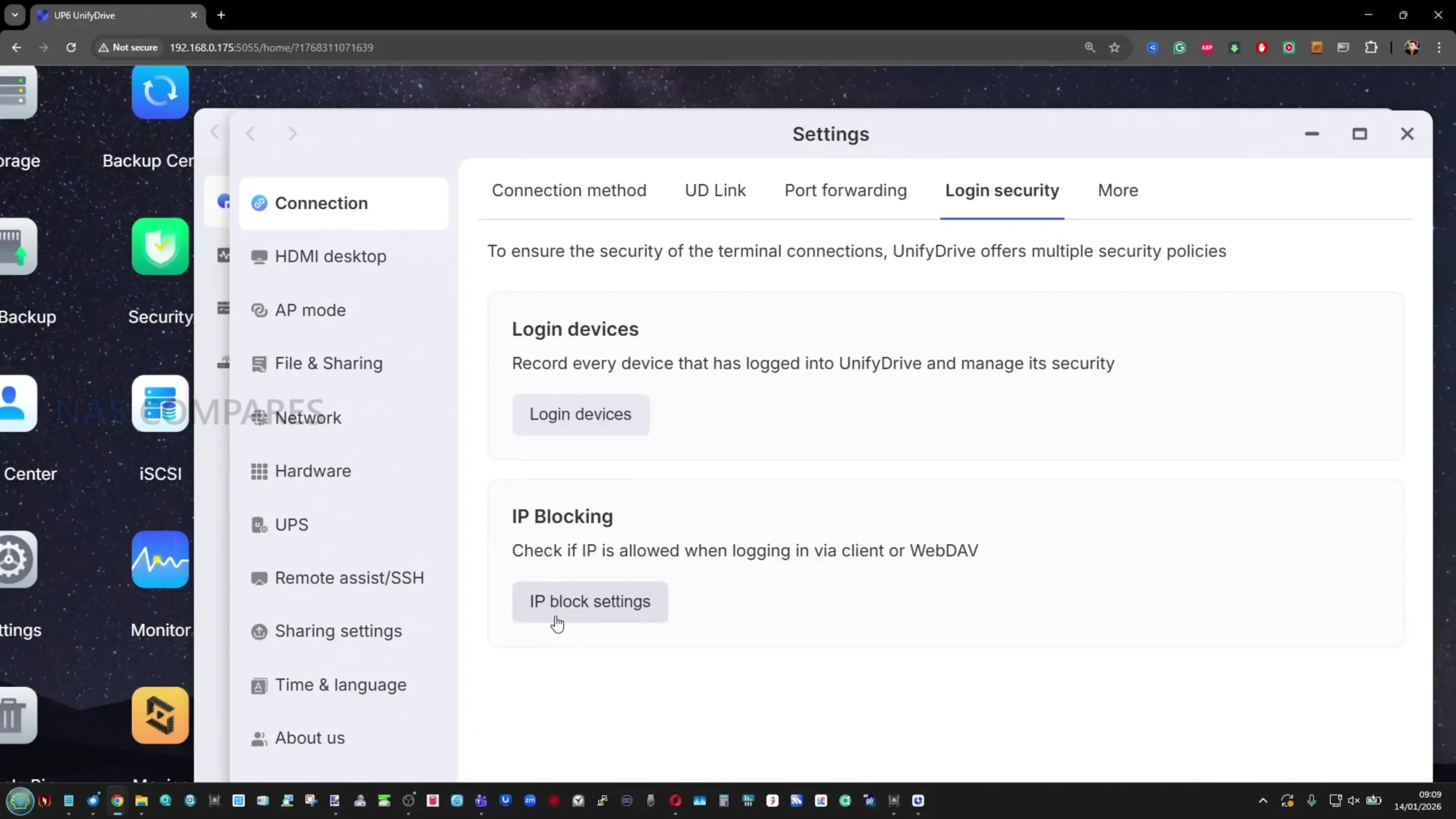
Security features are mixed in their execution. The platform includes firewall-related options, IP blocking rules, ransomware protection settings, and audit-style logs for sign-ins and connected devices. However, local login security is limited by the absence of standard 2-factor authentication methods such as authenticator apps, and session control is less direct than it could be, with limited tools for quickly removing connected clients from within the UI. Remote assistance features are available for support access if enabled, which may be useful for diagnostics but also places importance on how tightly the device is secured and how those permissions are managed.
 |
 |
 |
 |
 |
UnifyDrive UP6 Review – Noise, Heat, Power and Speed Tests
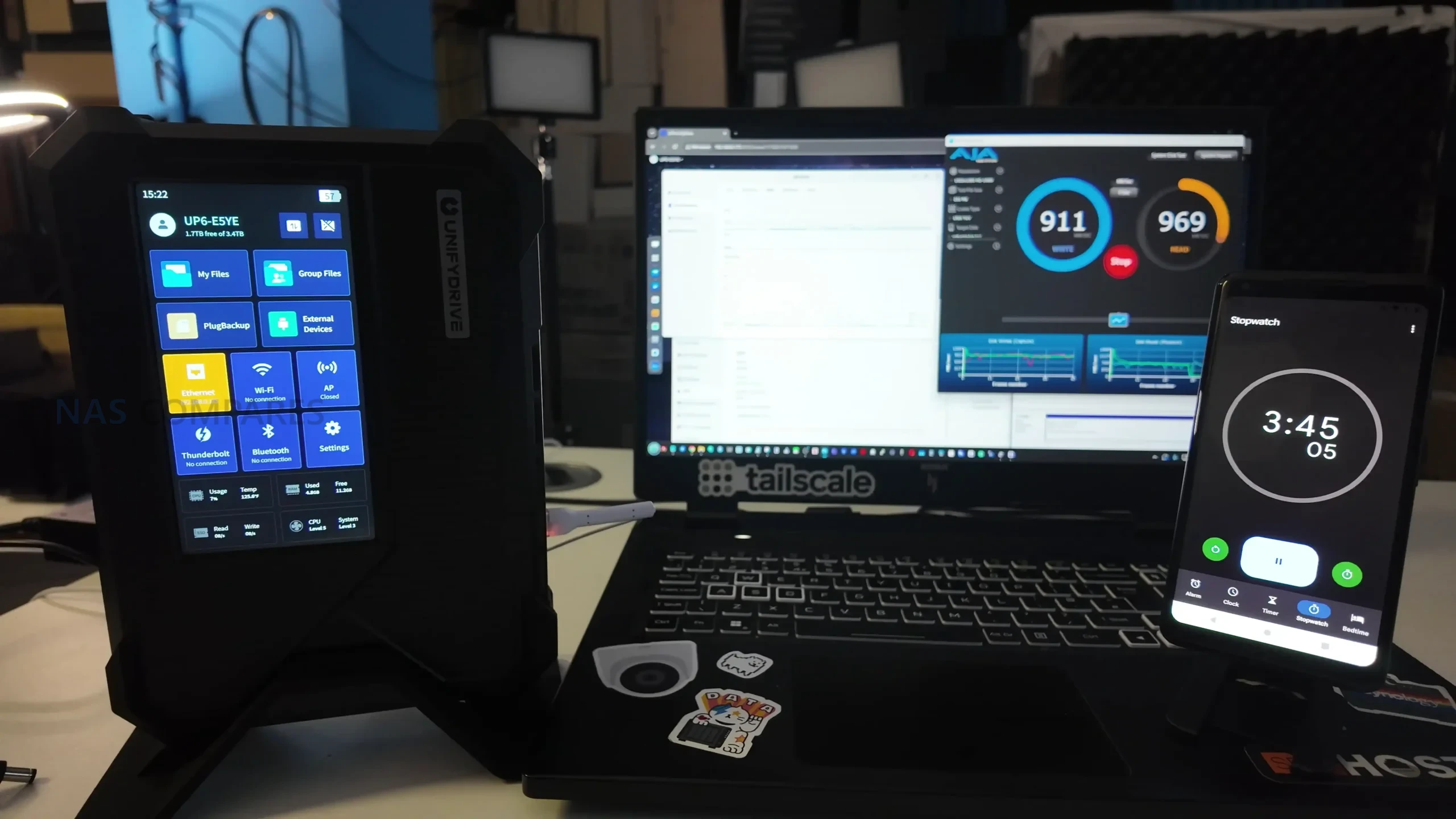
Battery behavior was evaluated under sustained network activity rather than light standby use. With the battery charged to 100%, the UP6 was connected over 10GbE to a Windows client and subjected to a continuous upload for 30 minutes, during which the battery dropped by 42%. In a separate test using repeated read and write operations, a 256MB AJA-style loop was run for 10 minutes against roughly 400GB of configured storage, and the battery consumption over that interval was 12%. These results suggest the internal battery can sustain meaningful transfer work for shorter periods, while heavier, continuous network activity reduces runtime quickly compared with lighter mixed use.
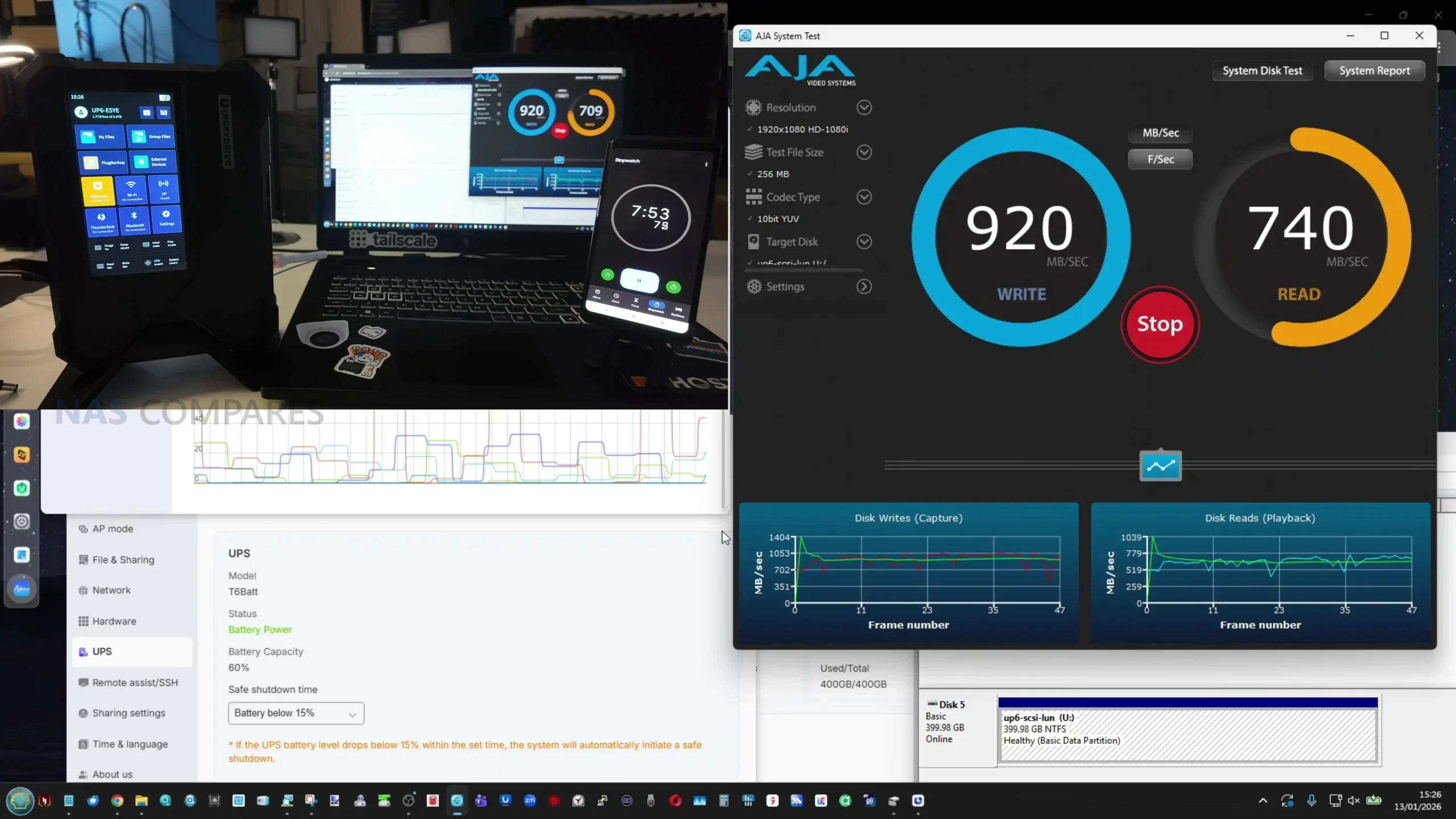
For more general usage, the device’s on-screen battery reporting provided a rough indication of lower-load runtime. During a recorded stretch of light interaction and file checks, the battery level fell slowly, and the observed rate was approximately 3 to 3.5 minutes per 1% in that specific scenario, implying several hours if the unit is mostly idle and not under sustained transfer pressure. This aligns with the device operating more like a small PC when pushed, and more like a low-intensity appliance when it is primarily waiting, indexing, or serving occasional file requests. The battery also functions as a UPS, with settings available to trigger safe shutdown at a defined remaining percentage and optional timers intended to prevent the unit continuing to run unattended in a bag.
Noise levels were measured with the device accessing SSD storage and using different fan behaviors. In automatic fan mode under active SSD access, the measured sound level was around 37 to 38 dBA. With the fan set to its highest level during similar activity, the noise level increased to around 46 to 47 dBA. The practical takeaway is that the UP6 does not remain silent under load, but it also does not default to maximum fan speed unless instructed or unless conditions demand it. Direct manual fan control is not consistently exposed on the touchscreen interface, but fan mode changes and broader hardware settings are available through the software environment.
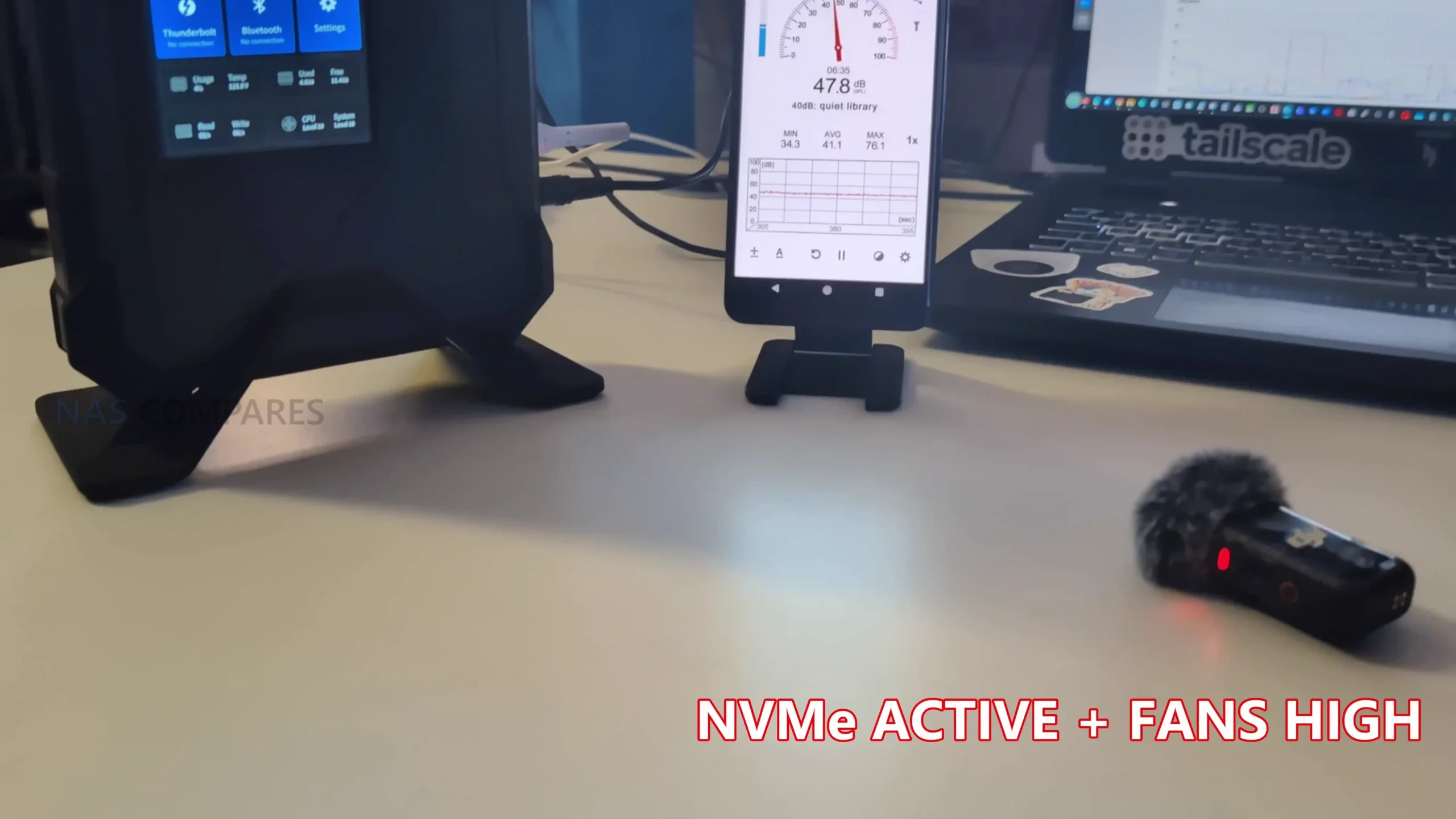 |
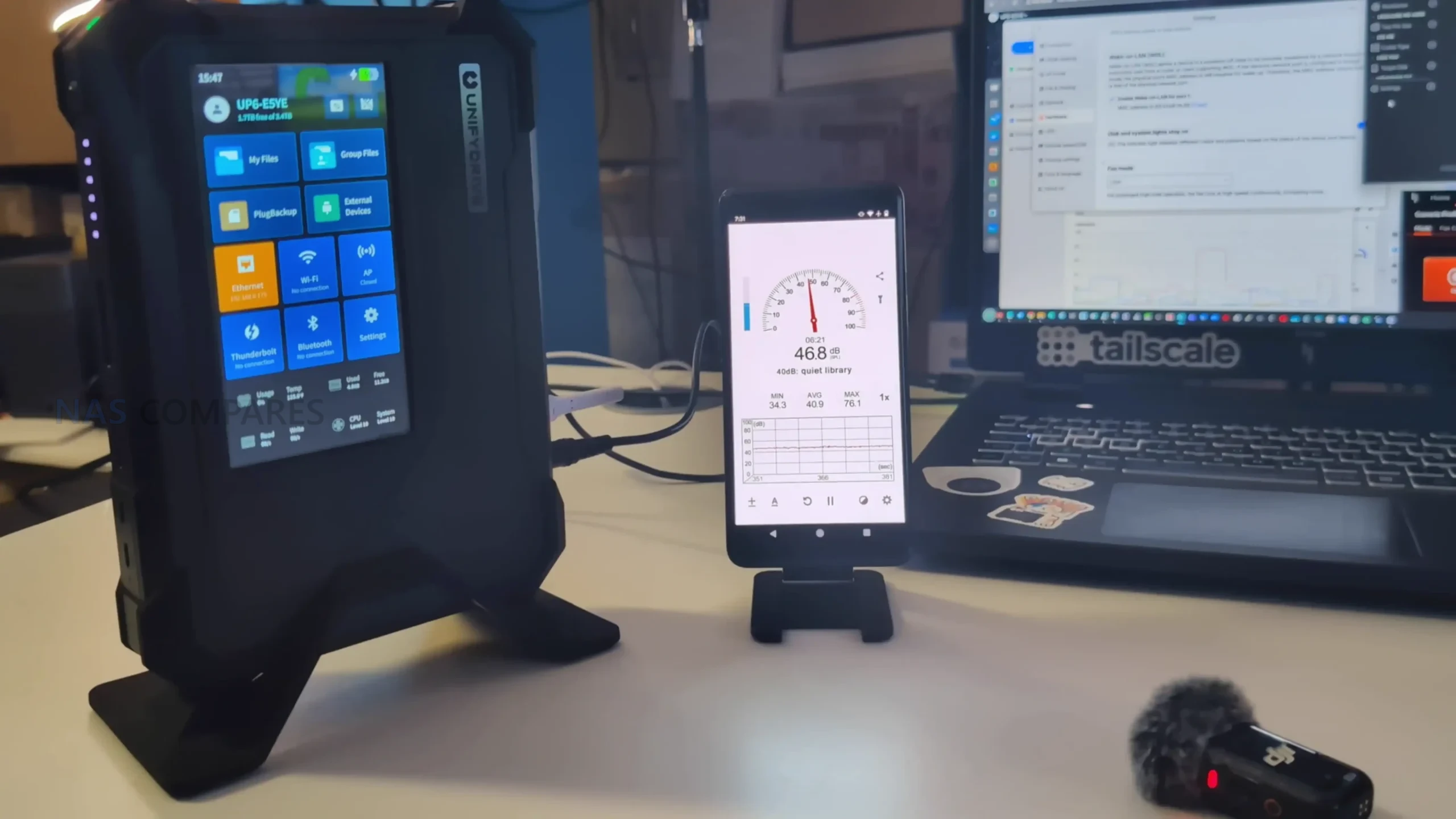 |
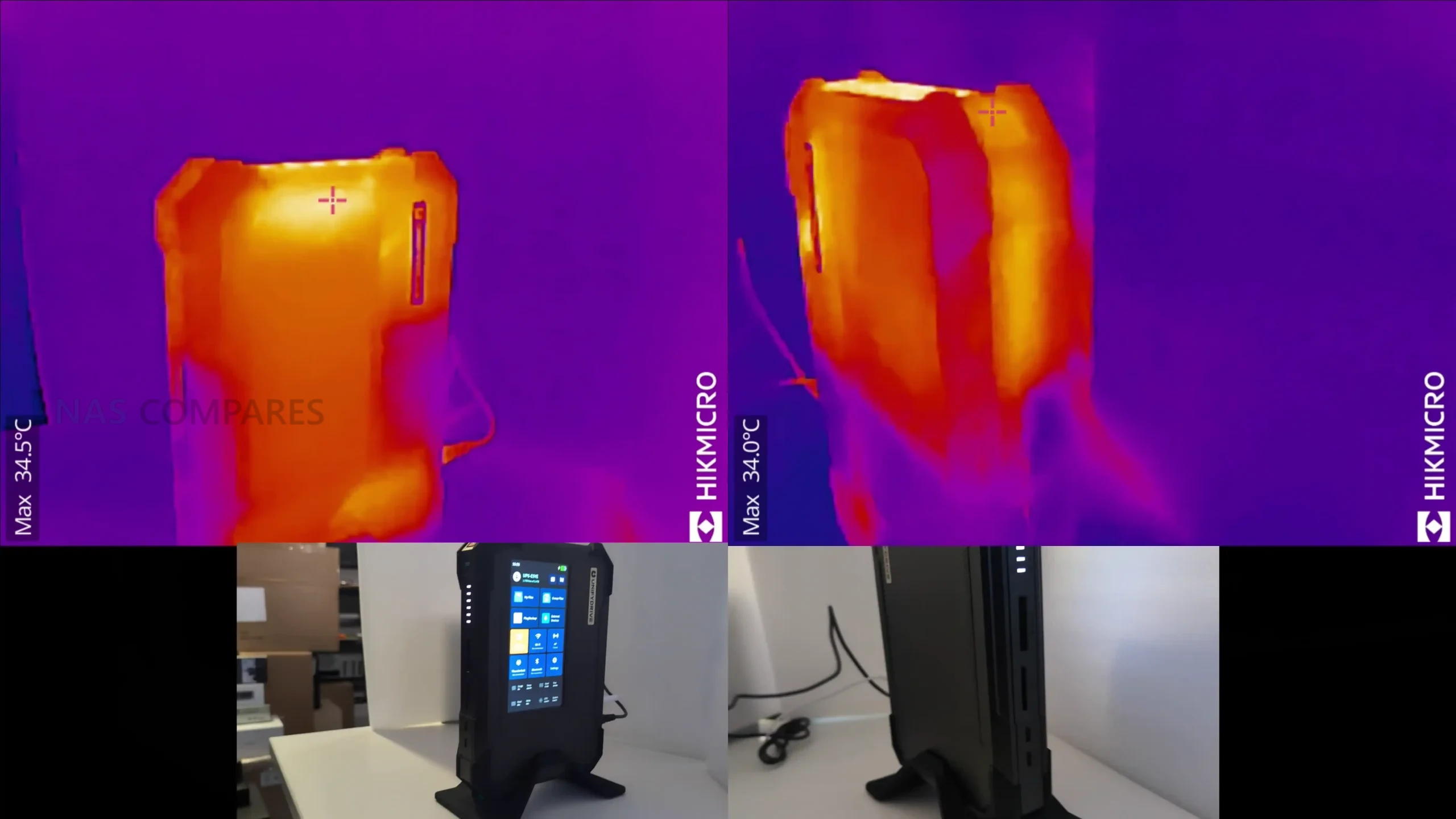
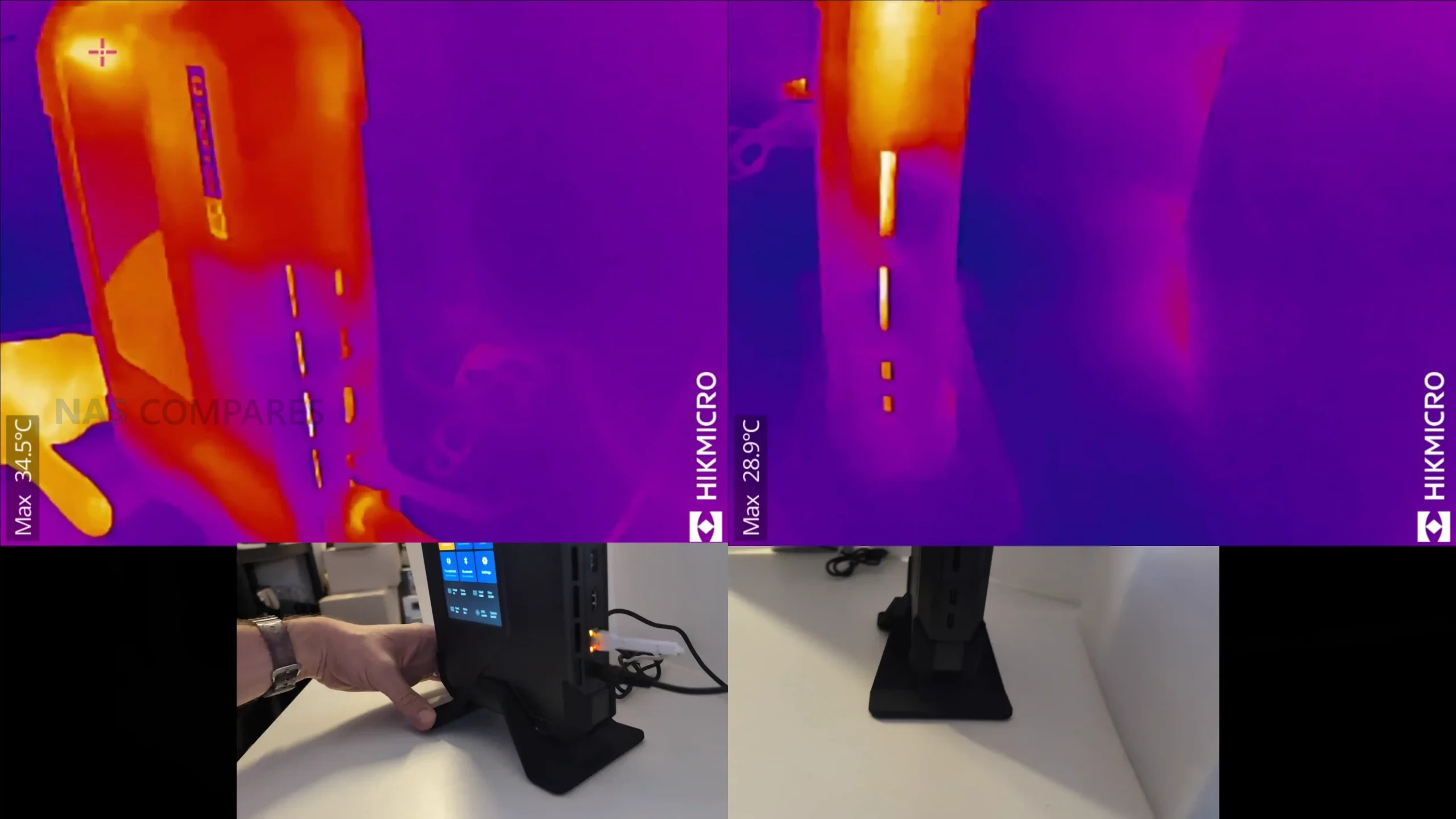
Thermal behavior was tracked both during heavier access and after extended powered operation. The NAS software reported SSD temperatures that generally stayed below the mid-60s Celsius, with a brief peak in the 55 to 60C range during heavier testing. After roughly 13 days of being left on and used daily in shorter sessions, external surface readings stayed in a mid-30s Celsius range across much of the casing, while the vented airflow path showed higher readings, roughly from the high-30s into the mid-40s Celsius depending on location. The device did not ship with SSD heat sinks, so third-party heat sinks were installed for testing, and that choice is likely to influence results, particularly with higher power PCIe 4.0 SSDs.
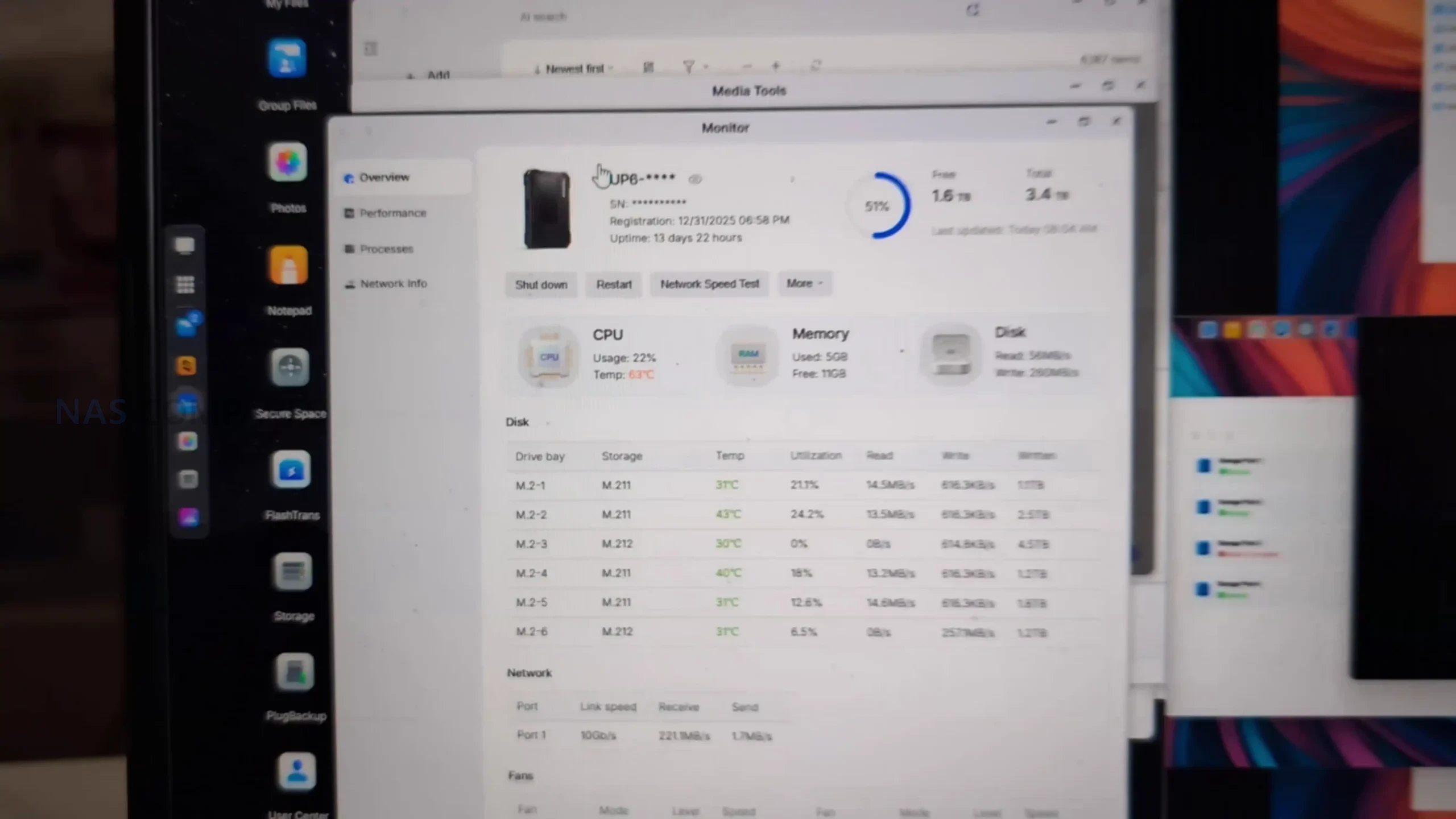 |
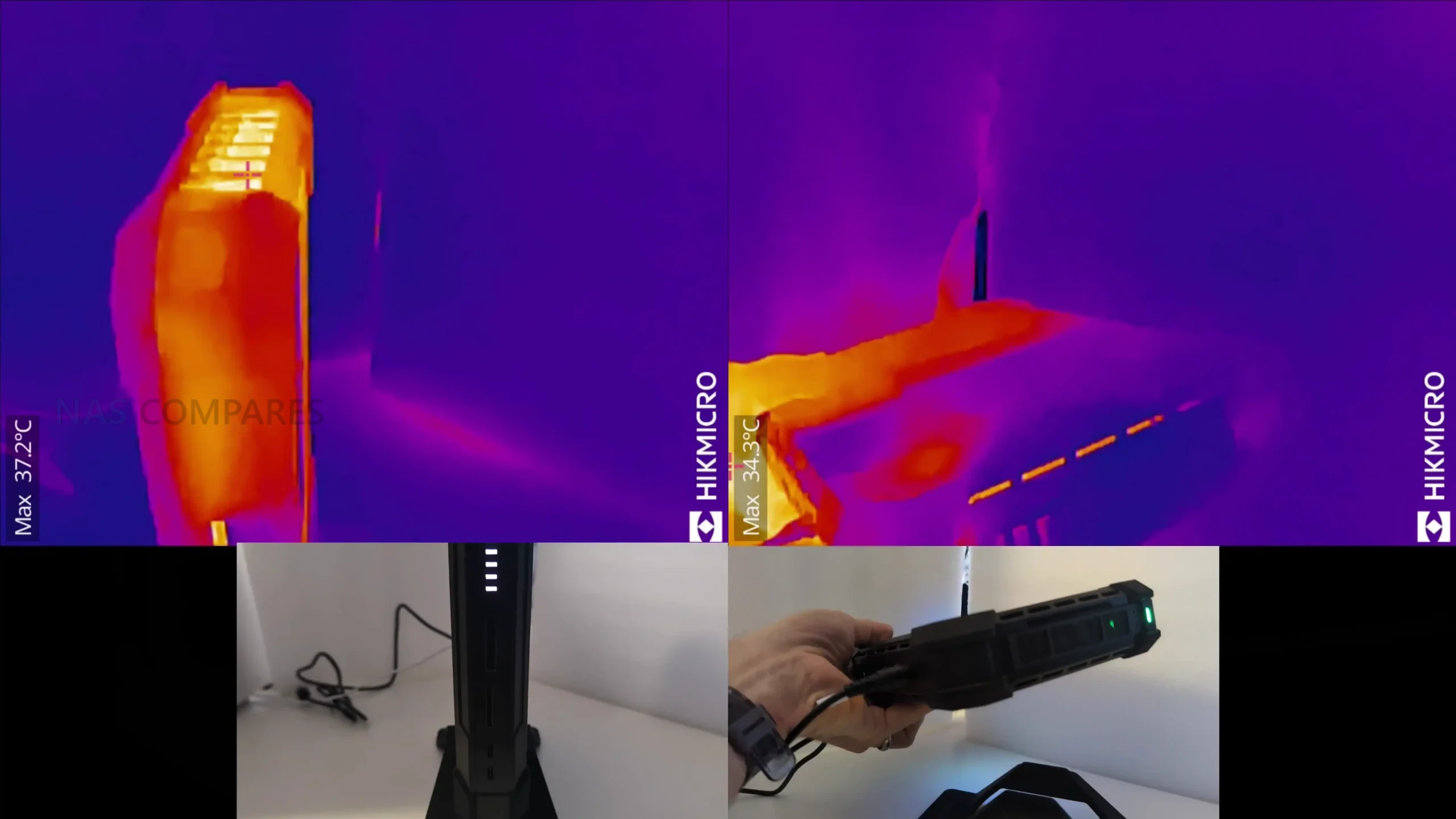 |
 |
 |
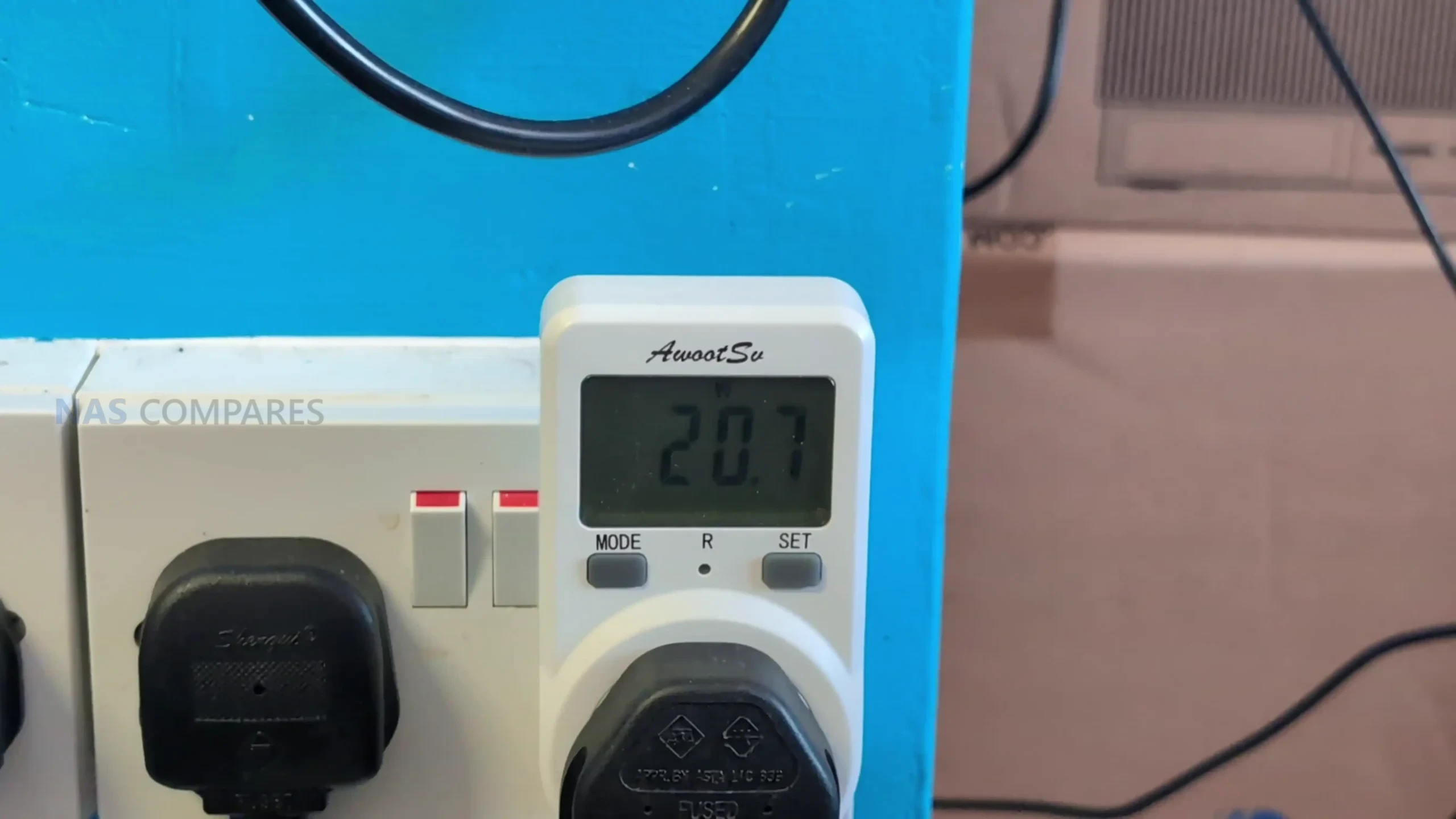
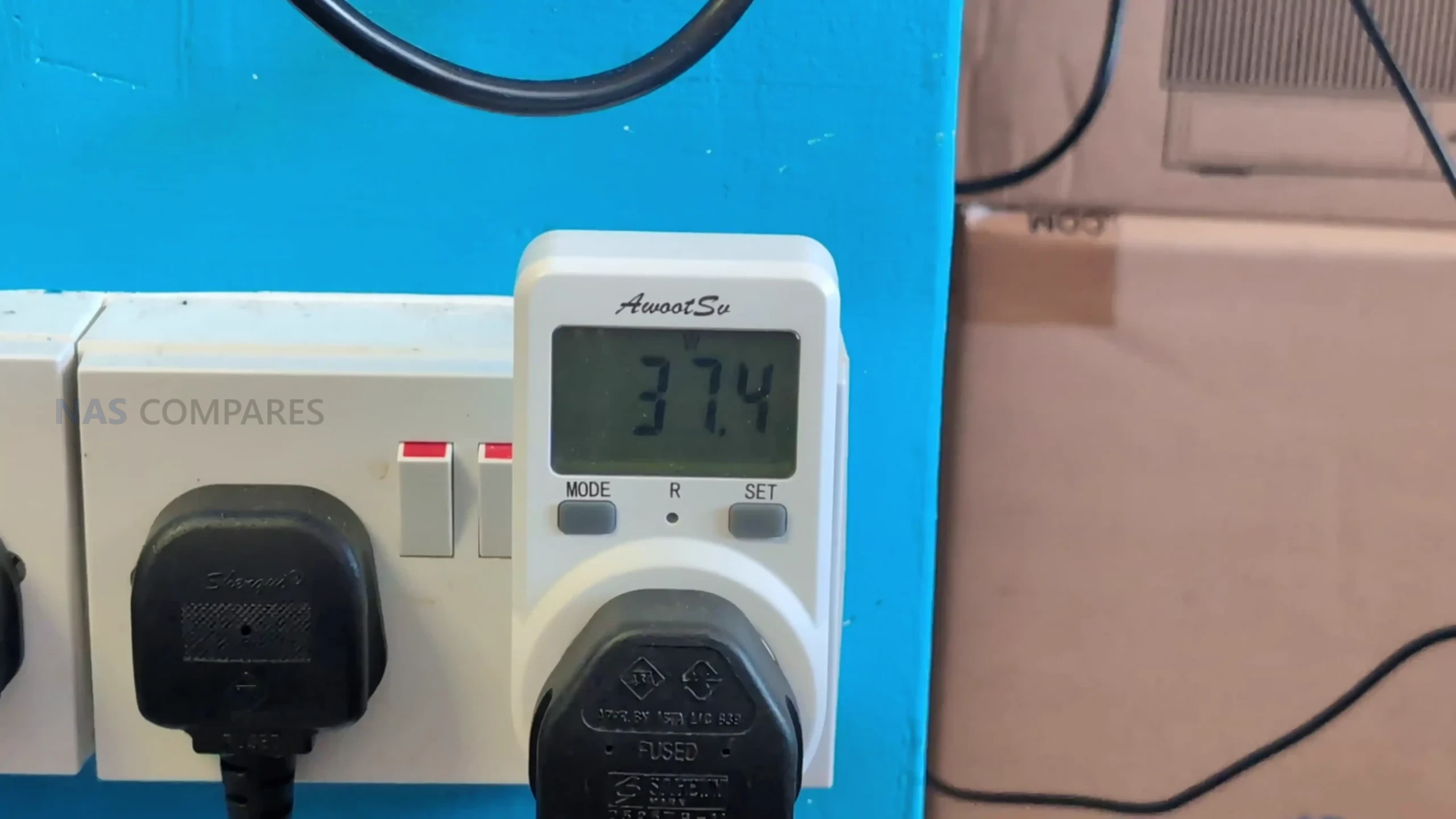
Power draw was measured on mains power with the battery held at 100% to avoid charging behavior affecting the readings. With SSDs idle, low CPU activity, and fans running at a moderate level, power consumption sat at around 21W. With the CPU still low but the fans set higher, draw increased to around 25 to 27W. Under active SSD access and higher CPU activity, power draw moved into the low-to-high 30W range based on the recorded observations, while the CPU itself tended to sit around 60C during regular use. These figures provide a practical baseline for planning portable use, since sustained high-speed transfers and heavier CPU workloads will directly affect both heat and runtime.
 |
 |
UnifyDrive UP6 Review – Conclusion & Verdict
The UP6 is a mobile NAS that leans heavily into workstation-class components and connectivity, and that choice shapes both its strengths and its compromises. It combines 6x NVMe capacity potential with a 10GbE port, dual Thunderbolt 4, Wi-Fi 6, and a built-in touchscreen that supports basic local operation without immediately reaching for a separate device. The platform is capable enough to run a broad set of NAS services and applications, including media organization features that take advantage of local processing, while also supporting more advanced options such as Docker and iSCSI. As a physical product it is compact for what it offers and is packaged with accessories that reflect its intended travel and on-location role, but it also expects the buyer to supply key performance-related components like SSDs and, in practical terms, heat sinks.
In measured use, the battery behaves more like a short-duration power buffer for real work than a long-runtime field station under constant load, with runtime varying sharply depending on whether the unit is idling, serving light access, or sustaining heavy transfer activity. Noise and thermals are generally controlled for a device built around PCIe 4.0 storage and a mobile Intel CPU, but results depend on environment and storage choices, and the CPU tends to run warm during normal operation. The software offering is feature-rich and broadly competitive with modern turnkey NAS platforms, yet security expectations for a portable device are not fully met, particularly around 2-factor authentication and some aspects of session control. At $1,599 USD before storage upgrades, the UP6 is best evaluated as a specialist tool for creators and teams who will use its mix of direct connectivity, rapid ingest, and portable operation, rather than as a cost-efficient alternative to a conventional desktop NAS.
| PROs of the UnifyDrive UP6 | CONs of the UnifyDrive UP6 |
|
|
📧 SUBSCRIBE TO OUR NEWSLETTER 🔔
🔒 Join Inner Circle
Get an alert every time something gets added to this specific article!
This description contains links to Amazon. These links will take you to some of the products mentioned in today's content. As an Amazon Associate, I earn from qualifying purchases. Visit the NASCompares Deal Finder to find the best place to buy this device in your region, based on Service, Support and Reputation - Just Search for your NAS Drive in the Box Below
Need Advice on Data Storage from an Expert?
Finally, for free advice about your setup, just leave a message in the comments below here at NASCompares.com and we will get back to you. Need Help?
Where possible (and where appropriate) please provide as much information about your requirements, as then I can arrange the best answer and solution to your needs. Do not worry about your e-mail address being required, it will NOT be used in a mailing list and will NOT be used in any way other than to respond to your enquiry.
Need Help?
Where possible (and where appropriate) please provide as much information about your requirements, as then I can arrange the best answer and solution to your needs. Do not worry about your e-mail address being required, it will NOT be used in a mailing list and will NOT be used in any way other than to respond to your enquiry.
 TRY CHAT
Terms and Conditions
TRY CHAT
Terms and Conditions





|
 |


UnifyDrive UP6 Mobile NAS Review
UniFi Travel Router Tests - Aeroplane Sharing, WiFi Portals, Power Draw, Heat and More
UGREEN iDX6011 Pro NAS Review
Beelink ME PRO NAS Review
UGREEN iDX6011 Pro - TESTING THE AI (What Can it ACTUALLY Do?)
OWC TB5 2x 10GbE Dock, UGREEN NAS Surveillance Software, AceMagic Retro PCs, Gl.iNet Comet 5G @CES
Access content via Patreon or KO-FI
Discover more from NAS Compares
Subscribe to get the latest posts sent to your email.
Please examine the possible issue of the device “phoning home” stated in the comments.
REPLY ON YOUTUBE
This looks like a one very big photobank.
If I still were into photography, I’d want to get one. Then again, nvme prices are so crazy nowadays…
REPLY ON YOUTUBE
I had the Unifidrive UT2 until I saw connections in my network logs that it was making to various IP address all over the world in various countries, Europe, Asia, etc. I unplugged it and sold it never to look back.
REPLY ON YOUTUBE
That CPU is way too overpowered for typical use. With a normal cpu and a phone app instead of the display that thing would be way less than 1000$
REPLY ON YOUTUBE
Thanks for telling me the price immediately. I stopped watching immediately. ????
REPLY ON YOUTUBE
I feel like Johnny Mnemonic just looking at it )
REPLY ON YOUTUBE
Interesting device, but it is so niche. A very, very specific one.
REPLY ON YOUTUBE
I hope you got over your cold before getting on a plane.
REPLY ON YOUTUBE
What’s this trend of eMMCs? Don’t they always inevitably fail after a short time? What’s the point
REPLY ON YOUTUBE
love your video. but man i hate this, why is every new devise is a NAS, i want a DAS, direct connection storage. man every time i see a new video its a NAS , i think its been years that i have seen a new DAS come out which is a shame man i would love a new DAS like 8 nvme SSD type to come out.
REPLY ON YOUTUBE
it’s already 2026 … NOT even Thunderbolt 5 ? NOT even PCIE 5.0 ? Didn’t even finished the video…
REPLY ON YOUTUBE
They are all too expensive now. I just made my mess out of an old laptop. None of us normal plebs can afford them anymore. Hell qnap is selling servers with 12-year-old chips
REPLY ON YOUTUBE
Why not PCIe 5.0? For $1600 you could buy a mini PC with a built-in 5080.
REPLY ON YOUTUBE
Crazy price for normal people regardless of usability.
REPLY ON YOUTUBE
Take simple notebook with 2-3x nvme + 2x TB4 external drives = storage, speed, battery, screen = portable NAS. This one is compact but pricy as hell.
REPLY ON YOUTUBE
Name lawsuit incoming..
REPLY ON YOUTUBE
This seems like it may be a useful bit of a kit for the mobile worker who is doing stuff with video and/or video editing, especially for some sort of weird less than ideal on location production
REPLY ON YOUTUBE
If ubiquiti gave us one it might be slightly better
REPLY ON YOUTUBE
Don’t worry I won’t be buy this (yet, if at all) as M.2 drives are so expensive that I’d would rather have (cheaper) SATA SSD’s instead. You can edit video on HDD’s (w/ 10gig network) and SATA SSD”s are a little bit faster than HDD’s so… It would be nice if you could find a 6 bay (for RAID 6) SATA SSD enclosure and do a review on it. Second the second most important is having a 10 gig network port as well.
REPLY ON YOUTUBE
Good M2 NAS + DAS option… If it works well with Raid5, I am sold.
REPLY ON YOUTUBE
1600 it should be aluminum at least
not cheap plastic
REPLY ON YOUTUBE
This is misleading. I thought it was a Ubiquiti product, but it is not. It is not your fault, but I don’t understand why a company would do this
REPLY ON YOUTUBE
What on earth happened to your right thumb nail??? ????
REPLY ON YOUTUBE
Whle I think this is cool this just isnt for me. Overall I´m not really personally interested in a mobile NAS since i just dont really have a need for it. I have my NAS at home, if I need my data on the go I connect via VPN and I dont really run into scenarios where I do need all of my Data with like gigabit access which would be the one advantage of this versus just downloading it from my NAS, just really not an issue I run into.
And also i just need way more storage than this can provide.
I am currently running a DIY NAS with 6x 8TB NVME Drives in RAID 0 (Yes I run regular backups so I dont care) and I only have like a bit more than 10TB of free space left with about 1.2TB-1.8TB of yearly growth.
So even though I´m already running expensive 8TB drives (thank god I bought those half a year ago), I ´m already thinking about what would be great ways to expand the storage with a new system in a few years, reusing the old SSDs ofcourse, so something with “just” 6 nvme slots doesn´t cut it for me personally anymore.
What I would really like is a new version of that Asustor Flashstor 12x NVME NAS but this time actually with a usable non shit processor and better lane distribution to those slots and proper non hacky truenas support.
But unfortunately no Gen 3 version has been anounced so far.
REPLY ON YOUTUBE
Do show load and thus temperature in your review
REPLY ON YOUTUBE
simply too big. does not make sense for portable device
REPLY ON YOUTUBE
Overpriced junk. Give it a metal case and larger EMMC for starters.
REPLY ON YOUTUBE
the das and nas mode can only be run one or the other? Set up as das and to use as das it has the be re formatted?
REPLY ON YOUTUBE
BTW How can you use a “NAS” with AI indexing features/navigation , NPU optional like TS-216g, like Qumagie or asus nuc storycube, on a big smart tv?! And How well does a pci TPU AI card work vs an NPU for indexing?
REPLY ON YOUTUBE
Блин, чувак, почини себе зубы и не пугай зрителей.
REPLY ON YOUTUBE
I want this so bad, but the current price of NVMe make it impossible to build NVMe NAS ????
REPLY ON YOUTUBE
you’ll never stress the drives enough over 10gbe for heat to be an issue. It looks like those fans are both pulling so those vents will draw air across all the NVME cards, all in all should be fine heat wise.
REPLY ON YOUTUBE
Some of his video’s are ok/good, this one.. How can you take anyone serous with this title? Sarcasm or not…:/ And buddy on a different note, I’ve always tried to ignore the bad dental hygiene, but what up with the fingernail, that’s so easily treatable. Maybe, I don’t know, treat it?
REPLY ON YOUTUBE
I hope you get over your cold/flu. And thanks for the review. Pointing out a plastic cover!
REPLY ON YOUTUBE
That battery on board the device is going to be a BIG issue for airlines given the number of fires that have occurred with batteries. Given the size of the device it will have to be in checked luggage and a fire in the cargo hold is also a BIG problem
REPLY ON YOUTUBE
Isn’t this an overkill for mobile NAS?
REPLY ON YOUTUBE
I love the idea, was very interested based on the sneak peaks, but now that it’s released. Price matches its specs which is way over my budget and it’s over kill for my needs. If UnifyDrive could make one that sits between that UP6 and the UT2. A UT2 with screen like the UP6 would be more ideal and practical for most consumers. Then basic ports like ethernet, usb port (one regular & one C), then card slot ports would be amazing. UnifyDrive hope you all continue this developing, there is a market for this.
REPLY ON YOUTUBE
And then, i looked at the price. NA WAY
REPLY ON YOUTUBE
Can’t wait to see toothbrush and fridge tested here as a NAS solution, only because they have somehow compute power and somehow storage.
REPLY ON YOUTUBE
Thumbnail got smashed
REPLY ON YOUTUBE
I’m surprised they haven’t had a legal letter from Ubiquity over the name. Very niche product but I can see someone doing video editing on the go as a potential buyer. Potentially perfect for editing videos at CES?
REPLY ON YOUTUBE
Dejavu GMKtec
REPLY ON YOUTUBE
I’d love to see a YouTube 1.0 style review. Puppets, ukeleles, 240p video, terrible sound…
REPLY ON YOUTUBE
and I thought it will be a mini pc sized box with two U.2 nvme ssds in 64TB range each in mirror raid supplemented with 32GB ddram5 all for 999, 90 eur with tax
REPLY ON YOUTUBE
So, this is not more of a NAS than any other mini PC, or laptop with more storage slots. Isn’t the purpose of the NAS to be storage? Isn’t that what “NAS” mean?
“Simpler” used to mean “less headaches on the long run”.
I think I may have been left behind on the trends because running VMs, AI workflows seem to me like not the NAS job at all.
This product seems to me like a mini portable computer, having their own screen and capable of staying on battery power for some time (I wonder what other kind of device would have these same features… ).
Sounds cool, looks pretty rad, but hardly a new concept.
Also, $1600 diskless? Ouch!
REPLY ON YOUTUBE
Dude you’re losing it… Said a max of 64gb ram when the documentation you show on screen is clearly 96. You said 2 USB 4, which are actually Thunderbolt 4, there’s a difference. I’ll wait for the full review before I watch the rest of this video. Hopefully you actually read the spec sheet first. lol.
REPLY ON YOUTUBE
Hope you’re feeling better soon Robbie. Enjoy CES, on my bucket list of things to do.
This thing is bonkers with all that is in it. I fear that the cost of storage / RAM will limit its market more so than it’s MSRP.
REPLY ON YOUTUBE
I think, the manufacturers can remedy the problem with the plastic cover, by allowing to buy a metallic cover, with silicon over the Nvme m2. And new units have corrected this problem. After all it is expensive, so there is room for it.
REPLY ON YOUTUBE
That flat plastic cover over the SSDs will be perfect for frying eggs on the go? Perfect for camping trips.
#sarcasm
REPLY ON YOUTUBE
your already lost me on the NAS; I’m probably the odd one out, but when I think NAS I think Network Attached Storage, not AI processor, VM runner, I don’t need my NAS to have any AI TOPS. 4TB drives are ~$500 a piece right now so that is close to $5k for a NAS; yeah, crazy no way.
REPLY ON YOUTUBE
People, please just stay sick when you’re home goddamnit. you look like something ran you over, give yourself the luxury of getting well and being at your best, CES will come back next year and we’ll watch your video again.
REPLY ON YOUTUBE
That top panel is begging for an after market replacement with a Noctua in it and some kind of power source. Or even a heatsink, which you could then direct any portable USB fan at.
REPLY ON YOUTUBE
This is not unifi network stuff? Ubiquiti? This is another company? So confusing..
REPLY ON YOUTUBE
Pending a positive review of the OS with proper remote access via relay services, this is the best NAS of 2026. Can’t wait for the full review.
REPLY ON YOUTUBE
Another non-ECC solution
REPLY ON YOUTUBE
All that base hw not worth the price, with 64Gb Ram, Ultra 9 285 plus at least 2Tb drive along with an outstanding firmware, yes. Otherwise really not. The portability aspect has is very appealing, yet a mini pc under half the requested price would do 90% of the claimed features.
REPLY ON YOUTUBE
Looking at the title I was like looks interesting but 1 minute in I was like maybe not
REPLY ON YOUTUBE
Not impressed al all…!
REPLY ON YOUTUBE
I watched half of the video thinking this was a UniFi NAS while getting pissed at how ugly it is compared to their other products ????
Now I’m wondering when UniFi is going to sue Unify for having a similar name.
REPLY ON YOUTUBE
No no no $1600
Make NaS cheap again !!!
REPLY ON YOUTUBE
Unify is on the march. Loving their products!
REPLY ON YOUTUBE
Emmc for the OS, I’m out.
REPLY ON YOUTUBE
God I hate you!….I want this so much! LOL…looking forward to the CES coverage and this full review…
REPLY ON YOUTUBE
I had a number of question on Patreon, hopefully they make it into the review – DAS vs NAS switching, temp impact on SSD life and performance, finding a manual, transfer speeds for card readers and usb attached drives.
REPLY ON YOUTUBE
Similar kind of cooling setup to the GMKTek? Seems a bit cheap to have a plastic casing, given the price.
REPLY ON YOUTUBE
As pro as this is I wouldn’t a dual u.2/3 version have been better in terms of speed bandwidth and capacity limits? Or is that not a viable option.
REPLY ON YOUTUBE
Hmm maybe need to 3D print a better cover to fit bigger heatsinks to it
REPLY ON YOUTUBE
1600 and looks like very cheap plastic all over? Makes no sense, with 6 SSD, RAM and processor this thing is very quickly going to be a portable induction stove for camping ????
REPLY ON YOUTUBE
Pricy. Nice specs. Wish it had more than 32GB of onboard drive. I have a couple similar devices that have 128 and I’m running Windows as the base OS.
REPLY ON YOUTUBE
this is so niche, that Webster’s is replacing the word “niche” with “UP6″…I mean the market for this must be in the dozens.
REPLY ON YOUTUBE
Make ceph proxmox? 10gbit
REPLY ON YOUTUBE
too bad the cost of nvme ssds has gone substantially up in recent years.
REPLY ON YOUTUBE
I just cannot get behind NMVe NAS storage when there are limited writes. It sounds like a ticking time bomb to me. This one is arguably temporary as it is portable but in general, I think spinners are best for long term storage.
REPLY ON YOUTUBE
unboxings were more like yt 2.0. anyway. i am buying no flash in 2026
REPLY ON YOUTUBE
Have fun at CES I ended up cancelling my hotel, coughing up almost $3k to go look at mostly vaporware, just didn’t see responsible this year when my grocery bill has almost quadrupled in the past 2 years.
REPLY ON YOUTUBE
If you ain’t first, you’re last
REPLY ON YOUTUBE